If CoreWeave Implodes, It’s Taking This Neocloud With It First

CoreWeave (NASDAQ:CRWV) and Applied Digital (NASDAQ:APLD) are the tenant and the landlord on the same lease. CoreWeave rents GPUs to AI labs. Applied Digital built the North Dakota campus where many of those GPUs sit. Both just reported revenue growth above 100%. Even so, a CNBC report now describes neocloud credit risk as a “doom cycle” that dominates that growth.
CoreWeave Has No Capacity Left to Sell While Applied Digital Bills Mostly for Construction
CoreWeave’s second-quarter revenue rose 112.3% to $2.575 billion. Management said near-term capacity “remains effectively sold out.” In July it raised prices by roughly 25% across SKUs, which shows real pricing power. Debt is the price of that growth. Interest expense reached $640 million, up from $267 million a year earlier.
Applied Digital’s revenue jumped 432.4% to $341.88 million, but most of it came from construction work. Tenant fit-out services brought in $183.5 million of HPC Hosting revenue. Base rent added only $65.8 million. That rent earns an 89% NOI margin, but it has to support roughly $6.4 billion of debt.
| Lens | CoreWeave | Applied Digital |
|---|---|---|
| Role | GPU cloud tenant | AI campus landlord |
| Contracted pipeline | $104.2 billion backlog | ~$36 billion contracted revenue |
| Key vulnerability | Rising interest expense | CoreWeave concentration |
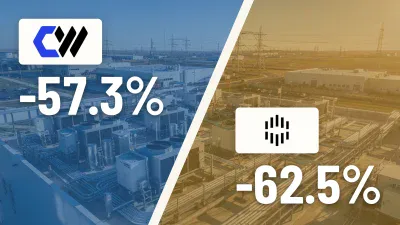
| Six-month stock move | -57.3% | -62.5% |
Applied Digital’s Cheaper Debt Rests on CoreWeave’s Credit
Applied Digital’s filings list “dependence on principal hyperscaler customers including CoreWeave” as a risk. CoreWeave anchors Polaris Forge 1, which now has 250 MW of live capacity. Applied Digital sold $1.59 billion of 7% notes to fund the campus’s third building. That rate is well below the 9.25% coupon on its earlier notes, and management credited “the credit enhancements we secured with CoreWeave.” If CoreWeave’s credit cracks, that discount works in reverse.
CEO Wes Cummins argues that as building new data centers gets harder, it raises “the scarcity value of established, powered, and community-supported campuses.” The logic holds, but limited power only pays off when tenants keep paying rent.
Three Unfinanced Campuses Decide What Comes Next
Polaris Forge 3, Delta Forge 1 and Delta Forge 2 are all leased to one investment-grade hyperscaler under 15-year take-or-pay leases. Management says it is in active talks with lenders. I will be watching whether those loans close at investment-grade pricing. At CoreWeave, watch whether revenue growth starts to exceed interest expense in its next earnings report.
Why CoreWeave Looks Sturdier Than Its Landlord
Investors are already treating the landlord as the more fragile stock, and I agree. CoreWeave sets its own prices and decides how its GPUs are allocated. Its customers range from OpenAI and Anthropic to Jane Street. Applied Digital controls power and land, yet its main North Dakota campus still depends on CoreWeave.
CoreWeave offers the more direct exposure to AI compute demand, coupled with heavy debt. Applied Digital’s case rests on the hyperscaler leases reducing its reliance on CoreWeave (the power, cooling, and infrastructure suppliers quietly collecting on the same AI expansion are the subject of a report we put together, here). My view could change once those southern campuses lock in investment-grade financing. Until then, if CoreWeave stumbles, I expect Applied Digital to feel it first.
Contact [email protected] for any questions or corrections.
Alex Sirois is a financial writer with experience spanning both retail and institutional investing. He has written for InvestorPlace and held roles at BNY Mellon and Bernstein, giving him a perspective that bridges Main Street portfolios and Wall Street analysis.
Alex holds an MBA from George Washington University and has built his career across multiple industries, including e-commerce, education, and translation — a breadth of experience that informs how he breaks down complex financial topics for everyday investors. His writing is conversational, actionable, and grounded in long-term, buy-and-hold investing principles.
At 247 Wall St., Alex focuses on delivering analysis that is both accessible and useful, with a clear emphasis on helping readers make more informed decisions with their money.