I’m Treating Applied Digital Like a Long-Term Call Option on $41B+ in Hyperscaler Leases

This post may contain links from our sponsors and affiliates, and Flywheel Publishing may receive compensation for actions taken through them.
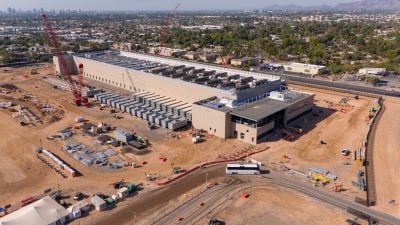
Every time Applied Digital (NASDAQ:APLD) drops, I add to my position, and the stock has given me lot of chances. Shares traded at $13.82 Monday evening. That is about 72.8% below the $50.73 52-week high and 43.64% lower year to date.
My thesis is simple. Applied Digital builds powered, liquid-cooled AI campuses and leases them on long contracts to the largest technology companies in the world. The market is pricing in the pain of construction. I own the shares for the cash flows that start once the buildings are finished.
Contracted Revenue Dwarfs the Market Cap
As of the October earnings report, Applied Digital held roughly 1.41 GW[1] of leased critical IT load across five campuses. That load is about $36 billion[1] in contracted revenue over the initial base terms, or $86 billion if every renewal option gets exercised. Add the new 150 MW, 18-year lease at about $2.0 million per MW per year, and base-term revenue tops $41 billion. The whole company has a market cap near $4.18 billion, which works out to roughly 11.6% of the $36 billion figure alone. That gap is my call option.
The tenants are high quality. Management targets take-or-pay contracts of at least 15 years[2]. According to the CFO, Polaris Forge 3, Delta Forge 1 and Delta Forge 2 all go to the same Tier 1 investment-grade hyperscaler[2].
Operating Leverage Is Already Showing Up
Fiscal Q1 2027 revenue reached $341.88 million, up 432.4% YoY[1]. Adjusted EBITDA hit $64.41 million versus $537,000[1] a year earlier. HPC base rental produced $58.8 million of NOI at an 89% margin[1]. Over the next 12 months, management expects to put over 600 megawatts[2] into service, up from 250 megawatts over the past 12. Expansion leases could has rate increases “definitely north of 15%”[2].
Borrowing is getting cheaper too. The latest $1.59 billion[1] of senior secured notes priced at 7%[2]. The first Polaris Forge 1 tranche has a 9.25%[2] coupon.
Why I Own the Landlord Instead of CoreWeave
Investors looking for AI infrastructure usually reach for CoreWeave (NASDAQ:CRWV), which is one of Applied Digital’s principal tenants. I would rather take in its rent. CoreWeave trades at 6.75 times book with debt-to-equity of 8.94. Applied Digital trades at 2.35 times book and 2.86. CoreWeave guided to $37 billion to $39 billion of 2026 capex and booked $846 million of net interest expense in a single quarter.
Debt and Dilution Can Still Hurt Me
These risks are real. After Q1, Applied Digital has about $6.4 billion of debt against $3.7 billion[1] of cash and restricted cash. It posted a $184.055 million[1] net loss and spent $2.075 billion on capex in one quarter. Shares outstanding rose from 201,194,451 at the end of fiscal 2025 to 291,557,618 in the latest quarter. Revenue also depends heavily on CoreWeave and one hyperscaler. With a beta of 5.54, this stock can knock a portfolio around fast.
That is why I keep it as a small satellite next to my income holdings. The thesis still holds because more than 80%[2] of debt principal comes due in fiscal 2031 or later, which gives the leases years to turn into cash flow. The CoreWeave campus at Polaris Forge 1 and 200 megawatts[2] at Polaris Forge 2 are already fully funded.
Scarcity Keeps My Buy Button Active
CEO Wes Cummins put it plainly: “We view every new restriction elsewhere as making what we already own harder to replicate.”[1] Power, permits and community support take years to line up, and Applied Digital already has them in North Dakota, Louisiana and Alabama. Management targets an operating portfolio of 3.5 to 4 gigawatts by the end of calendar year 2030[2].
I keep buying because the market is selling me decades of investment-grade rent at a construction-site discount.
Contact [email protected] for any questions or corrections.
Alex Sirois is a financial writer with experience spanning both retail and institutional investing. He has written for InvestorPlace and held roles at BNY Mellon and Bernstein, giving him a perspective that bridges Main Street portfolios and Wall Street analysis.
Alex holds an MBA from George Washington University and has built his career across multiple industries, including e-commerce, education, and translation — a breadth of experience that informs how he breaks down complex financial topics for everyday investors. His writing is conversational, actionable, and grounded in long-term, buy-and-hold investing principles.
At 247 Wall St., Alex focuses on delivering analysis that is both accessible and useful, with a clear emphasis on helping readers make more informed decisions with their money.