Skydance Plans to Cut $6 Billion in Costs After Swallowing Warner Bros.

Skydance (NYSE:SKYD) closed at $8.70 on November 9, 2026, up 8.61%. That gain came before the company said how it plans to pay for Warner Bros. After the bell, it released its first quarterly results since closing its roughly $110 billion purchase of Warner Bros. Discovery on October 6, 2026.
The main target is at least $6 billion in run-rate synergies within three years, net of reinvestment, out of an expense base of more than $50 billion. Run-rate means the yearly savings pace once every action is in place, so the full benefit shows up late in the program while the costs show up early.
Shares traded at $8.50 after hours, down 2.30% at 7:57 p.m. ET. That muted response fits a plan that added detail on costs but little on growth.
Where Skydance Finds $6 Billion
Operating costs, real estate, and facilities carry at least $2.2 billion of savings against about $8 billion of spending. Procurement adds at least $1.4 billion against about $9 billion. Duplicate offices and overlapping vendors are the easiest costs to remove.
Technology targets at least $1.4 billion from about $4 billion, and marketing at least $1.0 billion from about $5 billion. Those larger cuts touch the streaming and film releases that drive revenue.
Disclosed measures include buyouts, a five-day office mandate and a Skydance Games reorganization impacting at least 25 roles. The company identified more than $30 billion in annual content spending for optimization, with no dollar target.
Paying to Cut Before Saving
About 30% of savings, roughly $1.8 billion, should arrive in year one and 70% by the end of year two. One-time cash costs run about $1.5 billion to $2 billion in 2027 and about $4 billion overall.
Management guided 2027 free cash flow to break even or better, including those costs. That leaves little cash for debt repayment in the first full year.
Debt Load Sets the Pace
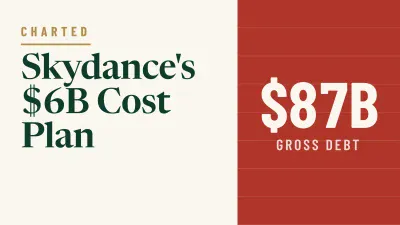
The deal used $47 billion of new equity and $57 billion of new secured debt, leaving gross debt of $87 billion and about $10 billion of cash. Net leverage, debt minus cash divided by yearly operating profit, is targeted at 3.0x by the end of 2029.
The 2030 goal is more than $10 billion of free cash flow at mid-20% margins. Legacy Paramount posted a 14.2% adjusted EBITDA margin in the third quarter, so the gap is wide.
What the Results Left Unsaid
Third-quarter figures cover legacy Paramount only. Revenue rose 5% to $7.0 billion, missing expectations of $7.04 billion, while adjusted EPS was $0.45 and GAAP EPS was $0.06.
The Warner Bros. film slate carries a fourth-quarter profit hit of up to $200 million, and Digger opened in fifth place. The Paramount+ and HBO Max bundle has no price, and quarterly subscriber reporting ends with fourth-quarter results.
Analysts have lowered their numbers. The average 2027 EPS estimate is $0.0548, down from $0.8182 thirty days earlier.
What Analyst Targets Signal for SKYD Stock
The stock sits near the $9.15 average target from 23 analysts, within a range of $6.61 to $17.16. Yet the costs land before the savings.
Unlike Skydance, Netflix (NASDAQ:NFLX | NFLX Price Prediction) carries no merger debt, a contrast one observer summed up as “Netflix just has to fund Netflix.” Look for the signal in the full-year 2027 guidance due with fourth-quarter results. If that guidance shows free cash flow clearly above breakeven, this view is wrong. A close below $6.61 would support it.
Contact [email protected] for any questions or corrections.
Omor Ibne Ehsan is a writer at 24/7 Wall St. He is a self-taught investor with a focus on growth, cyclical, and dividend equities that have strong fundamentals, value, and long-term potential. He also has an interest in high-risk, high-reward investments such as penny stocks.