Even After a 5% Dividend Raise, UnitedHealth Has Left $1,000 From Ten Years Ago at $2,993 While the S&P 500 Topped $4,000

This post may contain links from our sponsors and affiliates, and Flywheel Publishing may receive compensation for actions taken through them.
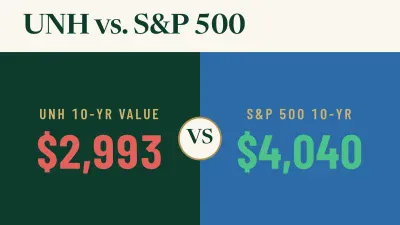
Imagine a scenario in which a $1,000 investment in UnitedHealth Group (NYSE:UNH | UNH Price Prediction) at the Nov. 30, 2016 close is being compared against the same amount in the SPDR S&P 500 ETF Trust (NYSEARCA:SPY), the fund used here for the S&P 500. Unless noted as price only, both cases assume dividends were reinvested.
How a Steady Health Care Name Hit a Rough 2025
UnitedHealth runs two businesses: UnitedHealthcare sells insurance, and Optum handles care delivery, analytics, and pharmacy services. For years, many investors treated it as a safe health care holding. In 2025, the company faced several problems. Medical costs rose faster than expected, driving the medical care ratio (the share of premiums spent on care) up 340 bps to 88.9%.
A cyberattack led to $799M in final recovery costs, CMS reduced Medicare funding, and the DOJ launched criminal and civil investigations into the company’s Medicare practices. On May 13, 2025, CEO Andrew Witty stepped down, and Stephen Hemsley replaced him, as fourth-quarter GAAP EPS dropped to $0.01 after a $2.88B pre-tax charge.
On the plus side for investors, results have improved in 2026, as the third-quarter medical care ratio fell to 88.4% from 89.9%, and full-year adjusted EPS guidance rose to at least $20.50.

$1,000 Grew to $2,993 While the S&P 500 Fund Reached $4,040
1-Year Return (price change only)
- Initial Investment: $1,000
- Current Value: $1,263.20
- Total Return: 26.32%
- S&P 500 (same period): $1,112.50 (11.25%)
5-Year Return
- Initial Investment: $1,000
- Current Value: $993
- Total Return: -0.7%
- Annualized Return: -0.14%
- S&P 500 (same period, price only): $1,626.10 (62.61%)
10-Year Return
- Initial Investment: $1,000
- Current Value: $2,993
- Total Return: 199.3%
- Annualized Return: 11.59%
- S&P 500 (same period): $4,040 (304%)

Over five years, the two drifted further apart. A position started five years ago is still slightly below its starting value, while the index fund kept going up. The one-year result depends on the starting date. Over the past 52 weeks, the stock has traded between $252.96 and $458.79.
A 5% Dividend Raise Still Trails the Share Price Decline
The quarterly dividend went from $2.21 to $2.32, a 5% increase. Payments have gone up every year on record, from $1.25 in early 2021. The forward annualized dividend is $9.28, and the yield is 2.28%. Even after reinvesting dividends, the five-year stake still stands at $993.
What Needs to Go Right From $402.94
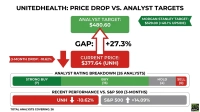
The stock closed at $402.94. It is valued at about 23 times trailing earnings and 17 times forward earnings. Analysts count 6 strong buys, 15 buys, 5 holds, and no sells, with an average target of $476.64.


Optimists are counting on medical costs to level off and Optum Health to move toward its 6%-8% target margin by 2028. Pessimists worry that costs keep rising. On the third-quarter call, UnitedHealthcare’s CEO said costs “remain stubbornly high across the entire healthcare landscape.”
The dividend raise came during a period of higher medical costs. Over the five-year period, the share price declined while the dividend increased.
Contact [email protected] for any questions or corrections.
David Beren has been a Flywheel Publishing contributor since 2022. Writing for 24/7 Wall St. since 2023, David loves to write about topics of all shapes and sizes. As a technology expert, David focuses heavily on consumer electronics brands, automobiles, and general technology. He has previously written for LifeWire, formerly About.com. As a part-time freelance writer, David’s “day job” has been working on and leading social media for multiple Fortune 100 brands. David loves the flexibility of this field and its ability to reach customers exactly where they like to spend their time. Additionally, David previously published his own blog, TmoNews.com, which reached 3 million readers in its first year. In addition to freelance and social media work, David loves to spend time with his family and children and relive the glory days of video game consoles by playing any retro game console he can get his hands on.