NVIDIA Sinks 9% on Reports Board Is Preparing to Oust Jensen Huang; Intel Falls 4%, AMD Holds Steady

This post may contain links from our sponsors and affiliates, and Flywheel Publishing may receive compensation for actions taken through them.

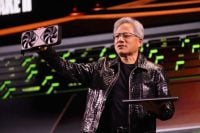
A reported boardroom move against Jensen Huang is rattling chip stocks and splitting the semiconductor group into winners and losers. NVIDIA (NASDAQ:NVDA | NVDA Price Prediction) stock is at $158.78 in morning trading, down 9%. Pressure is building after reports that its board is preparing to remove Huang as CEO.
So far, NVIDIA’s board hasn’t confirmed any such plan, and the allegations surrounding Huang haven’t been proven. On August 26, NVIDIA disclosed that it expected Q3 FY2027 revenue of $108 billion, plus or minus 2%, and the company’s upcoming earnings report will test that outlook.

Inside the Reported Push to Remove Huang
The Wall Street Journal reported on November 11 that NVIDIA’s board is preparing to oust Huang and could meet soon to decide his fate. Reporting from The New York Times added that Huang allegedly had a relationship with Kimberly Powell, NVIDIA’s vice president of health care. Congress is reportedly prepared to subpoena Huang as well.
Those reports followed disclosures on November 8, when Huang acknowledged being unfaithful to his wife and NVIDIA opened an investigation into reports that he was targeted by a foreign intelligence effort involving a woman U.S. officials deemed a Chinese spy. At the time, NVIDIA’s board stated it had “no reason to believe that either national security or NVIDIA secrets were compromised.” President Trump has praised Huang as an “amazing guy” and an “honorable man.”
NVIDIA’s Leadership Vacuum Raises the Stakes
NVIDIA’s board reportedly has no chair, the company has no chief operating officer, and there’s no clear succession plan in place. Huang has about 60 direct reports. Governance experts have suggested chief financial officer Colette Kress or lead independent director Stephen Neal as possible interim CEOs.
D.A. Davidson analyst Gil Luria warned the situation could “hasten a transition the company is not prepared for.” Seaport Research Partners analyst Jay Goldberg noted that NVIDIA is “sold out” and stated that “it’s all contracted into next year, but it loses a lot of its luster.”

Intel Slides With NVIDIA While AMD Holds Steady
Intel (NASDAQ:INTC) stock is at $59.95, down 4%. That’s a smaller drop than NVIDIA’s slide, but Intel is moving in the same direction as the turmoil weighs on chip stocks and the broader artificial intelligence (AI) trade. According to The Wall Street Journal, NVIDIA’s leadership crisis is also dragging on U.S. stock futures.
Advanced Micro Devices (NASDAQ:AMD) stock is at $554.65, up 0.3%. The modest gain leaves AMD on the opposite side of NVIDIA’s selloff. Broadcom (NASDAQ:AVGO) is inching higher too, and Bloomberg reported that NVIDIA’s turmoil is lifting both AMD and Broadcom on expectations they could pick up business.

The NVIDIA selloff follows a strong November 11 session in which the S&P 500 rose 1.3% and the NASDAQ 100 climbed 2.3%. Hot inflation data has traders pricing in a December Federal Reserve rate hike as a near-certainty. Chicago Fed President Austan Goolsbee called the latest Consumer Price Index report “borderline disturbing.”
How NVIDIA’s Business Model Stands Apart
NVIDIA sells merchant AI graphics processors alongside networking hardware and its CUDA software ecosystem, and its Vera Rubin platform is now in full production. That full-stack model ties hyperscalers, AI clouds and government buyers closely to NVIDIA’s roadmap, which helps explain why questions about leadership carry so much weight.
AMD is a fabless challenger pairing EPYC server processors with Instinct accelerators and Helios rack-scale systems, making it the closest merchant alternative to NVIDIA, while Intel runs a different playbook as an integrated device manufacturer that designs Xeon and Core processors and operates its own foundry. Broadcom builds custom AI chips and networking silicon for a small group of hyperscalers, a model that sits outside NVIDIA’s merchant approach. The chipmakers are only one layer of the AI expansion, and we rounded up seven power, cooling and networking suppliers riding the same wave in a free report on AI infrastructure stocks.
What Comes Next for NVIDIA’s Leadership
Whether its board formally acts on Huang’s future, and whom it names as an interim leader, will show what NVIDIA does next. The bulls can point to sold-out supply and committed demand that don’t depend on any single executive. For the bears, an abrupt transition at a company without a chair or a chief operating officer could disrupt execution on its product ramps.
Watch for an official statement from NVIDIA’s board, which could also shape how AMD and Intel trade in the near term. Traders may prefer to keep their exposure smaller until NVIDIA’s leadership question resolves.
Contact [email protected] for any questions or corrections.
David Moadel is financial writer specializing in stocks, ETFs, options, precious metals, and Bitcoin. David has written well over 1,000 articles for leading online publications, helping investors understand markets, income strategies, and risk. His work has appeared in 24/7 Wall St., The Motley Fool, InvestorPlace, U.S. News & World Report, TipRanks, ValueWalk, Benzinga, Market Realist, MarketScreener, TalkMarkets, Finmasters, and others. With a master’s degree in education, David has taught at the elementary, high school, and college levels. That teaching background shapes his writing style: clear, educational, and practical. David has also built a loyal social-media audience by providing trustworthy financial content on YouTube, X/Twitter, and StockTwits.