Prediction: One AI Trend Could Send Dell Stock Higher

This post may contain links from our sponsors and affiliates, and Flywheel Publishing may receive compensation for actions taken through them.
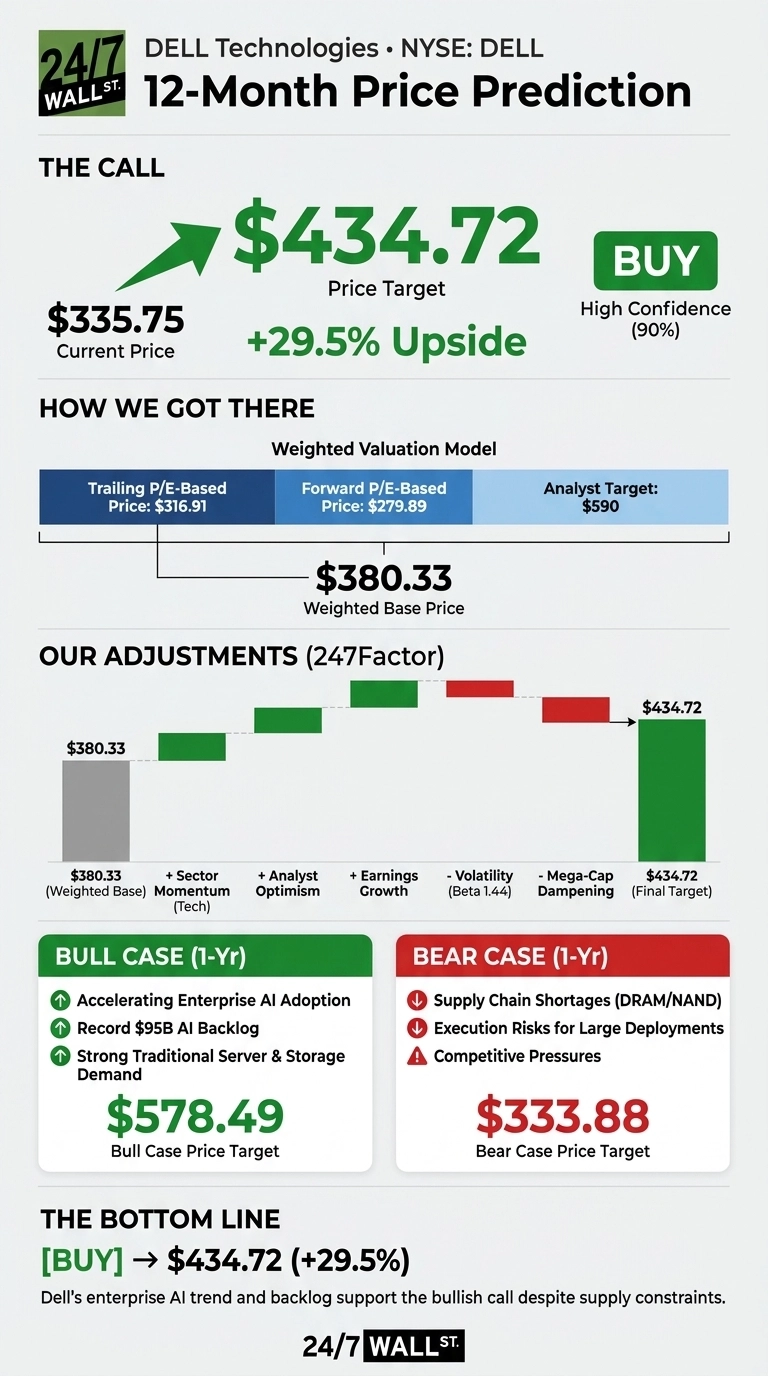
The 24/7 Wall St. price target for Dell Technologies (NYSE:DELL | DELL Price Prediction) is $434.72 over the next 12 months. With shares at $335.75, that means 29.5% upside.
| Metric | Value |
|---|---|
| Current Price | $335.75 |
| Price Target from 24/7 Wall St. | $434.72 |
| Upside/Downside | 29.5% |
| Model Rating | BUY |
| Confidence Level | 90% |

That is high confidence. The AI trend behind the call is buyers spreading beyond hyperscalers to enterprise and government customers.
Dell sells the whole package to that group: servers, storage, networking, services and financing (we covered seven other companies providing this expansion, from power to cooling, in a free AI infrastructure report).
A $95 Billion Backlog Meets a Steep Pullback
The stock has fallen 29.39% over the past week and 41.43% over the past month. It now trades 43.5% below its 52-week high of $594.69. Even so, shares are still up 169.56% year to date and rose 5.94% today.

The drop makes little sense next to the fundamentals. Q2 FY27 revenue came in at $46.97 billion (+57.8% YoY), and non-GAAP EPS of $7.04 easily beat the $4.90 estimate. AI server orders reached a record $60.9 billion, and management raised full-year revenue guidance to $192 billion.
Enterprise AI Is the Trend That Bulls Are Counting On
Dell’s AI customer count has exceeded 6,500, and 3,300 of those were added in the last three quarters. Management noted that “That acceleration is enterprise.” Enterprise buyers also tend to purchase more storage and networking. That helps explain why the infrastructure segment’s operating margin expanded to 15% from 8.8%.
The analyst consensus target stands at $590. That reflects 5 Strong Buy ratings, 14 Buys and zero Sells. The bull case of $578.49 assumes the stock returns close to its highs.

Providing Crunch and Cash Flow Could Cap Gains
Management keeps saying “Demand outstrips supply,” and it lists shortages of DRAM, NAND and CPUs. Dell also posts negative shareholders’ equity of -$1.43 billion, and free cash flow dropped to $986 million (-47.22%).
That drop has an explanation: capital spending rose 83.6% to build out AI capacity. Even so, Dell returned a record $4.3 billion to shareholders in the quarter. The bear case lands at $333.88, close to today’s price.
How Dell Compares to HPE and Super Micro
| Company | Trailing P/E | Latest Quarter Revenue Growth |
|---|---|---|
| Dell | 17 | 57.8% |
| HPE | 1,044 | 32.72% |
| Super Micro | 8 | 93.16% |
Hewlett Packard Enterprise (NYSE:HPE) goes after the same enterprise AI buyers. Its trailing P/E is inflated by thin GAAP profits, so revenue growth is the better measure. On that score, Dell is growing almost twice as fast. HPE guides to just 13%-17% revenue growth for FY27.
Super Micro Computer (NASDAQ:SMCI) is the pure-play AI server name. The stock trades at 8x earnings but burned $6.8 billion in operating cash during FY26. Dell’s premium over Super Micro buys a stronger cash profile. Its premium over HPE buys faster growth. Against both peers, our target looks reasonable.
Our Verdict: Dell’s Selloff Looks Overdone
Our 24/7 Wall St. price target of $434.72 posts a buy rating with 90% confidence. The record $95 billion backlog tips the scale, giving visibility for several quarters.
I would get more confident if Dell converts that backlog while holding infrastructure margins near 15%. I would turn more cautious if memory shortages drove revenue into later quarters or orders begin to slip. At about 12x forward earnings, I think the risk/reward favors the bulls.
Looking further out, these are the levels our model projects for Dell if current growth and market conditions hold.
| Year | Price Target from 24/7 Wall St. |
|---|---|
| 2026 | $332.37 |
| 2027 | $434.72 |
| 2028 | $519.19 |
| 2029 | $620.06 |
| 2030 | $740.54 |
The projections rely on Dell keeping up its current strategy. A sharp slowdown in AI capital spending could pull the path lower. Faster enterprise adoption could drove it higher.
Contact [email protected] for any questions or corrections.
Vandita Jadeja is a financial publisher with over a decade of experience writing about financial topics, including investment, savings, retirement, insurance and banking. Vandita is a Chartered Accountant who loves to debunk financial concepts for readers.
Her work has appeared on sites that include The Motley Fool, InvestorPlace, and Benzinga. She covers investing and focuses on stock picks and price prediction for 24/7 Wall St.
When not looking for the next stock investment opportunity, she can be found traveling, reading, chasing sunsets and enjoying her iced latte.