The Same $10,000 in Nvidia and Palantir Could Produce Very Different Results by 2030

This post may contain links from our sponsors and affiliates, and Flywheel Publishing may receive compensation for actions taken through them.
Picture two $10,000 checks. One buys NVIDIA (NASDAQ:NVDA | NVDA Price Prediction), the company selling the chips and networking gear behind the AI buildout. The other buys Palantir (NASDAQ:PLTR), the software platform that turns those chips into business results through Foundry, Ontology and AIP.
Our model starts NVIDIA at $182.23 and Palantir at $154.99. Both stocks are bouncing back from a sharp tech selloff, with intraday quotes of $188.84 and $161.94 after one-week falls of 11.62% and 17.55%. Both ride the same AI boost, and the decline makes this a good moment to see where each $10,000 could end up.
Base Case: NVIDIA Edges Ahead by 2030
Our model projects five years out, so all specific figures below are tied to that horizon, which ends in November 2031. That is the modeled horizon closest to 2030. Treat any figure for 2030 itself as hypothetical, since a 2030 exit falls partway along the modeled path.
In the base case, a $10,000 investment in NVIDIA could be worth about $21,170, a total return of 111.7%, built on a per-share target of $385.77. The same $10,000 in Palantir could grow to about $19,438, a total return of 94.38%, on a target of $301.26. That puts NVIDIA $1,732 ahead in the middle scenario.
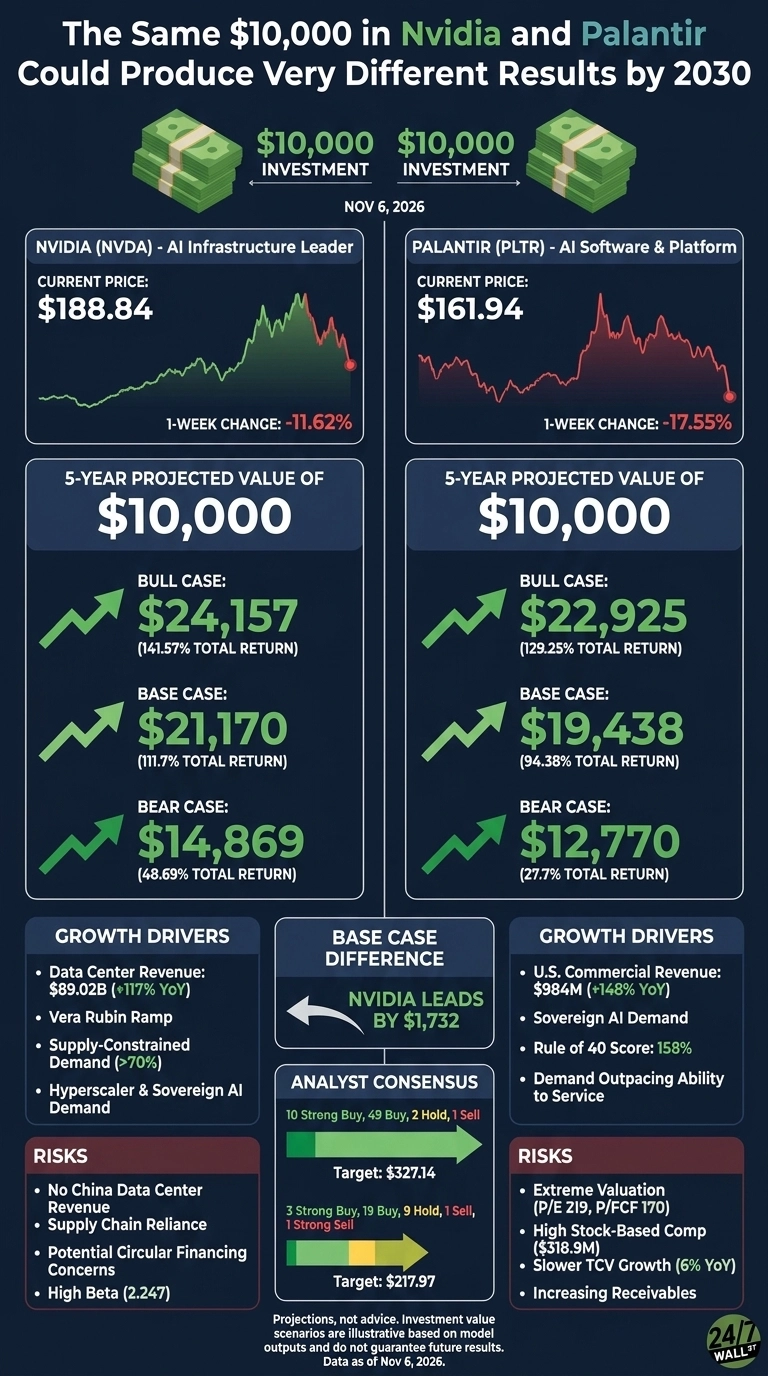
Bull, Base and Bear Outcomes for Your $10,000
| Stock / Scenario | Target Price | Total Return | Value of $10,000 |
|---|---|---|---|
| NVIDIA Bull | $440.21 | 141.57% | $24,157 |
| NVIDIA Base | $385.77 | 111.7% | $21,170 |
| NVIDIA Bear | $270.97 | 48.69% | $14,869 |
| Palantir Bull | $355.32 | 129.25% | $22,925 |
| Palantir Base | $301.26 | 94.38% | $19,438 |
| Palantir Bear | $197.93 | 27.7% | $12,770 |


The model gives both stocks a confidence level of 0.9. Over one year, it targets $236.53 for NVIDIA and $194.30 for Palantir.
Wall Street is more optimistic: the consensus analyst target is $327.14 for NVIDIA, which has 10 Strong Buy ratings, 49 Buy ratings, 2 Hold ratings and 1 Sell ratings.

Palantir’s consensus target is $217.97, with a more divided mix of 3 Strong Buy ratings, 19 Buy ratings, 9 Hold ratings, 1 Sell ratings and 1 Strong Sell.

What Powers Each Target
NVIDIA: Demand Running Ahead of Supply
In fiscal Q2 2027, NVIDIA’s revenue reached $96.22 billion, up 105.8% year over year. Data Center revenue alone came in at $89.02 billion. The company guided Q3 revenue to $108 billion ±2% and expects growth of roughly 70% in fiscal 2028, a figure limited by supply.
Its CEO said “Even though our demand is much greater than 70%, our supply allows us to confidently deliver 70%.” The Vera Rubin platform, which began shipping in August, is expected to be the fastest ramp in NVIDIA’s history.

Palantir: U.S. Commercial Takes the Lead
Palantir’s Q3 revenue rose 95.9% to $2.31 billion. U.S. commercial revenue of $984 million passed U.S. government revenue for the first time. Management raised full-year revenue guidance to between $8.530 billion and $8.534 billion and posted a Rule of 40 score of 158%.
The Rule of 40 adds a company’s revenue growth rate to its profit margin, and a score above 40 is considered healthy. CEO Alex Karp told analysts “We really cannot satiate demand.”

Risks That Could Shrink Either Stake
NVIDIA expects gross margins to bottom in the 71% to 72% range as memory costs rise. Its outlook includes no China data center revenue, and it has invested nearly $50 billion in advanced AI labs, which raises concerns about circular financing. A beta of 2.247 means the stock tends to swing much harder than the overall market.

Palantir’s biggest risk is its valuation: a P/E of 219 and a price-to-free-cash-flow ratio of 170. Total contract value grew just 6% while revenue grew 96%. Stock-based compensation rose to $318.9 million from $172.3 million, and receivables increased to $1.88 billion. These factors explain why Palantir’s bear case trails NVIDIA’s by $2,099.

What to Watch Before 2030
Under the five-year scenarios, a $10,000 stake in NVIDIA ranges from $14,869 to $24,157, and the same amount in Palantir ranges from $12,770 to $22,925.
NVIDIA comes out ahead in every scenario, but Palantir’s range is wider, which signals more uncertainty. Keep an eye on NVIDIA’s supply capacity and Palantir’s contract growth. These numbers are projections rather than recommendations, and neither outcome is guaranteed.
Contact [email protected] for any questions or corrections.
Vandita Jadeja is a financial publisher with over a decade of experience writing about financial topics, including investment, savings, retirement, insurance and banking. Vandita is a Chartered Accountant who loves to debunk financial concepts for readers.
Her work has appeared on sites that include The Motley Fool, InvestorPlace, and Benzinga. She covers investing and focuses on stock picks and price prediction for 24/7 Wall St.
When not looking for the next stock investment opportunity, she can be found traveling, reading, chasing sunsets and enjoying her iced latte.