They Retired at 62 With $900,000 Between Two IRAs and Lived on His Pension for 11 Years. At 73 Their First RMDs Came to $58,000, on Top of the Pension

This post may contain links from our sponsors and affiliates, and Flywheel Publishing may receive compensation for actions taken through them.

Ron and Judy Keller’s first required minimum distributions came to $58,000 this year, $39,311 from his IRA and $18,689 from hers, on top of the $64,800 pension that has paid their bills since they retired at 62.
They left work together in 2015, both born in 1953. He had 33 years at a power utility and a pension of $5,400 a month. She ran a school district office. Between them they had $900,000 in two IRAs: $610,000 in his, rolled over from the utility plan, and $290,000 in hers. The pension covered the bills. At 66, their full retirement age, they both claimed Social Security, $2,700 a month for him and $1,500 for her, and that covered the travel. In 11 years they never took a dollar from either IRA.
The accounts did what untouched accounts do. At about 5% a year the $900,000 became $1,537,000 on December 31 of last year, $1,041,744 in his IRA and $495,256 in hers. The IRS sets the first withdrawal at 73 for anyone born from 1951 through 1959 (75 for anyone born in 1960 or later), and its Uniform Lifetime Table divides the year-end balance by 26.5 at that age. That is where the $58,000 comes from, and it goes up from here. The $58,000 is the bill for 11 years of leaving the accounts alone; it is also money they never needed, which is why the window to move it cheaply stayed open the whole time. The Kellers are a scenario built to show the math; the rules and the numbers are real.
What $58,000 does to the tax return
Start with what the return looked like before the RMD. The pension is fully taxable. Social Security is taxed on a formula: the pension plus half of their benefits comes to $90,000, far past the $44,000 line for a couple, so 85% of their $50,400 in benefits, $42,840, was already taxable. The tax torpedo had fired years ago. The RMD cannot make Social Security any more taxable than it already is.
| Pension and Social Security | With the $58,000 RMD | |
|---|---|---|
| Adjusted gross income | $107,640 | $165,640 |
| Standard deduction, the 65-plus add-on and the $6,000 senior deductions | $47,500 | $46,562 |
| Taxable income | $60,140 | $119,078 |
| Federal income tax, 2026 brackets | $6,721 | $15,621 |
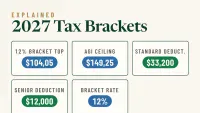
The RMD adds $8,900 of federal tax, 15.3% of the $58,000. Three things happen inside that number. The first $39,722 of the RMD fills what was left of the 12% bracket, which ends at $100,800 of taxable income for a couple. The next $18,278 is taxed at 22%. And the new $6,000 senior deduction, $12,000 for two, shrinks by 6 cents for every dollar of income above $150,000, so the RMD takes $938 of it back. From here on, every extra dollar out of the IRAs costs them 22 cents plus the senior clawback, until that deduction expires after 2028.
The line they have not crossed
Medicare’s income surcharge starts at $218,000 of modified adjusted gross income for a couple, read off the tax return from two years earlier. With the RMD they sit at $165,640, $52,360 under the line. Crossing it by a dollar would add $81.20 a month to each of their Part B premiums for a full year, $1,949 for the two of them, plus a Part D surcharge.
The RMD pushes toward that line on its own. At the same 5% growth, with each year’s withdrawal taken at year end, their combined RMD is $63,668 at 75, $79,018 at 80 and $96,279 at 85, with the balance still near $1,540,466 at 85. At this year’s figures the RMD alone does not cross the line by 85, and the line is indexed. What crosses it is the RMD plus anything else in the same year: a car bought from the IRA, a roof, a large Roth conversion. One such year costs you the surcharge two years later.
What Buffett did with his
Warren Buffett has a Roth IRA. Tax records obtained by ProPublica, reported in June 2021, show that he converted $11.6 million from a traditional retirement account to a Roth and that at the end of 2018 the account held $20.2 million. The year of the conversion and the tax he paid on it were not reported, and Buffett did not respond to ProPublica’s questions. The conversion came after a 2010 rule change removed the $100,000 income limit that had kept high earners from converting. His deputy Ted Weschler did the same on a larger scale, a Roth of $264.4 million at the end of 2018, and said he paid more than $28 million in federal tax to convert.
The reason it works is the same for a billionaire and for you. A conversion is taxed as ordinary income in the year it is done, once. After that the Roth has no required minimum distributions while the owner is alive, and what it earns is never taxed again. The only choice is which year to pay the tax on the money, and at what rate.
The window the Kellers had
Use this year’s brackets and deductions as the yardstick for every year, which is generous for the early years, when the brackets were numbered higher and the deductions were smaller. From 62 to 64 the Kellers had only the pension, so their taxable income was $64,800 less the $32,200 standard deduction, and the 12% bracket had $68,200 of room a year. At 65, with the senior deductions, the room was $83,500. From 66 to 72, with Social Security on the return, it was $40,660 a year.
Filling that room every year would have converted $572,720 over the 11 years and cost $68,576 in federal tax, about 12% of it, paid from savings so the whole amount moved. At the same 5% growth, the Kellers would have ended last year with $803,722 in Roth IRAs and $733,278 in the traditional ones. The same $1,537,000 in total. But the first RMD would be $27,671 instead of $58,000, taxable income would be $87,811, entirely inside the 12% bracket, and the federal tax $10,041, which is $5,580 less than they will pay this year. Their room under the Medicare line would be $82,689. The Roth side would owe nothing, this year or any year.
Two rules shape how you do it. A conversion is taxed in the year it happens, so you size it against that year’s return; the Kellers’ cheapest years were 62 to 65, before Social Security began. And from the year you reach 73, the RMD comes out first; the IRS does not allow the required amount itself to be converted. Anything above it still can be.
The gift that counts as the RMD
The Kellers give their church $5,000 a year, by check, from the pension. Since 2023, the year they reached 70 1/2, that gift could have gone straight from his IRA to the church as a qualified charitable distribution. It never appears in their income, and from this year it counts toward his RMD: $5,000 is 13% of his $39,311. Done that way in 2026, it cuts their federal tax from $15,621 to $14,455, a saving of $1,166, on a gift they were making anyway. The limit is $111,000 a person this year.
The bottom line
The Kellers did nothing wrong. They lived within a pension, left $900,000 alone and watched it grow to $1,537,000. The cost is that the IRS now chooses how much comes out each year, $58,000 this year and more after, and the top of it lands in the 22% bracket with a piece of the senior deduction gone. Eleven years of 12% room, worth $572,720 of conversions, went unused. If your pension or Social Security covers the bills and your IRAs are growing untouched, the years before 73 are your cheap ones, and the Roth in Buffett’s tax records is the same tool at any size.
Contact [email protected] for any questions or corrections.
AJ spent 10 years writing about financial markets at The Motley Fool. His coverage centers on technology stocks and the broader macroeconomic trends, from interest rates to geopolitics, that shape where markets are headed next. AJ is drawn to the stories where big-picture economics and individual companies collide.