Nvidia Has Fallen 18% Since the Jensen Huang Scandal Broke and the Biggest Chip ETF Barely Moved. Here’s What Tonight’s Report Does to SMH, SOXX, SOXL and NVDL

This post may contain links from our sponsors and affiliates, and Flywheel Publishing may receive compensation for actions taken through them.
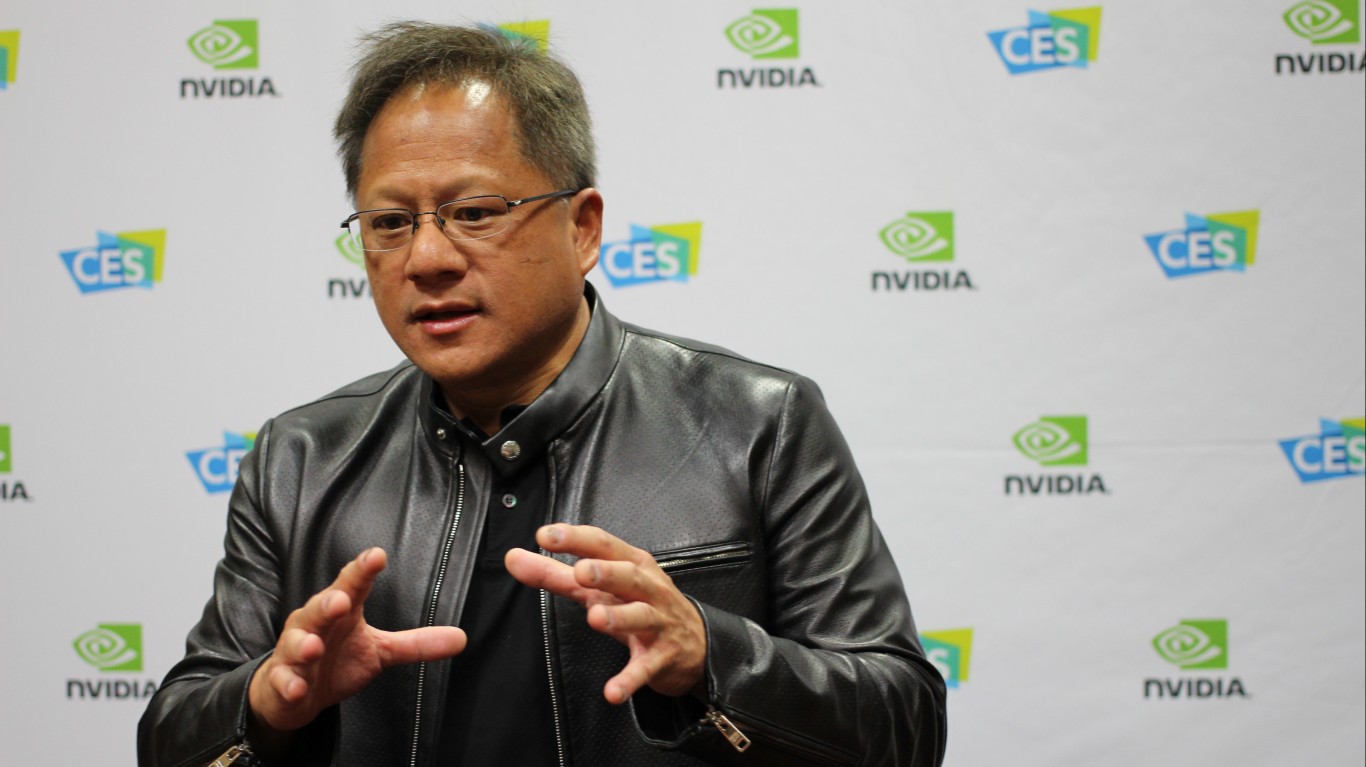
Nvidia (NASDAQ: NVDA) has fallen 18% since the Jensen Huang scandal broke on Saturday, November 7, and it reports its fiscal third quarter after the close on Tuesday, November 17, its first report since Huang resigned on November 12. Colette Kress, the chief financial officer, is interim chief executive and leads the call at 5 PM ET. At about 11 AM ET on Tuesday, Huang said in a written statement that if the board decides his return is in the best interest of shareholders, employees, the company and America, he "would be honored to answer these calls and return as CEO."
The chip funds have not followed the stock down. The VanEck Semiconductor ETF (NASDAQ: SMH), the biggest chip ETF, is down 1.6% over the same stretch. The iShares Semiconductor ETF (NASDAQ: SOXX) is up 2.7%, and the Direxion Daily Semiconductor Bull 3X ETF (NYSEARCA: SOXL) is up 3.8%. Only the GraniteShares 2x Long NVDA Daily ETF (NASDAQ: NVDL), which holds nothing but Nvidia exposure, tracked the stock: down 33.0%.
Read one way, that split is a signal that the chip funds have stopped being a bet on Nvidia, so a fund holder has less riding on tonight than the ticker suggests. The limit on that reading is this month’s two worst days, November 5 and Monday, when every chip stock fell with Nvidia. Take a 66-year-old retired engineer with $1.9 million in a rollover IRA, most of it in broad index funds, and $150,000 in SMH that he bought because he wanted the chip trade without picking a winner. He is a scenario, and his arithmetic is below, after what each fund holds and what a Nvidia move does to it, from the funds’ own holdings files and the price record. Prices are as of 1:25 PM ET Tuesday.
What each fund actually holds
SMH holds 25 stocks and had 17.44% of its money in Nvidia in VanEck’s daily holdings file for November 16: 67,772,427 shares, worth more than $10 billion at Tuesday’s price of $153.95. That is the largest Nvidia position of the four funds here, and it implies net assets of about $61 billion. The fund charges 0.35% a year. Taiwan Semiconductor is second at 9.97%, then Broadcom at 6.50%.
SOXX holds far less. In iShares’ holdings file dated November 13, Nvidia was 6.71% of the fund, its fourth-largest position, behind AMD at 10.28%, Broadcom at 8.51% and Micron at 7.35%. The fund tracks the NYSE Semiconductor Index, which spreads its weight more evenly than SMH’s index does: its top holding is 10.28% of the fund against SMH’s 17.44%. SOXX holds 30 stocks, had $36.0 billion in net assets on November 16 and charges 0.33%. Its Nvidia shares, 15,692,525 of them, were worth about $2.42 billion on Tuesday.
SOXL promises three times the daily move of that same index, before its 0.75% fee. Direxion’s holdings file for November 17 shows how: about 41% of its assets sit in cash funds, the index stocks are held directly (Nvidia is 5.02% of assets that way), and swaps on the index add 226% of assets on top. Put together, the fund carries about 300% of its value in index exposure, so its Nvidia exposure is three times the index weight: about a fifth of net assets, or roughly $2.9 billion on a fund worth about $14 billion.
NVDL is the pure play. GraniteShares’ holdings file for November 16 lists one position: a swap on 29,458,686 Nvidia shares, 200.05% of the fund’s $2.30 billion in net assets, collateralized by cash. The fund holds no Nvidia shares directly. It charges 1.64% a year after waivers, 0.60 points of it the interest cost of the swaps.
What a Nvidia move alone does to $100,000 in each fund
Suppose Nvidia moves 10% on Wednesday and every other chip stock stays flat. The funds move by Nvidia’s weight times 10%, which is the daily promise of the leveraged pair and simple proportion for the other two.
| $100,000 in | Nvidia inside it | Nvidia +10% | Nvidia -10% |
|---|---|---|---|
| SMH | $17,440 | +1.74%, $1,744 | -1.74%, -$1,744 |
| SOXX | $6,710 | +0.67%, $671 | -0.67%, -$671 |
| SOXL | $20,130 of exposure | +2.01%, $2,013 | -2.01%, -$2,013 |
| NVDL | $200,000 of exposure | +20%, $20,000 | -20%, -$20,000 |
A 5% move halves every line and a 15% move adds half. The SOXX line is the one that surprises people: $671 for a 10% Nvidia move. A holder who bought SOXX as a way to own Nvidia owns about 7 cents of it on the dollar.
What happened the morning after the last eight reports
Other chip stocks do not stay flat on a Nvidia report night, so the table above is a floor. Here is the next session’s move after each of Nvidia’s last eight reports, from the Fuse daily series, split-adjusted:
| Report date | Nvidia | SMH | SOXX | SOXL | NVDL |
|---|---|---|---|---|---|
| August 26, 2026 | +8.7% | +3.1% | +1.9% | +5.5% | +16.8% |
| May 20, 2026 | -1.8% | +0.6% | +0.8% | +3.0% | -3.6% |
| February 25, 2026 | -5.5% | -3.3% | -3.0% | -9.1% | -11.2% |
| November 19, 2025 | -3.2% | -4.2% | -4.8% | -14.3% | -6.3% |
| August 27, 2025 | -0.8% | +0.4% | +0.5% | +1.2% | -1.7% |
| May 28, 2025 | +3.2% | +0.7% | +0.4% | +0.9% | +6.4% |
| February 26, 2025 | -8.5% | -6.2% | -5.8% | -17.3% | -17.1% |
| November 20, 2024 | +0.5% | +1.5% | +1.6% | +5.0% | +1.0% |
Nvidia’s average next-day move over those eight reports was 4.0% in either direction, with the biggest at +8.7% in August and -8.5% in February 2025. SMH and SOXX each moved less than Nvidia on 6 of the 8 mornings, and SOXX went the same direction as Nvidia on 6 of 8. Twice, in May 2026 and August 2025, Nvidia fell and both unleveraged funds rose.
Since the scandal broke, the funds went their own way
The split got wider this month. On November 9, the first session after the Financial Times report, Nvidia fell 4.3% while SOXX rose 7.5%, SMH rose 5.1% and SOXL rose 22.3%; NVDL fell 8.7%. On November 12, the day Huang resigned, Nvidia fell 4.3% and SOXX fell 0.3%. Those two days read as money moving out of Nvidia and into the other chip names.
Then came the days when it did not. On November 5, the AI selloff day, Nvidia fell 9.3% and SOXX fell 12.1%, SMH 11.2% and SOXL 38.7%. On Monday, Nvidia fell 4.1%, SOXX 5.4%, SMH 5.1% and SOXL 16.4%. A report that reads as bad news for AI spending, rather than bad news for Nvidia’s management, would be a November 5 kind of day for every fund in the table, and the group would move more than Nvidia’s weight explains.
Analysts expect Nvidia to report earnings of $2.47 a share on revenue of $109.15 billion, against the company’s own forecast of $108.0 billion, plus or minus 2%, and $96.2 billion last quarter.
The leveraged funds reset every day
SOXL and NVDL keep their promise one day at a time. Each night the exposure is reset to 300% or 200% of whatever the fund is then worth, so over any longer stretch the return is the compounded product of daily moves, which GraniteShares’ prospectus says "will very likely differ" from two times the stock’s return for the period, and Direxion’s says "should not be expected to be 300%" of the index’s.
The arithmetic: if Nvidia rises 10% on Wednesday and falls 10% on Thursday, the stock ends down 1.0%. NVDL rises 20% and then falls 20%, and ends down 4.0%. The record since Nvidia’s record close of $239.24 on October 6 shows the other side of the same coin. Nvidia is down 35.7% since then and NVDL 60.5%, less than twice the stock’s fall because each day’s loss was taken on a smaller base. SMH is down 27.8% and SOXX 28.7% over the same stretch, and SOXL 71.0%. From their June 22 records, SOXX is down 35.3% and SOXL 83.8%. GraniteShares’ summary prospectus says NVDL "is not intended to be used by, and is not appropriate for, investors who do not intend to actively monitor and manage their portfolios," and that an investor "could lose the full principal value of his/her investment within a single day."
What tonight does to the engineer’s SMH
His SMH position is 7.9% of his IRA, and the Nvidia inside it is worth $26,160. If Nvidia moves 10% on Wednesday and nothing else moves, his SMH moves $2,616, which is 0.14% of the IRA. A repeat of November 5, when the whole group fell, would cost him $16,818; a repeat of November 9, when money rotated out of Nvidia into the rest, would make him $7,581. Had he put the same money into NVDL instead, a 10% Nvidia drop would cost $30,000 in one session.
The useful conclusion for him is that tonight is a Nvidia event and his position is a chip-sector bet. Whether $150,000 in one sector belongs in a retirement account is a question about concentration, and it is the same question on Wednesday whatever Kress says. There is no tax bill for trimming inside an IRA, so the only cost is the chance the group keeps rising.
The bottom line
Nvidia reports tonight with Kress on the call and Huang saying he would return if asked. If you own one of these funds, find your line in the table. A $100,000 SMH holder has about $17,440 riding on Nvidia itself; a SOXX holder about $6,710; a SOXL holder about $20,130 of exposure for one day; an NVDL holder $200,000 of exposure for one day. The group has moved with Nvidia on its worst days and against it on the scandal days, so the fund’s own move tomorrow depends more on how the market reads the quarter for AI spending than on Nvidia’s weight. The leveraged pair should be judged one day at a time, which is how they are built.
Contact [email protected] for any questions or corrections.
I've been writing about stocks and personal finance for 20+ years. I believe all great companies are tech companies in the long run, and I invest accordingly.