Amazon’s CEO Says Pulling Back on Data Centers Would Be a “Historic Mistake”

This post may contain links from our sponsors and affiliates, and Flywheel Publishing may receive compensation for actions taken through them.
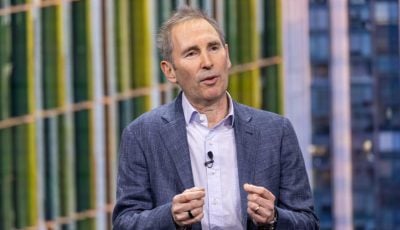
Amazon (NASDAQ:AMZN | AMZN Price Prediction) chief executive Andy Jassy used Tuesday to defend a spending program measured in hundreds of billions of dollars, and he did it in front of an audience that had just voted against data centers. At Semafor’s Silicon Valley & The World conference, he said pulling back on AI infrastructure would be a “historic mistake” that would let a country such as China set the rules. He also said tech companies need to do better and partner more closely with their communities.
In a CNBC interview shortly after, he called falling significantly behind China a “catastrophic” mistake and said the U.S. had underinvested in the grid even before AI. He compared the build-out to the highways and bridges of the 1950s.
The stock barely moved. It closed at $257.89, up 0.05%, and traded at $260.20 after hours as of 7:59 p.m. ET. That followed a 4.79% decline over the week from November 10 and left the stock below its 52-week high of $287.20.
A Spending Commitment With No Ceiling
Jassy reaffirmed capex (capital expenditures, the money spent on buildings and equipment) of around $220 billion this year and “meaningfully more” next year. He gave no 2027 figure and would not confirm Wall Street’s estimate that spending roughly doubles in each of the next two years.
The missing figure matters because the spending has already pushed trailing free cash flow to an outflow of $42.4 billion. Without the 2027 budget, you can’t estimate when cash generation turns positive again. He said he understands why investors are nervous given the size of the numbers.
Payback Math That Flatters the Case
His main evidence was AWS AI revenue of over $25 billion in the first three years of generative AI. He compared that with a $57 million annual run rate after AWS’s own first three years, which he called 440 times faster.
That comparison sets three years of cumulative revenue against a single annualized figure, so it exaggerates the gap. The stronger point is visibility, because big blocks of compute are largely reserved for 2027, and a good portion of 2028 and a fair bit of 2029 are also spoken for. AWS’s backlog was already $578 billion[1] at the third-quarter report.

Chips and Leasebacks Spread the Burden
Trainium and the Graviton CPU together passed a $25 billion annual revenue run rate as of the second-quarter call, with triple-digit growth. This figure is separate from AWS AI revenue. In-house chips lower Amazon’s compute costs and its reliance on NVIDIA (NASDAQ:NVDA), although Jassy said he can’t anticipate the partnership ending.
A day before his remarks, a Blackstone (NYSE:BX) data center trust agreed to buy 75% of two joint ventures that hold 13 new AWS buildings. The deal values them at about $5 billion at a 7% initial cap rate (first-year property income as a share of price). AWS leases them back for 12 years, renewable to 32, which moves some capital to outside owners in exchange for long lease obligations.
Permits May Bind Before Demand Does
Early November tracking showed voters on course to reject data center development in all but one of 41 local ballot measures. Democrat Gina Hinojosa, who defeated Texas Gov. Greg Abbott, has called for a pause on new permits until stronger community protections are in place.
Jassy named no state, vote, or politician. He gave no details on community partnerships and said nothing about where the power will come from (we rounded up seven companies supplying the power, cooling and networking behind the data center boom in a free report), and permits and power hookups are where the reserved demand runs into its real limit.
What Amazon’s Valuation Signals Now
At a forward earnings multiple of 26x and a $2.79 trillion market value, Amazon is priced for a reasonable payoff from AI, even after an 11.73% gain this year.

Reserved capacity, cheaper in-house chips, and leasebacks give this spending a clearer path to returns than the market is paying for. If AI returns disappoint, the depreciation (the cost of the equipment spread over its useful life) will matter more than the reserved capacity.
The next earnings report bears watching. A specific 2027 capex number, plus fourth-quarter operating income at or above the $28.5 billion[2] low end of guidance, would support the case.

A close below the 52-week low of $196.00 would mean the market has rejected Jassy’s argument.
Contact [email protected] for any questions or corrections.
Omor Ibne Ehsan is a writer at 24/7 Wall St. He is a self-taught investor with a focus on growth, cyclical, and dividend equities that have strong fundamentals, value, and long-term potential. He also has an interest in high-risk, high-reward investments such as penny stocks.