3 Cloud Giants Are Pouring Billions Into AI. Here Is What Their Spending Numbers Reveal
When a hyperscaler doubles its capex, it is locking in land, power, and GPUs years before a single dollar of revenue arrives. The spending numbers from three cloud giants reveal exactly how different their bets look and which signals actually…


AI capital spending has become the single most important tell for where cloud demand is heading. When a hyperscaler doubles capex, it is contracting land, power, GPUs, and years of customer commitments long before revenue shows up. The three names below show what that looks like at very different scales. Two are hyperscalers building the physical layer of the AI economy. One is an application software company monetizing agents on top. Ranked by the size of the capex commitment, the growth of the cloud/AI revenue line, and the backlog signaling future demand, here is the countdown.
No. 3: Salesforce Is a Different Trade Entirely
Salesforce (NYSE:CRM | CRM Price Prediction) sits third on this list because it is playing a different game. Capex in the most recent quarter was $171 million, a rounding error next to the hyperscalers. Salesforce is a SaaS company, so its AI investment shows up in software, M&A, and buybacks rather than data centers.
The AI monetization story is still real. Fiscal Q2 2027 revenue was $11.35 billion, up 10.8% year over year, with subscription and support up 12%. Agentforce and Data 360 combined ARR reached nearly $3.9 billion, up over 210% year over year, and Agentforce ARR alone crossed $1.5 billion, up over 240%. Current RPO of $33.5 billion, up 14%, is a real backlog, but it is a fraction of what the hyperscalers report.
CEO Marc Benioff framed the moment bluntly: “AI is delivering value across every layer of our platform. We’re seeing incredible demand for our AI and data products, with ARR about to cross $4 billion.” The stock trades at a P/E near 27x with a market cap around $203.8 billion. Year to date, CRM is down 6%, though it has ripped 28.14% over the past month as AI narrative caught up. Investors treating CRM as a hyperscaler proxy will get the risk profile wrong.
No. 2: Amazon Is Spending to Reserve the Next Decade of Compute
Amazon (NASDAQ:AMZN) takes the second slot because the capex figure and the backlog are staggering. Q2 2026 capital expenditures were $54.21 billion, up 68.44% year over year, essentially all pointed at AWS and generative AI. That spending has flipped trailing free cash flow negative to -$7.6 billion. That is the tension: near-term FCF compression as a vote of confidence in multi-year demand.
AWS revenue hit $42.23 billion, up 37%, the fastest growth in 18 quarters, with a 39.4% operating margin. AI and chips businesses each cleared $25 billion annualized run rates, both growing triple digits. AWS backlog on the earnings call reached $496 billion, growing triple digits year over year, and management said the lion’s share of 2027 capacity is largely reserved with meaningful 2028 already booked. Anthropic and OpenAI have committed multi-gigawatt Trainium capacity.
CEO Andy Jassy said AWS could become “a trillion dollar annual revenue business for us in time.” AMZN trades at a P/E near 35x and is up 11.25% year to date. The capex is huge, but the demand signal behind it is larger.
No. 1: Microsoft’s $115.95 Billion Capex Year Sets the Ceiling
Microsoft (NASDAQ:MSFT) tops the list on all three criteria. Full-year FY26 capital expenditures reached $115.95 billion, up 79.62% year over year, with Q4 alone at $35.80 billion, up 109.63%. Free cash flow fell 6.46% for the year on the ramp. Management guided FY27 capex to grow again, with the finance-lease shift adjusting the number to roughly $175 billion.
The demand behind that spend is documented. Azure and other cloud services grew 43%, Azure crossed $100 billion in annual revenue for the first time, and Intelligent Cloud revenue was $39.31 billion, up 32%. The kicker is the backlog: commercial RPO surged 84% to $678 billion, with RPO recognized beyond the next 12 months up 112%. Microsoft 365 Copilot passed 30 million paid seats. CFO Amy Hood told the call, “demand continues to exceed available supply” and that efficiency gains “are quickly monetized in quarter.”
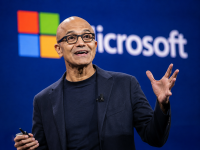
CEO Satya Nadella captured the framing: “We are advancing the frontier on the cost-to-outcome curve, ensuring every customer can turn tokens into business results.” MSFT trades near a 27x P/E on a $3.68 trillion market cap. Year to date, shares are up 3.14%, a modest number relative to the operational scale being deployed.
What the Spending Actually Reveals
Capex is the cleanest read on where cloud demand is going. Microsoft’s $115.95 billion capex year, $678 billion RPO, and $100 billion Azure milestone say the company sees years of contracted AI workloads it must build ahead of. Amazon’s $54 billion single-quarter spend and $496 billion AWS backlog say the same story at a similar scale, with custom silicon as the differentiator. All of that concrete, power, and networking has to come from somebody, and we rounded up seven suppliers riding the same buildout in a free report on the picks-and-shovels side of the AI boom. Salesforce, by contrast, is monetizing agents on top of that infrastructure rather than paying to build it, which is why its $171 million capex line looks nothing like the other two. Investors should keep an eye on FY27 capex updates and Azure/AWS growth reports, because the gap between demand commitments and free cash flow is where the next chapter of this trade gets decided.
Contact [email protected] for any questions or corrections.
Joel South covers large-cap stocks, dividend investing, and major market trends, with a focus on earnings analysis, valuation, and turning complex data into actionable insights for investors.
He brings more than 15 years of experience as an investor and financial journalist, including 12 years at The Motley Fool, where he served as an investment analyst, Bureau Chief, and later led the Fool.com investing news desk. He has also co-hosted an investing podcast and appeared across TV and radio discussing market trends.