Bloom Energy Is Down 25% in a Month as BMO Upgrades to Outperform, Trims Target to $230: What’s Next for BE Stock?

This post may contain links from our sponsors and affiliates, and Flywheel Publishing may receive compensation for actions taken through them.

A Wall Street firm that spent months questioning Bloom Energy (NYSE:BE) now sees a better setup in the stock. Bloom Energy stock is at $168.15 midday on Thursday, down 2%. BMO Capital Markets upgraded Bloom to Outperform from Market Perform on November 19 and trimmed its price target to $230 from $260.
The upgrade follows a sharp decline in recent weeks, and BMO cites that drop as part of its case. Even after the slide, Bloom Energy stock is up 103% year to date (YTD). The call also arrives as Anthropic (NASDAQ:ANT) and its initial public offering (IPO) revive the broader artificial intelligence (AI) infrastructure trade.
Why BMO Turned Bullish on Bloom Energy
BMO had been cautious on Bloom for three reasons, according to its research note. The firm questioned whether Bloom could prove its technology at large scale, whether a higher-cost power generation solution would hold up once grid availability improves, and how heavily the company relies on U.S. data center demand.
Those debates remain open, according to BMO. Two factors have shifted, the price and the proof. shares have pulled back, and large projects, including Bloom’s work for Nebius Group (NASDAQ:NBIS | NBIS Price Prediction), are increasingly providing the execution evidence the firm wanted to see. In BMO’s view, the risk-reward has turned more attractive. The AI expansion driving that evidence runs well beyond the chipmakers, and we rounded up seven of the power, cooling, and networking suppliers behind it in a free report here.
On the company’s October 22[1] earnings call, Bloom founder and CEO K. R. Sridhar told analysts, “We have our servers ready for the 300 megawatts. We will not be the bottleneck.”[1] That call capped a Q3 2026 in which Bloom’s revenue rose 138.1%[2] year over year (YoY) to $1.24 billion, and management raised its full-year 2026 guidance for the third time. Bloom’s updated outlook calls for revenue of $4.4 billion to $4.6 billion[2] and adjusted earnings per share (EPS) of $3.10 to $3.40.

How FuelCell and Plug Power Stack Up Against Bloom
Bloom’s fuel cell peers aren’t moving in tandem. FuelCell Energy (NASDAQ:FCEL) stock is at $7.90, up 2%, moving with the sector as Bloom rises. Year to date, FuelCell stock is up 8%.
Meanwhile, Plug Power (NASDAQ:PLUG) stock is at $1.06, down 2%, moving opposite Bloom. Deeper losses define the year for Plug Power, with the stock down 46% YTD.
The gap shows the market rewarding Bloom’s data center power story far more than its hydrogen-focused peers. Only Bloom has turned that demand into a profitable business so far, while FuelCell and Plug Power are still working toward their profitability targets.
Three Different Paths to Distributed Power
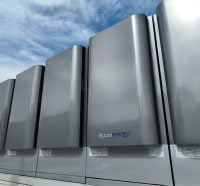
Bloom Energy sells solid-oxide fuel cell systems called Energy Servers that generate always-on electricity right at a customer’s site. Hyperscalers and data centers powering AI drive much of the demand, but Bloom is expanding into hospitals, semiconductor plants, utilities and other commercial users. The systems can also run as a microgrid, operating independently of transmission or distribution infrastructure.
FuelCell builds carbonate fuel cell platforms and is reorganizing around standardized blocks for behind-the-meter data center power, and the company also delivers modules to customers in South Korea and conducts carbon capture research. Those systems convert natural gas, biogas or hydrogen blends into electricity without combustion.
Plug Power is centered on hydrogen itself. Electrolyzers that produce green hydrogen, GenDrive fuel cells for forklifts, liquid hydrogen supply and fueling stations make up Plug Power’s business, which ties its prospects to hydrogen adoption more than to data center power.
What BMO’s Open Questions Mean for Bloom Energy
BMO’s upgrade leaves the debates it raised about Bloom unresolved. The bears can point to the firm’s own concerns. Higher-cost onsite power could lose ground once grid capacity catches up, and heavy reliance on U.S. data center spending leaves the company exposed if AI buildouts slow. Tariffs, air permitting delays and shifts in tax-credit availability are other risks Bloom has identified.
The bulls have their own evidence. Bloom’s Q3 marked its fifth consecutive quarter[3] exceeding EPS expectations, and big installations like Nebius are answering the scale question block by block. Chief financial officer Simon Edwards added on the same call, “We already view this as a self-funding business.”[1]
Next, Bloom Energy faces the test of whether those large projects keep converting on schedule. A cautious, research-driven investment approach could make sense while the debate over Bloom’s staying power plays out.
Contact [email protected] for any questions or corrections.
David Moadel is financial writer specializing in stocks, ETFs, options, precious metals, and Bitcoin. David has written well over 1,000 articles for leading online publications, helping investors understand markets, income strategies, and risk. His work has appeared in 24/7 Wall St., The Motley Fool, InvestorPlace, U.S. News & World Report, TipRanks, ValueWalk, Benzinga, Market Realist, MarketScreener, TalkMarkets, Finmasters, and others. With a master’s degree in education, David has taught at the elementary, high school, and college levels. That teaching background shapes his writing style: clear, educational, and practical. David has also built a loyal social-media audience by providing trustworthy financial content on YouTube, X/Twitter, and StockTwits.