Clorox Just Declared Another Dividend, but Its $5 Payout Faces a Debt Test

This post may contain links from our sponsors and affiliates, and Flywheel Publishing may receive compensation for actions taken through them.
Clorox (NYSE:CLX | CLX Price Prediction) declared another regular quarterly dividend of $1.25 per share[1] this week. Over the past month, the stock has climbed 28.51% to $108.41. Consumers still buy the bleach, trash bags, and ranch dressing. Investors need to know whether a balance sheet carrying debt from the Purell acquisition can keep paying an annualized $5 per share.

A One-Cent Raise Shows Caution
Clorox raised its quarterly payout to $1.25 from $1.24, starting with the August 12, 2026 ex-dividend date. Before that, the payout was $1.22. That one-cent raise protects the company’s Dividend Aristocrat heritage while preserving cash. The yield now stands at 4.52%. Our prior coverage put it at roughly 6% ahead of the November 2 earnings report.
Cash Coverage Has Thinned
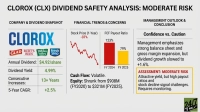
In fiscal 2026, Clorox generated $612 million in operating cash flow and spent $207 million on capex. That left $405 million of free cash flow against $602 million in dividends, or about 149% of free cash flow. A one-time $476 million[2] payment to exit the Glad joint venture accounts for part of that gap. In the first quarter of fiscal 2027, operating cash flow of $143 million still fell short of the $151 million paid out.

Earnings coverage looks better. Management guides to adjusted EPS of $5.70 to $6.00 and expects results at the low end. At $5.70, the dividend would take about 88% of profits.
Purell Debt and Inflation Squeeze Margins
Interest expense more than doubled to $52 million, and shareholders’ equity turned negative at -$39 million. S&P also downgraded Clorox’s credit rating. Gross margin fell 130 bps to 40.4%, and management now expects $240 million[3] in input-cost inflation this year. Outgoing CEO Linda Rendle summed up the pressure:
“Consumers continue to seek value, competitive activity remains elevated, and increased commodity and transportation costs are putting additional pressure on margins.”[3]
Health and Wellness, which includes cleaning products and Purell, brought in $918 million of quarterly revenue. Household, home to Glad and Kingsford, added $423 million. Lifestyle, which covers Hidden Valley, Burt’s Bees and Brita, contributed $283 million. Store brands keep pressure on pricing, and Glad is the business most exposed to resin costs. CFO Luc Bellet set the priority clearly:
“Job one is getting back to historically big margin.”[3]
Peers Have Bigger Cushions
Procter & Gamble (NYSE:PG) produced $15.835 billion of free cash flow in fiscal 2026. It plans over $10 billion in dividends plus approximately $5 billion in buybacks, and it is in its 70th consecutive year of dividend increases. Church & Dwight (NYSE:CHD) expanded its gross margin to 46.8%. It guides to about $1.175 billion in operating cash flow and just authorized a $1 billion buyback. Both peers can fund their payouts and still have room for buybacks. Clorox has no such buffer right now.
Analysts remain conservative on Clorox: 14 hold ratings, 2 sell, 2 strong sell, and a $97 price target.

Verdict: Safe for Now, With Weaker Footing Than the Brand
Clorox’s dividend looks secure over the next year. Earnings cover it, and the board keeps raising it. Still, the payout is less reliable than the brands behind it, because cash flow has lagged the dividend and the company carries new debt. Thinning coverage is one of the classic warning signs we flagged in a free guide to dividend traps, worth a read before believing any high yield at face value.
The signal to watch is quarterly operating cash flow against the about $151 million dividend in the February report. That report will be the first under new CEO Fabian Garcia[3]. If cash flow runs consistently above the payout while gross margin moves toward the roughly 41.5% target, the dividend is on solid ground. Another shortfall would mean borrowed money is helping fund the payout.
Contact [email protected] for any questions or corrections.
Chris Lange is a financial and geopolitical writer with more than a decade of experience covering a myriad of topics. He has published thousands of articles for 24/7 Wall St., with past coverage focused heavily on stocks, IPOs, healthcare, defense, global affairs, and technology.
His work has been quoted, or referenced by a number of outlets including Business Insider, USA Today, Yahoo Finance, MSN, The Motley Fool, and many other publications. A graduate of Southwestern University, he studied business with a focus on investments and has previous experience in banking and startups.
When not reading or writing the news, he is following his passion for Lacrosse, playing chess, or building solar projects with his dad.