AMD Stock Drops Another 7% Before the Bell and Taiwan Semiconductor Slides 4.2% as Nasdaq Futures Fall 1.6% After Asia’s Chip Selloff

This post may contain links from our sponsors and affiliates, and Flywheel Publishing may receive compensation for actions taken through them.

Advanced Micro Devices (NASDAQ: AMD) was down another 7% before Friday’s opening bell after Thursday’s 7.7% drop, and Taiwan Semiconductor Manufacturing (NYSE: TSM) was down 4.2%. Chip stocks are leading the decline: Nasdaq 100 futures were down 1.6%, while Dow futures were flat. Hours earlier, Taiwan’s stock market closed out its worst week since 1991.
S&P 500 futures were down 0.7%, and those on the Russell 2000 0.1%. All readings are from about 7 a.m. Eastern.
The gap reads as a sign that the selling is concentrated in chip and AI stocks after Thursday, when the Dow fell 2.2%, the S&P 500 2% and the Nasdaq Composite 2.3%. The Dow, which holds few chip stocks, points flat, while the Nasdaq 100, where chip stocks carry more weight, points down. That reading has a limit. Pre-market trading is thin, and Thursday started higher too: the SPDR S&P 500 ETF (SPY) opened up 1% and closed down 2%.
Chip stocks before the bell
AMD traded at $454.80, below the $472.50 where it ended Thursday’s after-hours session. From Wednesday’s close of $530.14 it has lost 14.2% in two days, and it sits 30% below its Oct. 6 record close. Thursday’s drop followed a short seller’s report on the company’s ties to China.
Taiwan Semiconductor’s U.S. shares traded at $337.18, 31% below their October high. Micron Technology (NASDAQ: MU) was down 4.8%, Intel 5.3%, Broadcom 2.9% and Nvidia (NASDAQ: NVDA) 2.4%. Nvidia has closed lower six sessions in a row.
The VanEck Semiconductor ETF (NASDAQ: SMH) was down 3.1%. It has also fallen six sessions in a row, and at its pre-market price it is 35% below its June high.
Asia’s losses are already in U.S. prices
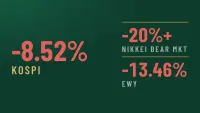
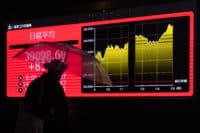
Taiwan’s Taiex closed down 6.2% on Friday, South Korea’s KOSPI 5.2%, Japan’s Nikkei 225 5.1% and Hong Kong’s Hang Seng 1.9%. Our after-close story has the full scorecard.
The U.S.-listed funds that track those markets show how much of that New York has already priced. The iShares MSCI Taiwan ETF (NYSEARCA: EWT) was down 5.9% before the bell, in line with Taipei’s day. For the week the fund is down 18.8% and its market 17.5%.
The South Korea fund (NYSEARCA: EWY) was down 2.6% and the Japan fund (NYSEARCA: EWJ) 1%. Both moves are small next to a 5% day at home. The funds trade in New York, and they took part of the loss on Thursday, hours before Asia opened. For the week, the Korea fund is down 8.2% against 7.9% in Seoul, and the Japan fund is down 6.1% against 7.7% in Tokyo. The funds are priced in dollars and the indexes in local currencies, so the two never match exactly.
Nikkei 225 futures traded at 56,595, 0.3% above the index’s close, and Taiwan index futures in Singapore were little changed.
Europe and the day ahead
Europe is lower. Germany’s DAX and the Euro Stoxx 50 were each down 2%, and London’s FTSE 100 was down 0.6%.
SPY has closed lower six sessions in a row, its longest losing streak since April 2024. It was down 5.1% for the week through Thursday. A close at its pre-market price of $711.36 would make the week’s loss 5.7%, the largest since April 2025.
The University of Michigan’s consumer sentiment survey is due at 10 a.m. Eastern, and monthly stock options expire Friday.
Savers who own these markets through a retirement account can see what a $500,000 401(k) in a target-date fund holds in Asia’s largest chip makers.
Contact [email protected] for any questions or corrections.
I've been writing about stocks and personal finance for 20+ years. I believe all great companies are tech companies in the long run, and I invest accordingly.