Here’s Why SanDisk Has The Cleaner Setup Over Bigger Rival SKHynix to Through The End of 2026

This post may contain links from our sponsors and affiliates, and Flywheel Publishing may receive compensation for actions taken through them.
SanDisk (NASDAQ:SNDK | SNDK Price Prediction) and SK hynix (NASDAQ:SKHY) both reported in late October, and both are riding AI infrastructure spending. SanDisk sells only NAND flash. SK hynix sells DRAM, HBM and NAND at a far larger scale, with a $840.57B market cap against SanDisk’s $107.45B. SanDisk’s 8-for-1 split took effect November 19, 2026[1], so the question is which company has the cleaner setup into year-end.
Data Center Flash Lifts SanDisk as HBM4 Lifts SK hynix
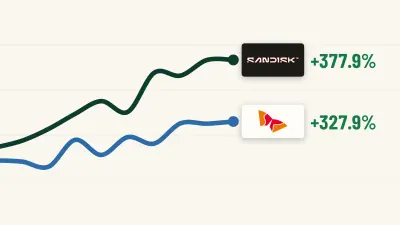
SanDisk’s fiscal Q1 revenue reached $11.03B, up 377.9% year over year[1]. Non-GAAP EPS of $49.51[1] beat the $46.27 consensus, its sixth consecutive beat. Datacenter revenue jumped 61% sequentially to $4.80B[1] as three U.S. hyperscalers[2] took more supply. Consumer slid 29% to $397M[1] as retail buyers adjusted to higher pricing. CEO David Goeckeler cited “robust and growing demand for our products driving outpaced growth in our data center business.”[1]
SK hynix posted revenue of $78.88B, up 327.9%[3]. Operating income rose 632.1% to $62.83B[3], and profit growing faster than sales shows how much pricing power AI memory carries. Server DDR5 drove DRAM sales, and HBM4 shipments began in earnest. Management expects HBM4 to become the mainstream product starting in the fourth quarter. The weak spot was pre-tax profit, which fell 58.7% sequentially[3] because of non-operating charges the company did not itemize. The results are also still unaudited.
| Lens | SanDisk | SK hynix |
|---|---|---|
| Growth Engine | Enterprise SSDs (TLC and QLC)[2] | HBM4 and server DDR5 |
| Soft Spot | Consumer retail storage | Non-operating charges |
| Key Dependency | Kioxia partnership | Won-based reporting |
A Focused Flash Specialist Against a Diversified Giant
SanDisk guided fiscal Q2 revenue to $12.2B to $12.6B[1] with non-GAAP gross margin of 84.5% to 85.5%, which means management expects margins near record levels to hold. About 60%[2] of Q1 growth came from volume, so higher demand did more of the work than higher prices. Its New Business Model (NBM) contracts cover about 50% of fiscal 2027 bits and two-thirds of fiscal 2028[2].
SK hynix expects demand to outrun supply through 2030 and has secured long-term agreements covering much of its 2027 to 2028 capacity. That gives it longer contracted AI memory visibility. Still, ADS holders carry Korean won risk, and its filings include no formal guidance.
Fiscal Q3 Seasonality Is SanDisk’s Next Hurdle
SanDisk management warned that fiscal Q3 is “normally our weakest sequential quarter.”[2] I will be watching whether NBM coverage climbs and whether samples of its high bandwidth flash arrive on schedule next calendar year. With SK hynix, you should track the M15X ramp and whether the audited results explain the non-operating swings. Both stocks have cooled. SanDisk fell 44.69% over the past month despite a 218.12% year-to-date gain, while SK hynix dropped 14.73%.
Why SanDisk Has the Cleaner Setup Through Year-End
Through December, SanDisk’s near-term setup looks cleaner. It trades at about 9 times earnings, carries no debt and spent $5.0B[1] on buybacks last quarter. Its growth driver is direct: AI inference needs more flash storage. Over a horizon that runs through 2027 and 2028, SK hynix’s contracted capacity offers longer visibility. If NBM renewals or Datacenter growth slow sharply, I would change my view.
Contact [email protected] for any questions or corrections.
Alex Sirois is a financial writer with experience spanning both retail and institutional investing. He has written for InvestorPlace and held roles at BNY Mellon and Bernstein, giving him a perspective that bridges Main Street portfolios and Wall Street analysis.
Alex holds an MBA from George Washington University and has built his career across multiple industries, including e-commerce, education, and translation — a breadth of experience that informs how he breaks down complex financial topics for everyday investors. His writing is conversational, actionable, and grounded in long-term, buy-and-hold investing principles.
At 247 Wall St., Alex focuses on delivering analysis that is both accessible and useful, with a clear emphasis on helping readers make more informed decisions with their money.