Steve Eisman Says “Stock Picking Is Back” Now That AI Is “No Longer One Trade”

This post may contain links from our sponsors and affiliates, and Flywheel Publishing may receive compensation for actions taken through them.

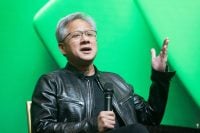
Steve Eisman, the investor made famous by The Big Short, used the November 20 episode of his podcast, The Real Eisman Playbook, to argue that the AI market has changed: “Without Nvidia backstopping the AI stack, AI is no longer one trade. And that’s why stock picking is back, and valuation is back.”
Three days later, the board of NVIDIA (NASDAQ:NVDA | NVDA Price Prediction) reinstated Jensen Huang as CEO, and the stock rose 32.36% in today’s session. Does his return undo Eisman’s thesis? The price data suggests the split he described had already happened.

Why Eisman Says NVIDIA Held the AI Trade Together
Eisman’s argument centers on circular financing. He said Huang took equity stakes in, or lent money to, companies including Anthropic, OpenAI, CoreWeave and Nebius Group, and those companies then used the money to buy NVIDIA chips. “He created, I think, a virtual vertical holding company,” Eisman said. When one balance sheet supports the whole network, having any AI stock means having a piece of the same machine. Once that support passes, Eisman said, the companies “need to be evaluated on their own merits and not as part of a larger whole.”
NVIDIA’s own disclosures show how concentrated that network is. In its third-quarter fiscal 2027 results, three direct customers made up 14%, 11%, and 11%[1] of revenue. Total guarantees reached $118 billion[2], and the company noted that its neocloud commitments depend on partners securing financing.

Six AI Stocks Ended Up With Six Very Different Years
| Company | YTD Change | Today | P/E |
|---|---|---|---|
| AMD (NASDAQ:AMD) | +114.5% | +8.24% | 162 |
| Amazon (NASDAQ:AMZN) | +11.65% | +4.41% | 34 |
| Microsoft (NASDAQ:MSFT) | +3.94% | +2.89% | 27 |
| Broadcom (NASDAQ:AVGO) | -10.11% | +1.65% | N/A |
| NVIDIA | -10.7% | +32.36% | 25 |
| Oracle (NYSE:ORCL) | -40.89% | +12.36% | N/A |
AMD’s Data Center revenue rose 97%[3] to $8.55 billion, and the company guided for about $17 billion in fourth-quarter revenue. Oracle grew cloud infrastructure revenue 121%[4], but it spent $28.5 billion on capex, which left free cash flow at -$5.40 billion. Broadcom’s AI semiconductor revenue rose 221%[5], yet the stock slipped after a report that Google is cutting AI chip shipments. Microsoft’s Azure revenue grew 48%, and Amazon’s AWS revenue grew 39%. Both companies also have large businesses outside AI.
Huang’s Return Leaves the AI Trade Split Apart
Every name rose today, which looks like the old one-trade reflex. Gains ran from 1.65% at Broadcom to 32.36% at NVIDIA, but one day of relief leaves intact a year-to-date spread from a triple-digit gain at AMD to a loss of more than 40% at Oracle. Huang’s return may steady the financing network. The questions Eisman raised remain: who gets funded, how strong each balance sheet is, and what each stock costs (we pulled together seven suppliers powering the AI expansion, from power to cooling, in a free report). Barron’s summed it up in a headline: “The Stock Is Surging, but the Problems Remain.”
What “Stock Picking Is Back” Means for Your Index Fund
A cap-weighted index fund has all six of these stocks, weighted by size. NVIDIA’s market cap is about $4.01 trillion, compared with about $354.0 billion for Oracle. That means your AI exposure leans heavily on the biggest names, whatever their fundamentals.
To act on this, review your fund’s top 10 holdings and check whether a few AI stocks make up too large a share of your retirement balance. Compare valuations, such as AMD at 162 times earnings against NVIDIA at 25. Scheduled rebalancing is one way investors keep one year’s winners from quietly taking over a portfolio. The next test comes with NVIDIA’s guidance of about $130 billion[1] in fourth-quarter revenue and Broadcom’s forecast of $21.7 billion[5] in AI semiconductor revenue.
Contact [email protected] for any questions or corrections.
Chris Lange is a financial and geopolitical writer with more than a decade of experience covering a myriad of topics. He has published thousands of articles for 24/7 Wall St., with past coverage focused heavily on stocks, IPOs, healthcare, defense, global affairs, and technology.
His work has been quoted, or referenced by a number of outlets including Business Insider, USA Today, Yahoo Finance, MSN, The Motley Fool, and many other publications. A graduate of Southwestern University, he studied business with a focus on investments and has previous experience in banking and startups.
When not reading or writing the news, he is following his passion for Lacrosse, playing chess, or building solar projects with his dad.