These High-Yielding S&P 500 Stocks Are Black Friday Steals This Year

This post may contain links from our sponsors and affiliates, and Flywheel Publishing may receive compensation for actions taken through them.

Black Friday rewards shoppers who can tell a real markdown from a fake one, and income investors need the same discipline. The three S&P 500 dividend payers below come from health care, consumer staples, and utilities. Each trades below its 52-week high and pays a dividend backed by earnings guidance, cash flow, and a long payment record. The star, Pfizer (NYSE: PFE | PFE Price Prediction), yields about 6.25%. That is the kind of payout retirees usually have to accept far more risk to get.
Pfizer: Ultra-High Yield at a Single-Digit Multiple
Pfizer pays an annualized forward dividend of $1.72 per share, which works out to an ultra-high yield of roughly 6.25% at a recent price of $27.64. The next quarterly check of $0.43 is scheduled for December 7.

Why It’s Marked Down
The stock has slipped 6.05% over the latest one-month stretch. It sits below its 52-week high of $30.99 and below the average analyst target of $30.22. At about 9x forward earnings, the market is pricing in a shrinking COVID business. Paxlovid fell 63%,[1] and Comirnaty fell 30% in the third quarter. Pfizer also expects about $1.1B[1] in negative revenue impact from generic and biosimilar competition. Patent expirations for Ibrance and Xtandi in the U.S., plus Eliquis internationally, are also on the horizon (Q3 earnings call)[2].
Dividend Safety Check
The $1.72 annual payout compares with raised full-year adjusted EPS guidance of $2.95 to $3.05[1]. Through the first nine months, operating cash flow reached $8.8 billion[2], while the dividend returned $7.3 billion to shareholders. Leverage ended the quarter at 2.6 times,[2] and interest coverage stands at 6.52. Pfizer has also made no buybacks this year to pay down debt. On track record, the quarterly dividend rose every year from $0.32 in 2017 to $0.43 and has held there since. Management said: “Through the LOE period, our operating cash flow, financial assets, and access to capital markets will give us the ability to continue to invest and maintain the dividend.”[2]
Bull Case for Income Investors
Pfizer beat third-quarter expectations with adjusted EPS of $0.87[1] against a consensus of $0.728, its 7th consecutive beat. Launched and acquired products grew 32%[1] operationally, with Padcev up 55%. The company is close to completing $7.2 billion[2] in net savings and has a second phase targeting another $2.5 billion. Management is aiming for a high-single-digit revenue CAGR from year-end 2028 through year-end 2033[2].
Risk to Weigh
Coverage on a trailing basis is thin. Pfizer’s free cash flow yield of 5.805% trails its dividend yield, and trailing GAAP diluted EPS of $0.70 falls short of the payout. That is a yield-trap warning sign. Until the patent cliff passes, dividend growth appears unlikely.
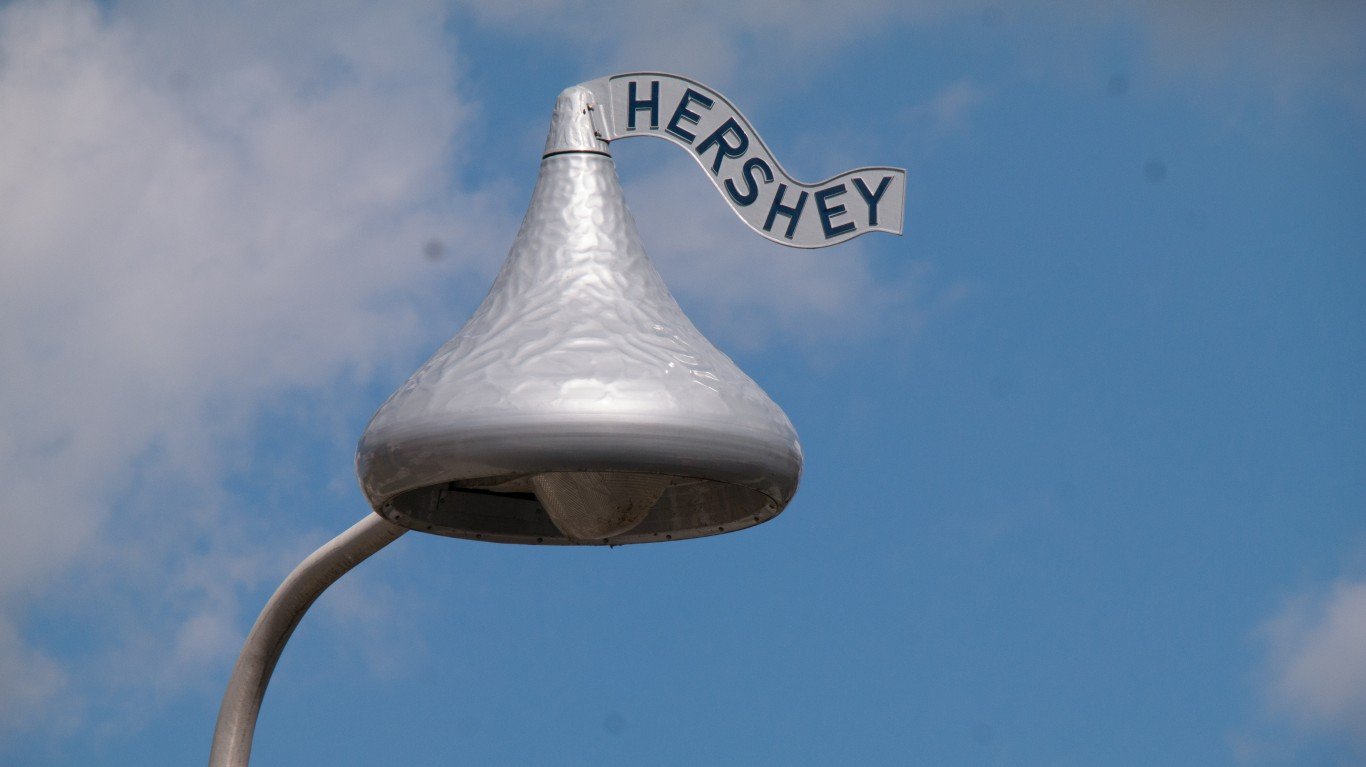
Hershey: Sweet Income Well Below the 52-Week High
Hershey (NYSE:HSY) yields 3.29% on an annualized dividend of $5.808 per share. The next payment is due December 15. That yield is modest next to Pfizer’s, but it is a high yield by Hershey’s own standards and comes with stronger earnings coverage.
Why It’s Marked Down
At $182.70, shares remain far below the 52-week high of $233.83 and under the 200-day moving average of $187.14. The stock trades at about 19x forward earnings. Record cocoa costs and price hikes hurt volume, which fell about 10 points[3] in the third quarter, offset by roughly 11 points of net price. Convenience stores have been the weakest channel. One caution for bargain hunters: the stock already sits above the average analyst target of $180.90, so the discount is measured against its own high.
Dividend Safety Check
The $5.808 annual payout sits well inside raised full-year adjusted EPS guidance of $8.58 to $8.74[3], and trailing EPS is $8.84. Hershey holds $676.7M[3] in cash and $4.876B of shareholders’ equity against $9.017B in total liabilities. Interest expense runs about $200M[3]. Hershey has paid quarterly dividends without a break since at least 1999, and the payout rose from $0.2975 per quarter in 2007 to $1.452. When cocoa costs peaked, the company froze the payout at $1.37 for two years before raising it again.
Bull Case for Income Investors
Margins are recovering fast. Third-quarter adjusted EPS of $2.64[3] topped the $2.1142 consensus, and reported gross margin expanded to 46.1% from 32.6%. Salty Snacks sales grew 22.3%[3], and management says next year’s innovation pipeline is up 50%[4]. Chief Executive Kirk Tanner said the company is “on track to deliver solid sales growth, a meaningful recovery in margin and earnings, and disciplined investment to fuel our next chapter of growth.”[3]
Risk to Weigh
Third-quarter profit got help from $113.4M[3] in pre-tax derivative mark-to-market gains, plus duty refunds. CFO Dave Hulays warned that “you can expect things to look different next year as the different hedges roll through.”[4] If cocoa prices spike again, the margin recovery that supports dividend growth could stall.
Eversource Energy: Regulated Income Under Its Price Target
Eversource Energy (NYSE:ES) yields 4.41%, with an annualized forward dividend of $3.15 per share. As a pure-play regulated utility serving New England, it offers the steadiest cash flow profile of the three.
Why It’s Marked Down
Shares closed at $71.04, below the 52-week high of $75.68 and the average analyst target of $72.29. That is about 14x forward earnings and 1.63 times book value. Regulators have weighed on the stock. A FERC decision cut the company’s transmission ROE to 9.57%[5], and management narrowed 2026 non-GAAP EPS guidance to $4.62-$4.70, below the $4.80-$4.95[6] range it gave earlier.
Dividend Safety Check
Even under the cut guidance, the $3.15 annual dividend is comfortably covered by expected earnings. Credit metrics are solid: FFO-to-debt stood at 15.4%[5] at S&P and 16.1% at Moody’s, and all three rating agencies have stable outlooks. CFO John Moreira said, “I don’t see a need for near-term equity.”[5] Securitizing about $1.1 billion of storm costs should also reduce debt. The dividend record is the strongest in this group. Eversource has raised its quarterly payout every year from $0.505 in 2018 to $0.7875, and its quarterly payments stretch back to 2000.
Bull Case for Income Investors
A $26.5 billion[5] five-year capital plan is projected to grow the rate base from $30.6B to $49.3B by 2030[6]. That growth drives regulated earnings, and earnings fund the dividend. Management expects EPS growth “towards the upper half of our long-term target range of 5% to 7% by 2028.”[5] A transmission project selected by ISO New England adds $700 million in capital investment beyond the current plan.
Risk to Weigh
Regulators largely decide Eversource’s returns. A retroactive FERC refund involves recalculating “more than 10 years’ worth of load settlement and billing data,”[5] and accounting rules may force the company to book the refund before its appeal is resolved. The Connecticut rate case adds more uncertainty, with a final decision targeted for June[5].
Matching the Markdown to Your Income Needs
These three markdowns each offer something different. Pfizer gives the biggest check at a single-digit forward multiple, but its free cash flow coverage needs close monitoring. Hershey has the widest earnings cushion as its margins recover, and Eversource pairs an annual dividend raise with regulated growth. Next to keep an eye on: Pfizer’s patent cliff, Hershey’s cocoa hedges, and Eversource’s Connecticut rate decision.
Contact [email protected] for any questions or corrections.
Lee Jackson has covered Wall Street analysts' equity and debt research and equity strategy daily for 24/7 Wall St. since 2012. His broad, diverse career, including a stint as creative services director at an NBC affiliate in Austin, Texas, gives him unique insight into the financial industry.
Lee Jackson's journey in the financial industry spans more than 30 years, including nearly two decades as an institutional equity salesperson at Bear Stearns, Lehman Brothers, and Morgan Stanley. His career spanned pivotal sell-side Wall Street events, from the dot-com rise and bubble to the Long-Term Capital Management debacle, 9/11, and the Great Recession of 2008. This reflects his resilience and adaptability amid market volatility.
Lee Jackson’s practical financial industry experience, gained through a career at some of the biggest banks and brokerage firms, is complemented by a lifetime of writing across various platforms. This unique combination allows him to shed light on the intricacies of Wall Street in a way only someone with deep insider experience and knowledge can. Moreover, his extensive network across Wall Street continues to provide direct access for him and 24/7 Wall St., a privilege few firms enjoy.
Since 2012, Jackson’s work for 24/7 Wall St. has been featured in Barron’s, Yahoo Finance, MarketWatch, Business Insider, TradingView, Real Money, The Street, Seeking Alpha, Benzinga, and other media outlets. He attended the prestigious Cranbrook Schools in Bloomfield Hills, Michigan, and has a degree in broadcasting from the Specs Howard School of Media Arts.