Here’s How Much You Need in Hershey and ADM to Earn $20,000 a Year in Dividends

This post may contain links from our sponsors and affiliates, and Flywheel Publishing may receive compensation for actions taken through them.

An income of $20,000 a year covers a solid share of a retiree’s fixed costs, or fills the gap between Social Security and real spending. Here is the capital it takes when the income comes from two consumer staples dividend payers, Hershey (NYSE:HSY | HSY Price Prediction) and Archer-Daniels-Midland (NYSE:ADM), split equally so each one produces $10,000. Treat every figure below as an estimate. Dividends can change.
Roughly $624,000 Gets You There Today.
Hershey pays an annualized forward dividend of $5.808 per share. At $175.44, that works out to a yield of about 3.31%. ADM pays $2.08 per share. At $66.97, it yields about 3.11%.
| Stock | Yield | Capital for $10,000 | Approx. Shares |
|---|---|---|---|
| Hershey | 3.31% | $302,000 | 1,722 |
| ADM | 3.11% | $322,000 | 4,808 |
| Total | 3.20% blended | $624,000 | n/a |
That puts the pair squarely in the conservative tier. For perspective, the same $20,000 at a 6% moderate-tier yield buys about $333,000, and at a 10% aggressive-tier yield about $200,000. The extra capital buys earnings coverage and dividend growth.
Hershey: Candy Pricing Power With a Cocoa Problem
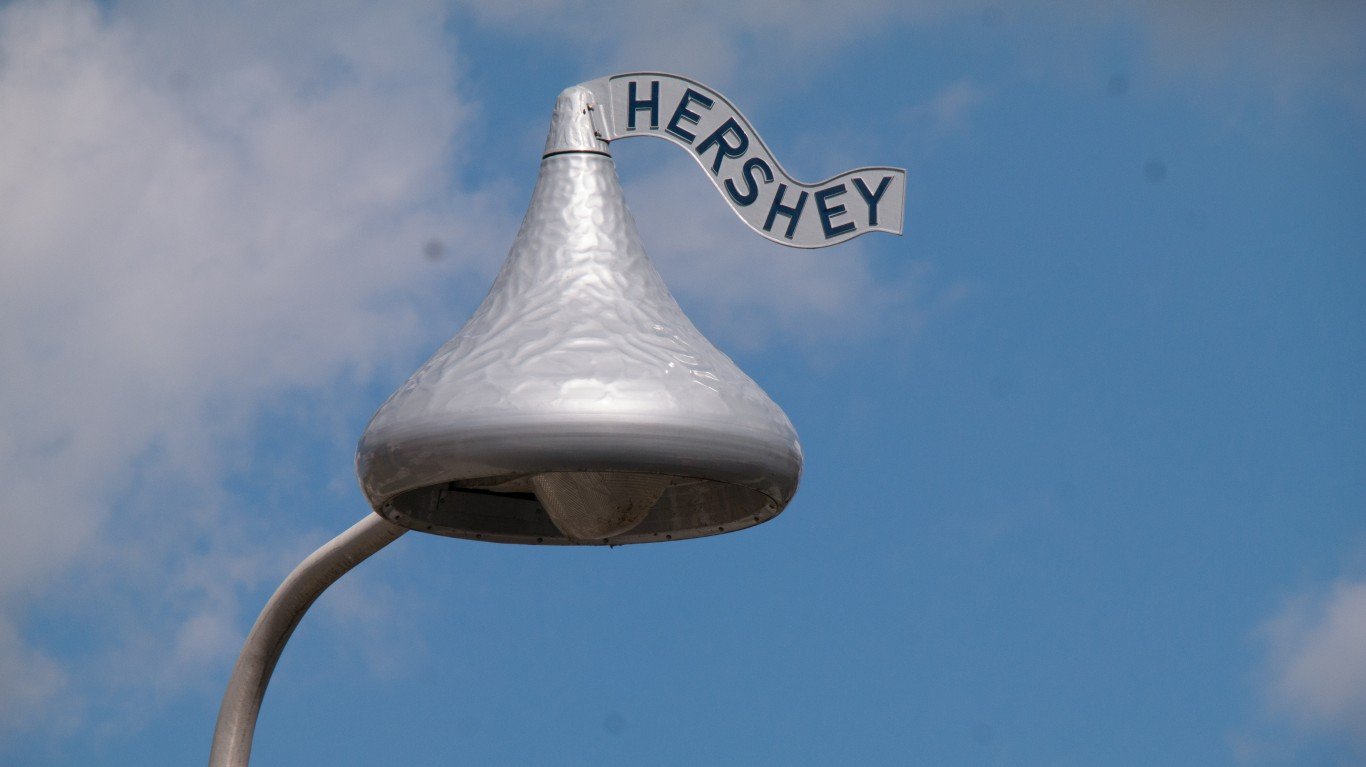
Hershey sells Hershey’s, Reese’s, Sour Strips, and the LesserEvil snack line through U.S. retail and convenience stores (company profile). Brands that people buy every week bring in steady cash, and that cash pays the dividend. Hershey raised the quarterly payout from $1.37 to $1.452 in 2026, an increase of about 6%, and its record of payments goes back to 1999.
Coverage looks comfortable. Against 2026 adjusted EPS guidance of $8.58 to $8.74[1], the dividend uses roughly 66% to 68% of earnings. Q3 adjusted EPS of $2.64[1] beat the $2.11 consensus. On the balance sheet, Hershey held $676.7 million[2] in cash against $9.02 billion in total liabilities, and cash was down 41.82% year over year.
The main risks are cocoa and consumers. Price increases added about 11 points[2] to Q3 sales, while volume fell roughly 10 points. The chief executive noted that “consumers grow more cautious.”[2]

ADM: A 53-Year Streak Riding Biofuel Margins
ADM buys, stores and ships crops, then processes oilseeds and corn into food, feed and fuel (company profile). Food, feed, and fuel are everyday essentials, and that volume supports the payout. The 2026 increase from $0.51 to $0.52 marked its 53rd consecutive year of dividend growth[3], putting ADM in the Dividend Kings club (we ranked ten of them by valuation in a free report here).
The dividend uses only about 36% to 38% of 2026 adjusted EPS guidance of $5.50 to $5.80[4]. Based on market cap and share price, the annual payout comes to roughly $990 million, about 24% of 2025 free cash flow of $4.204 billion[5]. Shareholders’ equity stands at $23.858 billion[5], with $711 million in cash.
Crop prices and trading margins are the main risks. Crushing profit rose to $311 million[5] because biofuel conditions were favorable, and those conditions depend on policy. The stock has dropped 14.99% over the past month, which helps explain why the yield sits where it does.

Dividend Growth Is the Reason the Capital Costs More
Hershey’s quarterly dividend has grown from $0.618 in late 2016 to $1.452, about 2.35 times. ADM’s went from $0.30 to $0.52 over the same stretch. A $20,000 income stream built on payers like these keeps rising without new money. A 10% yielder with flat payouts still pays $20,000 a decade from now, assuming it never cuts.
What This Means for a Retiree
- Size the target against $624,000, then recheck it. If the blended yield falls to 2.7%, the capital needed climbs to about $741,000. If it rises to 3.7%, it drops to about $541,000. Pull live yields before running these numbers.
- Stress-test the two-name risk. Each stock supplies half the income. Model what a cut at either one does to your monthly cash flow. Both depend on commodity prices, cocoa for Hershey and crops for ADM.
- Watch the next dividend announcements. Both companies announced their 2026 raises in February. A smaller raise, or none, in early 2027 would change the growth math above.
Contact [email protected] for any questions or corrections.
Chris Lange is a financial and geopolitical writer with more than a decade of experience covering a myriad of topics. He has published thousands of articles for 24/7 Wall St., with past coverage focused heavily on stocks, IPOs, healthcare, defense, global affairs, and technology.
His work has been quoted, or referenced by a number of outlets including Business Insider, USA Today, Yahoo Finance, MSN, The Motley Fool, and many other publications. A graduate of Southwestern University, he studied business with a focus on investments and has previous experience in banking and startups.
When not reading or writing the news, he is following his passion for Lacrosse, playing chess, or building solar projects with his dad.