About 1 in 3 Families 55 and Older Is Worth $1 Million or More. Here’s the Share at Every Age

This post may contain links from our sponsors and affiliates, and Flywheel Publishing may receive compensation for actions taken through them.

A 45-year-old checked her accounts after a good quarter and found she’d crossed a line she’d been watching for years. Her 401(k) and IRA hold $560,000, she has $80,000 in savings, and she has $380,000 of equity in a three-bedroom she bought in her 30s. Her net worth is $1.02 million.
At 45, that puts her in roughly the top quarter. In the 45 to 54 bracket, 23.6% are worth $1 million or more, about one in four. Across every age, 21.5% of U.S. households have reached $1 million. From 55 on, the share holds at about a third.
She’s a scenario we built for this story, and the shares are real. They come from the Federal Reserve’s 2025 Survey of Consumer Finances, which tracks what Americans own and owe every three years. The figures are from 24/7 Wall St.’s new research report, "The State of the American Household." The $1 million shares, and the figures that leave out real estate, are a 24/7 Wall St. calculation from the Fed’s public data. Net worth here counts the family residence, which matters a great deal further down.
How common $1 million is at every age
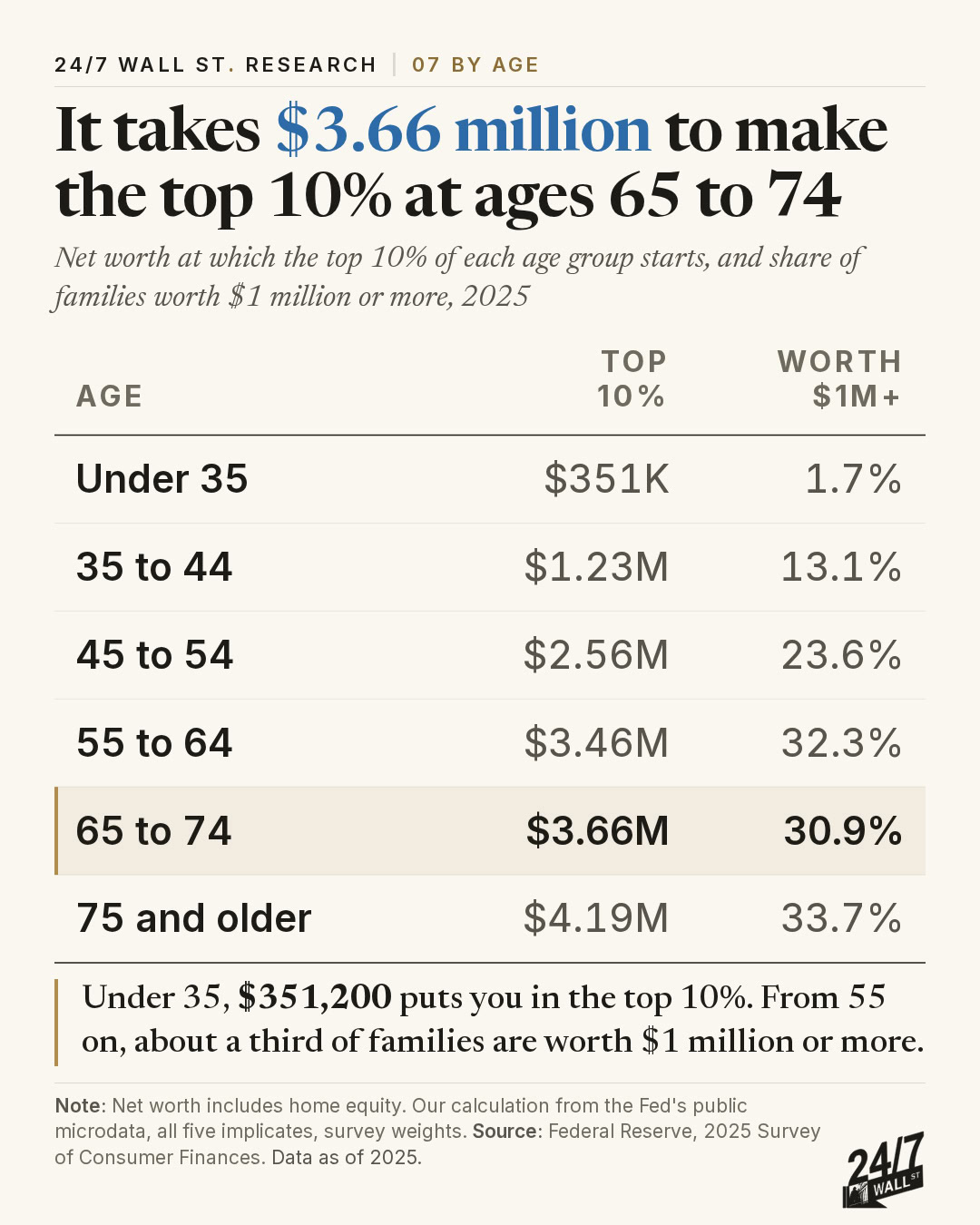
If you’re under 35, 1.7% of your peers are worth $1 million or more. That’s about one in 59.
If you’re 35 to 44, the share is 13.1%, about one in eight.
If you’re 45 to 54, it’s 23.6%. That’s 1.8 times the share a decade younger, and $1 million here beats more than three of every four people your age.
If you’re 55 to 64, 32.3% have reached $1 million, close to one in three.
If you’re 65 to 74, the share is 30.9%.
If you’re 75 and older, it’s 33.7%, the highest of any age group.
The climb stops at 55. From there on the share stays between 30.9% and 33.7%, so in every older bracket about two in three are worth less than $1 million. The survey doesn’t follow the same people over time, but the older brackets show no further climb. Our 45-year-old is already where only about a third of older Americans end up.
Count her million twice
A $1 million net worth means different things depending on how much of it is real estate. You can’t spend equity in the place you live without selling, borrowing against it or moving somewhere cheaper.
For the typical 45- to 54-year-old, the property is most of the money. The median net worth in that bracket is $254,700 counting the residence and $103,500 leaving it out, so the property is 59% of the median.
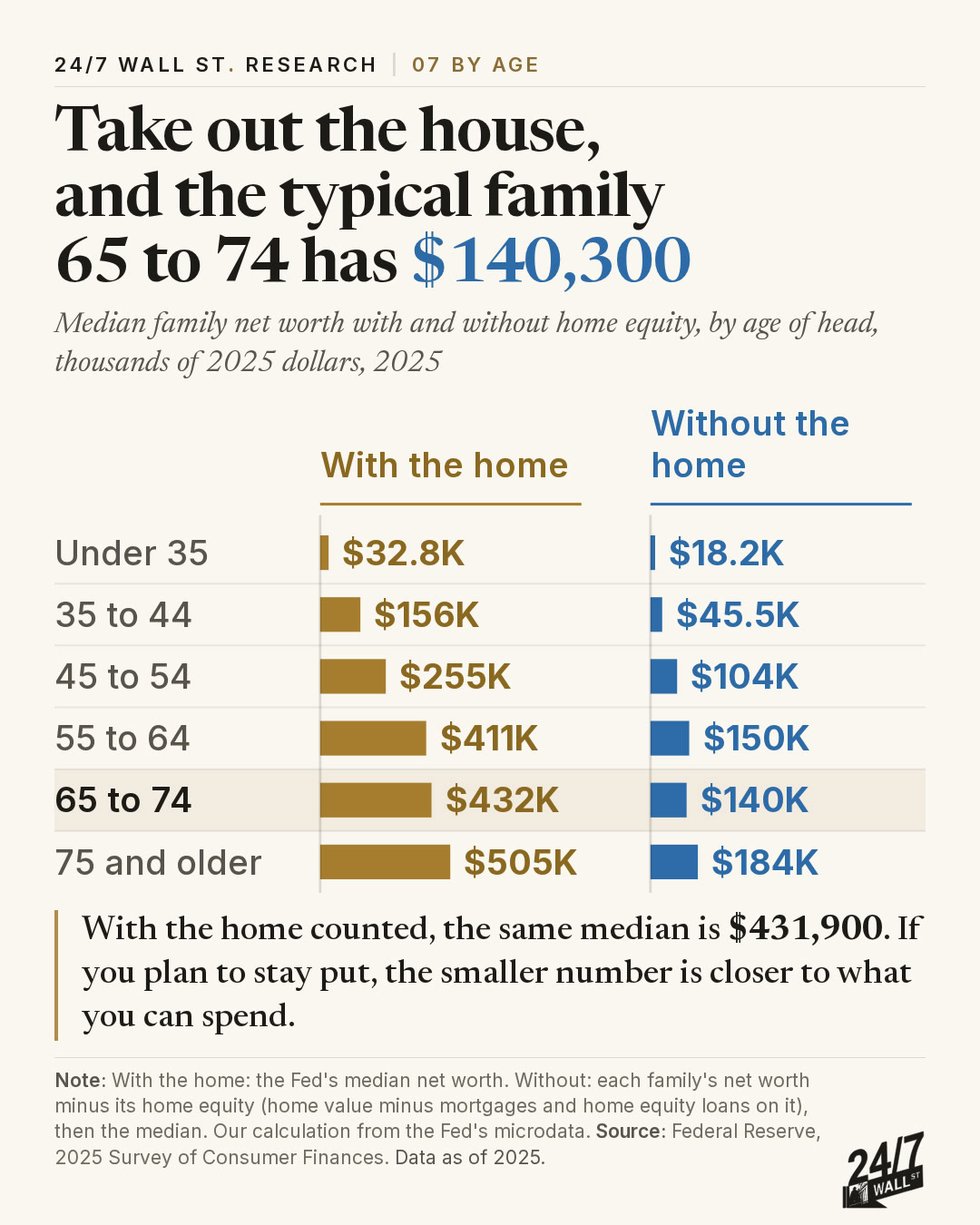
Our 45-year-old looks different. Real estate is 37% of her net worth, and $640,000 sits in accounts she can draw on. That’s 6.2 times the bracket’s median with real estate left out. It’s also 4.6 times what the typical household 65 to 74 holds outside its real estate.
If she drew 4% a year from that $640,000 today, a common rule of thumb for retirement withdrawals, it would pay $25,600 a year, about $2,100 a month. That’s a useful check on what her million can actually do, and it’s a long way from an early retirement.
What 20 more years can do
She has time on her side. Say she stops adding money altogether and her $640,000 grows 4% a year after inflation until she’s 65. It would reach $1.4 million in today’s dollars, 2.19 times what she has now. At the same 4% draw, that pays $56,100 a year, about $4,700 a month, before any Social Security.
Anything she adds pushes that higher. The $380,000 tied up in her three-bedroom stays out of the math until she sells or borrows against it.
Our story Saturday on Kevin O’Leary’s bar of $5 million liquid showed the median net worth for each bracket. A $1 million net worth is a far more common milestone. About a third of households 55 and older have it, and for most of them real estate is a big piece.
So count yours both ways. Add up your net worth with your property, then without it, and check the share of people your age who’ve reached $1 million. If most of your million is the place you live in, give the second number more weight when you plan your spending.
Vilma Rios, our tax and planning lead, works out the Roth, Medicare and withdrawal moves in dollars in The Daily Profit. It’s free.
Contact [email protected] for any questions or corrections.
I've spent more than 15 years inside enterprise software, working alongside the finance, sales operations, and HR leaders who run the revenue engines at some of the largest tech companies in the country.
My day job is helping enterprise executives make smarter decisions about retention, compensation, and growth. These are the same operational levers that show up in every earnings report investors actually read. That perspective shapes my writing for 24/7 Wall St.
The headline numbers are easy. The interesting stuff is underneath: how companies make money, what executives are worried about, and what any of it means for the person checking their 401(k) on a Sunday afternoon. I write about personal finance and business as someone who has spent her career inside the rooms where these decisions get made.