The Typical Couple 65 to 74 Can Draw Just $273 a Month From Savings by the 4% Rule

This post may contain links from our sponsors and affiliates, and Flywheel Publishing may receive compensation for actions taken through them.

A couple who just turned 65 and sit right in the middle for people their age can draw about $273 a month from their savings and investments. That’s what the 4% rule gives on $81,800, the Federal Reserve’s midpoint for households 65 to 74 in its 2025 Survey of Consumer Finances.
Say they both retired this year. The Social Security checks have started. The house is theirs and they mean to stay. What they want to know is simple: “Besides those checks, what do we actually have to live on each month?”
If you’re near 65 yourself, you can run the same math on your own accounts in a few minutes. The figures here come from 24/7 Wall St.’s new research report “The State of the American Household,” built on the Fed’s survey.
The $273 paycheck
The 4% rule is a rule of thumb for making savings last about 30 years. You take out 4% of your savings in the first year of retirement, then raise that dollar amount with inflation each year after. Nobody guarantees it works. A bad stretch of markets early in retirement can make 4% too much, and a long life can stretch any plan.
For the couple, the math is short:
- Savings and investments: $81,800. That’s bank accounts, CDs, retirement accounts, stocks, bonds and funds.
- 4% of that: $3,272 a year.
- Divided by 12: about $273 a month.
That’s about $63 a week. It covers a utility bill or a grocery run. It won’t cover a new roof.
Flip the math and you get a yardstick for your own plan. By the 4% rule, every $100 a month of income takes $30,000 in savings. A $1,000 monthly draw takes $300,000.
There’s a bigger number on the couple’s balance sheet. The Fed puts the typical net worth for households 65 to 74 at $431,900. Take out the house and it drops to $140,300 (the without-home figure is a 24/7 Wall St. calculation from the Fed’s public data). For a couple who plan to stay put, the smaller number is closer to what they can spend.
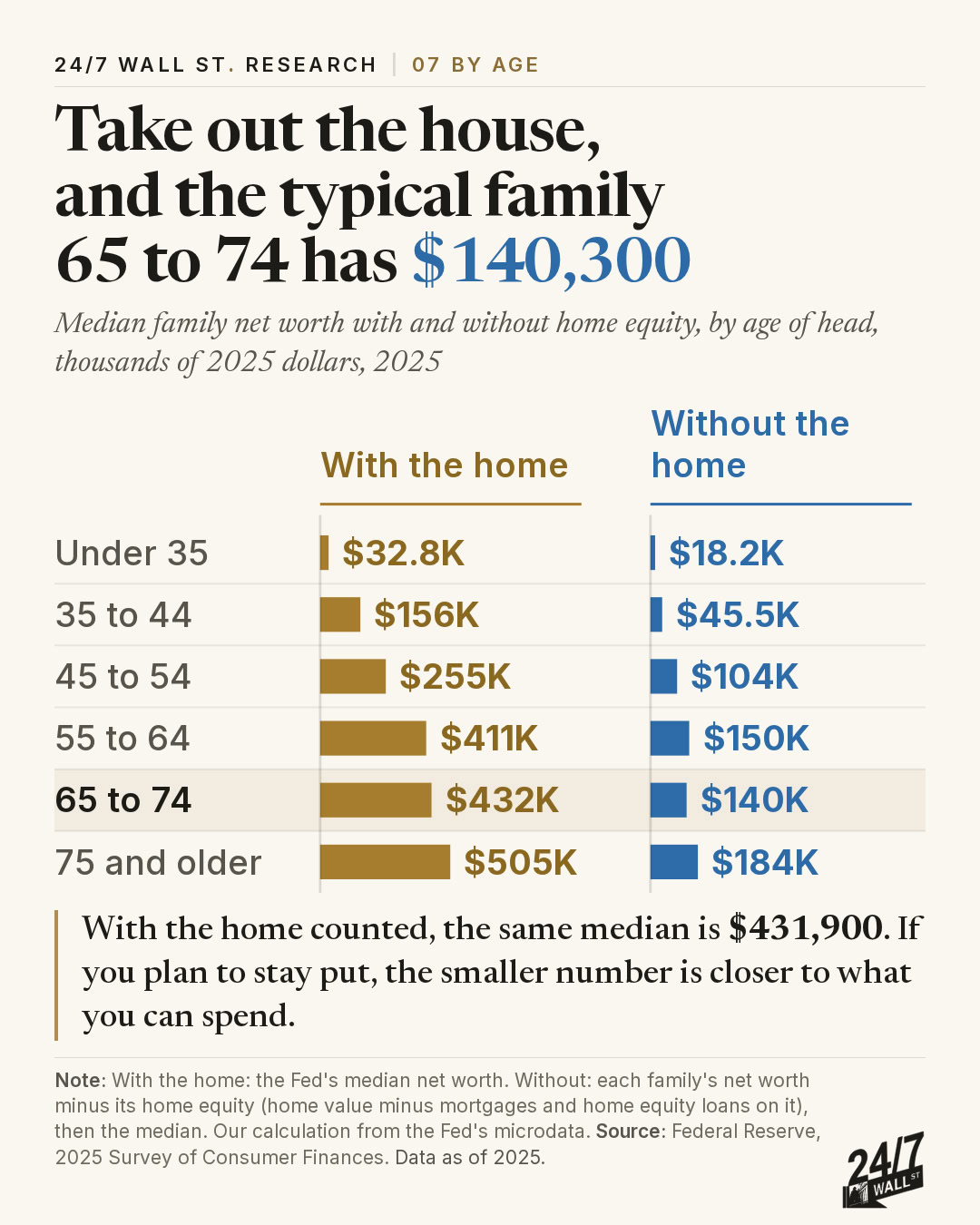
Even that overstates the monthly check. The without-house figure still counts the cars, and anything else they own that isn’t a bank or investment account. If every dollar of the $140,300 could be invested and drawn at 4%, it would pay about $468 a month. Most couples can’t sell the car they drive to the doctor, so the realistic paycheck sits between $273 and $468.
One caution on the couple: they sit at the median of each measure, and those three medians come from separate rankings. Together they sketch a typical couple. No real household has to match all three.
The paycheck your savings pay at every age

Run the same 4% math on the typical savings at each age and you get what a household could draw if it retired with that balance.
If you’re under 35, the typical balance is $12,300, which would pay $41 a month.
If you’re 35 to 44, it’s $33,000, or $110 a month.
If you’re 45 to 54, $77,800 pays $259 a month.
If you’re 55 to 64, $93,300 pays $311 a month. That’s the typical balance in the decade before retirement.
If you’re 65 to 74, $81,800 pays $273 a month.
If you’re 75 or older, $104,500 pays $348 a month, the most on the list.
At no age does the typical household’s savings pay as much as $350 a month by the 4% rule.
When 24/7 Wall St. looked at Kevin O’Leary’s $5 million bar on Nov. 21, the same $81,800 parked in Treasury bills paid about what the 4% rule pays, and two average Social Security checks paid many times more. Either way you count it, the savings are the small part of the couple’s monthly income.
What the couple should check this month
My view: for the typical couple at this age, Social Security carries the budget, and the savings are a cushion. Plan around that.
Put the checks first. Pull both Social Security statements from ssa.gov and add the monthly amounts. That total is the budget. Add the $273, and know that most of the money comes from the government checks.
Keep a repair fund. On $81,800, a single furnace or car repair can be a year or more of 4% withdrawals. Some couples hold a slice in a savings account for those bills and leave the rest invested.
Write down your own two numbers. Your savings and investments, and your net worth without the house. Multiply the first by 0.04 and divide by 12. If you’re 65 to 74 and the answer tops $273, you’re ahead of the middle for your age. If the result is a number you’d want to live on, you’re far ahead of it.
On a $900,000 IRA, the IRS will make you withdraw $36,585 at 75. Here’s how to shrink it, free in The Daily Profit.
Contact [email protected] for any questions or corrections.
I've spent more than 15 years inside enterprise software, working alongside the finance, sales operations, and HR leaders who run the revenue engines at some of the largest tech companies in the country.
My day job is helping enterprise executives make smarter decisions about retention, compensation, and growth. These are the same operational levers that show up in every earnings report investors actually read. That perspective shapes my writing for 24/7 Wall St.
The headline numbers are easy. The interesting stuff is underneath: how companies make money, what executives are worried about, and what any of it means for the person checking their 401(k) on a Sunday afternoon. I write about personal finance and business as someone who has spent her career inside the rooms where these decisions get made.