Berkshire Hathaway Is Up 15% in 2026 and Easily Beating the S&P 500. Is Berkshire Stock Better Than an Index Fund Now?

This post may contain links from our sponsors and affiliates, and Flywheel Publishing may receive compensation for actions taken through them.

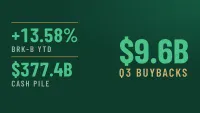
An AI-led selloff is dragging down tech-heavy indexes. Berkshire Hathaway (NYSE:BRK-B | BRK-B Price Prediction) is holding up well enough to extend its lead over the market in 2026. Berkshire stock is up 15% year to date (YTD) to $577.76 in afternoon trading. The Class B shares are up 0.1% from the prior close while NVIDIA (NASDAQ:NVDA) leads a renewed wave of the AI selloff. Indeed, AI-market jitters partially account for recent declines in tech stocks like Intel (NASDAQ:INTC) and Micron Technology (NASDAQ:MU).

That resilience brings back a familiar question for Berkshire: is it a better holding than an index fund? Core Personal Consumption Expenditures (PCE) inflation came in at 3.3% year over year (YoY) for October, above the 3.2% that economists expected. The hot reading has all but locked in a December Federal Reserve rate hike, and the AI selloff is hitting tech-heavy indexes hardest, which plays to Berkshire’s defensive profile.
What Powered Berkshire’s 2026 Lead Over the Market
On August 11[1], Berkshire disclosed that its operating earnings rose to $12.98 billion from $11.16 billion a year earlier. The company’s headline profit of $17,868[1] per Class A share beat the consensus estimate of $8,026.25, but $12.68 billion of after-tax investment gains drove most of that beat. Management called such gains “usually meaningless,”[1]. So the operating figure gives the cleaner read, with BNSF, Berkshire Hathaway Energy and the manufacturing, service and retailing group all growing.
Capital deployment shifted in that same report. Berkshire became a net buyer of stocks for the first time in over three years[1], putting $23.5 billion into equities and buying back $4.5 billion of its own shares. As of November 25, CEO Greg Abel is Warren Buffett’s successor.
How Berkshire Stacks Up Against the Big Index Funds
Checking in on some popular index ETFs, the State Street SPDR S&P 500 ETF Trust (NYSEARCA:SPY) is at $706.99, down 2%. Invesco QQQ Trust (NASDAQ:QQQ), which tracks the NASDAQ 100’s largest nonfinancial companies, is at $619.74, down 3%. The Dow-tracking State Street SPDR Dow Jones Industrial Average ETF Trust (NYSEARCA:DIA) is at $497.23, down 0.6%.
Over the past month, the S&P 500 fund is down 7%, the QQQ fund is down 12% and the Dow Jones fund is down 5%, while Berkshire stock is up 7%. Year to date, SPY is up 4%, DIA is up 3% and QQQ is up 0.8%, all well behind Berkshire. These ETF figures are price returns that exclude dividends, and Berkshire doesn’t pay a dividend at all.
Why Berkshire Holds Up When Tech Breaks Down
Berkshire owns whole operating businesses, including GEICO and General Re in insurance, the BNSF railroad, Berkshire Hathaway Energy and a long list of manufacturing, service and retail companies. On top of that, the conglomerate runs one of the world’s largest equity portfolios, funded partly by insurance float. That mix makes its money from freight volumes, utility rates, insurance premiums and consumer spending, which tend to move on a different cycle from AI chip demand.
Index funds work differently. SPY spreads money across the entire S&P 500 for a very low annual fee, and Berkshire itself ranks among its largest holdings, while QQQ concentrates heavily in semiconductor and big tech names, which is why it’s taking the brunt of the AI selloff. The Dow fund sits between the two, holding a short list of blue-chip stocks.
Is Berkshire Stock Better Than an Index Fund Right Now?
The bulls can point to Berkshire’s 101% gain over five years, ahead of SPY at 51%, QQQ at 55% and DIA at 39%. Over 10 years, Berkshire stock is up 265%, beating SPY’s 219%. A low-volatility profile, share buybacks and fresh stock purchases under Abel give the company tools an index fund lacks.
On the other side, the bears could note that QQQ is up 421% over 10 years, far ahead of Berkshire, so a long time frame has favored owning tech growth. An index fund also offers broader diversification, low fees and full participation if tech rebounds, while Berkshire concentrates risk in one management team and one balance sheet. Berkshire’s insurance underwriting and insurance investment income both declined YoY in its August 11[1] results, a reminder that the conglomerate faces its own challenges.

Berkshire’s Defensive Edge Faces Its Next Test
Berkshire now faces a question: whether its defensive lead holds if the Fed raises rates in December and tech stocks recover. One reasonable framing treats Berkshire as a complement to an index fund, combining broad market exposure with a steadier conglomerate that answers to a different set of drivers.
Upside for Berkshire depends on Abel’s stock purchases and operating growth continuing, while the main downside is a sharp tech rally that leaves the slower-moving conglomerate behind. Investors researching the stock may want to keep an eye on the December Fed decision.
Contact [email protected] for any questions or corrections.
David Moadel is financial writer specializing in stocks, ETFs, options, precious metals, and Bitcoin. David has written well over 1,000 articles for leading online publications, helping investors understand markets, income strategies, and risk. His work has appeared in 24/7 Wall St., The Motley Fool, InvestorPlace, U.S. News & World Report, TipRanks, ValueWalk, Benzinga, Market Realist, MarketScreener, TalkMarkets, Finmasters, and others. With a master’s degree in education, David has taught at the elementary, high school, and college levels. That teaching background shapes his writing style: clear, educational, and practical. David has also built a loyal social-media audience by providing trustworthy financial content on YouTube, X/Twitter, and StockTwits.