Credo Technology Crashed 27% Over a Month: This Wall Street Desk Now Expects 190% Returns

This post may contain links from our sponsors and affiliates, and Flywheel Publishing may receive compensation for actions taken through them.

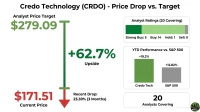
Credo Technology (NASDAQ:CRDO | CRDO Price Prediction) currently trades at $106.46, compared with an average analyst price target of $274.31. That gap implies 157.7% upside.
Credo designs high-speed connectivity products that link AI accelerators, switches and racks inside hyperscale data centers. Active Electrical Cables (AECs) built the franchise. Optical DSPs, silicon photonics and ZeroFlap optics are now the faster-growing layer. Fiscal 2026 revenue reached $1.335B[1], up 205.68%. Credo is exactly the kind of non-chipmaker AI infrastructure name we profiled in a free report on seven suppliers powering the data center buildout.
The most bullish analysts sit even further above the stock. Stifel and JPMorgan share a Street-high target of $310.00, implying roughly 191% upside. When the implied upside passes 100%, either the market is badly mispricing the business or the models are stale.
A Political Shock Turned an AI Hardware Wobble Into a Rout
A sector-wide AI hardware selloff did most of the damage, and Credo fell 32% in a single week with no bad news of its own. The trigger was the midterm elections. Democrats won both chambers of Congress, several winners campaigned on tougher limits on building data centers, and the Texas governor-elect promised an immediate data center freeze (per TIKR). A weak outlook from a major chipmaker had already squeezed the group.
The selling resumed in the latest session, when Credo dropped another 13.07%. Over one month the stock lost 27.72%, while the S&P 500 slid 5.45%. A beta of 3.292 explains much of that gain.
Slowing growth gave sellers ammunition. Revenue rose 114.7% in fiscal Q1 2027, down from 273.6% a year earlier. Concentration adds risk: the top two customers supplied 33%[2] and 28% of revenue.
Analysts Trimmed Targets but Kept Their Buy Ratings
Of 20 analysts, five rate Credo a Strong Buy, 14 rate it a Buy, one says Hold, and none say Sell. Recent moves were trims, with ratings intact. Stifel cut from $350.00 and JPMorgan from $335.00, both landing at $310.00, while Mizuho and BofA also lowered targets as AI connectivity multiples contracted.
The bull case centers on optics. Management expects more than $600 million[2] of optical revenue in fiscal 2027, with ZeroFlap optics, silicon photonics PICs and optical DSPs each exceeding $100 million. Full-year growth is guided above 85%[2], with non-GAAP net margin near 50%. Chief executive Bill Brennan said, “We remain confident in the outsized growth we expect to deliver in fiscal 27.”[2]
Later catalysts stack up: first 1.6T DSP revenue later in fiscal 2027, then Active LED Cables, OmniConnect memory products and near-package optics ramps in fiscal 2028. Analysts expect normalized EPS to climb from $3.46 to $9.71 by fiscal 2028.
The upcoming earnings report is the near-term test. Second-quarter guidance calls for revenue of $525M to $535M[3]. Targets are 12-month estimates. Analysts can be wrong, and several have already lowered theirs.
Astera Labs and Marvell Sank Too, Yet Credo Shows the Largest Upside
The whole peer group sold off together. Credo stands apart for the size of its implied upside.
Astera Labs (NASDAQ:ALAB) lost 25.61% over the month. Its shares, at $191.30, trade below a $344.15 target, leaving 79.9% upside. Its 7 Strong Buy, 11 Buy and 8 Hold ratings show a more divided Street than Credo’s.
Marvell Technology (NASDAQ:MRVL) fell hardest, down 42.42% in a month, after agreeing to buy an optical-component maker in an all-stock deal. At $131.57 versus a $303.52 target, upside is 130.7%, backed by 8 Strong Buy, 35 Buy and 4 Hold ratings.
Credo carries the group’s largest implied upside.
Credo Sits Down 26% This Year While the S&P 500 Gained
Credo’s shares closed at $106.46 versus a consensus target of $274.31, implying 157.7% upside across 20 analysts. Its forward P/E stands near 16, and its market value is about $20.0 billion.
The stock fell 14.11% in the past week and is down 26.01% year to date. The S&P 500 is up 5.38% over the same stretch. Credo also sits 65.5% below its 52-week high of $308.67.
A Selloff With a Political Asterisk
The bullish story improves if the upcoming report holds fiscal 2027 growth above 85% and optics stays on track for $600 million. That would show the selloff never reached customers and would make a 16x forward multiple look too low for a company growing this fast.
The outlook darkens if hyperscalers slow builds under new data center restrictions, or if a top customer pauses orders. With two buyers supplying most of the revenue, one delay could cut estimates quickly, and a high-beta stock would fall further.
On balance, the data leans positive. Guidance is intact, and the discount appears tied to politics, with Credo’s reported results holding up. The optimistic scenario is the $310.00 top target. The consensus target still implies substantial upside even if growth slows.
Contact [email protected] for any questions or corrections.
Alex Sirois is a financial writer with experience spanning both retail and institutional investing. He has written for InvestorPlace and held roles at BNY Mellon and Bernstein, giving him a perspective that bridges Main Street portfolios and Wall Street analysis.
Alex holds an MBA from George Washington University and has built his career across multiple industries, including e-commerce, education, and translation — a breadth of experience that informs how he breaks down complex financial topics for everyday investors. His writing is conversational, actionable, and grounded in long-term, buy-and-hold investing principles.
At 247 Wall St., Alex focuses on delivering analysis that is both accessible and useful, with a clear emphasis on helping readers make more informed decisions with their money.