No One Will Ever Compete With SpaceX’s Space

This post may contain links from our sponsors and affiliates, and Flywheel Publishing may receive compensation for actions taken through them.
The race for launching satellites is over; SpaceX’s (NASDAQ: SPCX | SPCX Price Prediction) “Space” has won. SpaceX may have a great “Connectivity” business, which is its satellite operations. What SpaceX calls “SI,” for “Superintelligence,” will do well, even if it is because of leasing data centers.
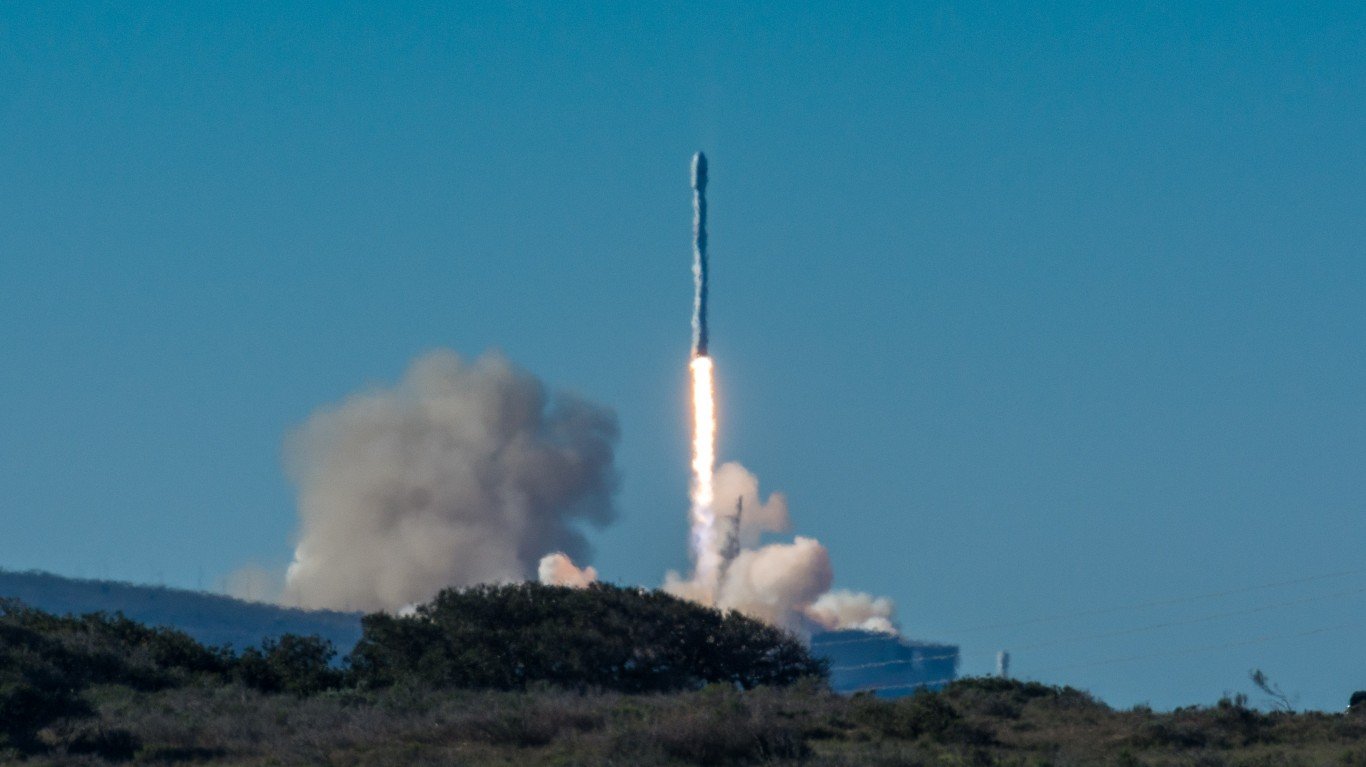
The huge advantage “Space” has now is that its technology and market share have built a massive “moat.” Its launches will hit as many as 200 this year. If founder Elon Musk is right, the figure will grow to 300 or more in 2027.
Amazon’s Jeff Bezos, Blue Origin has tried to catch up to “Space”, and it has posted failure after failure. NASA has nowhere else to turn, because no US company has the capacity, even if they can build mediocre rockets. The Chinese have had some success, but the chance that other nations, or large companies that need rockets, will turn to it is close to zero.
Musk can argue that his Starlink has 11,200 satellites. However, on the ground, the traditional cellular providers in the US, led by T-Mobile (NASDAQ: TMUS), AT&T (NYSE: T), and Verizon (NYSE: VZ), have plans to keep their customers. Similar plans exist among the largest cellular providers in every developed country. Does Starlink take market share from these? Probably some, but at what cost?
“SI”’s Grok has no chance of catching OpenAI, Anthropic, or even Google’s Gemini. That leaves Musk to lease server capacity to his competitors. Is it a good business? Yes, it is a great way to make money, but Musk has begun to give up being a player. As the New York Times recently reported, “Mr. Musk’s SpaceX is renting out computing power from its data centers to competitors, including Anthropic. That’s making it harder for his own A.I. effort.”
“Space” is not doing as well on paper as the other two SpaceX businesses. In the most recently reported quarter, it had revenue of $1.8 billion, which was barely up year over year. Adjusted EBITDA was $367 million, down from $674 million a year ago.
SI had revenue of $7.6 billion, up from $813 million a year ago. Adjusted EBITDA was $5 billion, up from a loss of $458 million; leasing servers is a good deal. However, capex will remain huge in the billions of dollars.
“Connectivity” is a great business. It has revenue of $5.2 billion, up from $3.1 billion a year ago. Adjusted EBITDA was $2.4 billion, up from $1.2 billion.
Starlink has to contend with legacy cellular companies. SI has to compete with much more successful AI companies. Space doesn’t have any competition at all.
Contact [email protected] for any questions or corrections.
Douglas A. McIntyre is the co-founder, chief executive officer and editor in chief of 24/7 Wall St. and 24/7 Tempo. He has held these jobs since 2006.
McIntyre has written thousands of articles for 24/7 Wall St. He is an expert on corporate finance, the automotive industry, media companies and international finance. He has edited articles on national demographics, sports, personal income and travel.
His work has been quoted or mentioned in The New York Times, The Wall Street Journal, Los Angeles Times, The Washington Post, NBC News, Time, The New Yorker, HuffPost USA Today, Business Insider, Yahoo, AOL, MarketWatch, The Atlantic, Bloomberg, New York Post, Chicago Tribune, Forbes, The Guardian and many other major publications. McIntyre has been a guest on CNBC, the BBC and television and radio stations across the country.
A magna cum laude graduate of Harvard College, McIntyre also was president of The Harvard Advocate. Founded in 1866, the Advocate is the oldest college publication in the United States.
TheStreet.com, Comps.com and Edgar Online are some of the public companies for which McIntyre served on the board of directors. He was a Vicinity Corporation board member when the company was sold to Microsoft in 2002. He served on the audit committees of some of these companies.
McIntyre has been the CEO of FutureSource, a provider of trading terminals and news to commodities and futures traders. He was president of Switchboard, the online phone directory company. He served as chairman and CEO of On2 Technologies, the video compression company that provided video compression software for Adobe’s Flash. Google bought On2 in 2009.