Trump Just Floated Taking a Stake in Nvidia. An Intel-Style Deal Could Be Worth $380 Billion

This post may contain links from our sponsors and affiliates, and Flywheel Publishing may receive compensation for actions taken through them.

Washington is rewriting the rules of American capitalism. After decades of using tax breaks, subsidies, and government contracts to support strategically important industries, the federal government is increasingly interested in becoming a shareholder in the businesses it helps.
For investors, government ownership introduces a new variable into the investment equation. Uncle Sam has priorities that don’t always align with those of Wall Street, particularly when national security and economic competitiveness are involved.
Now President Donald Trump is entertaining the possibility of taking a government stake in Nvidia (NASDAQ:NVDA | NVDA Price Prediction). Applying the same ownership model Washington used with another American chipmaker could result in a government holding worth $380 billion.
Washington Wants a Piece of the AI Boom
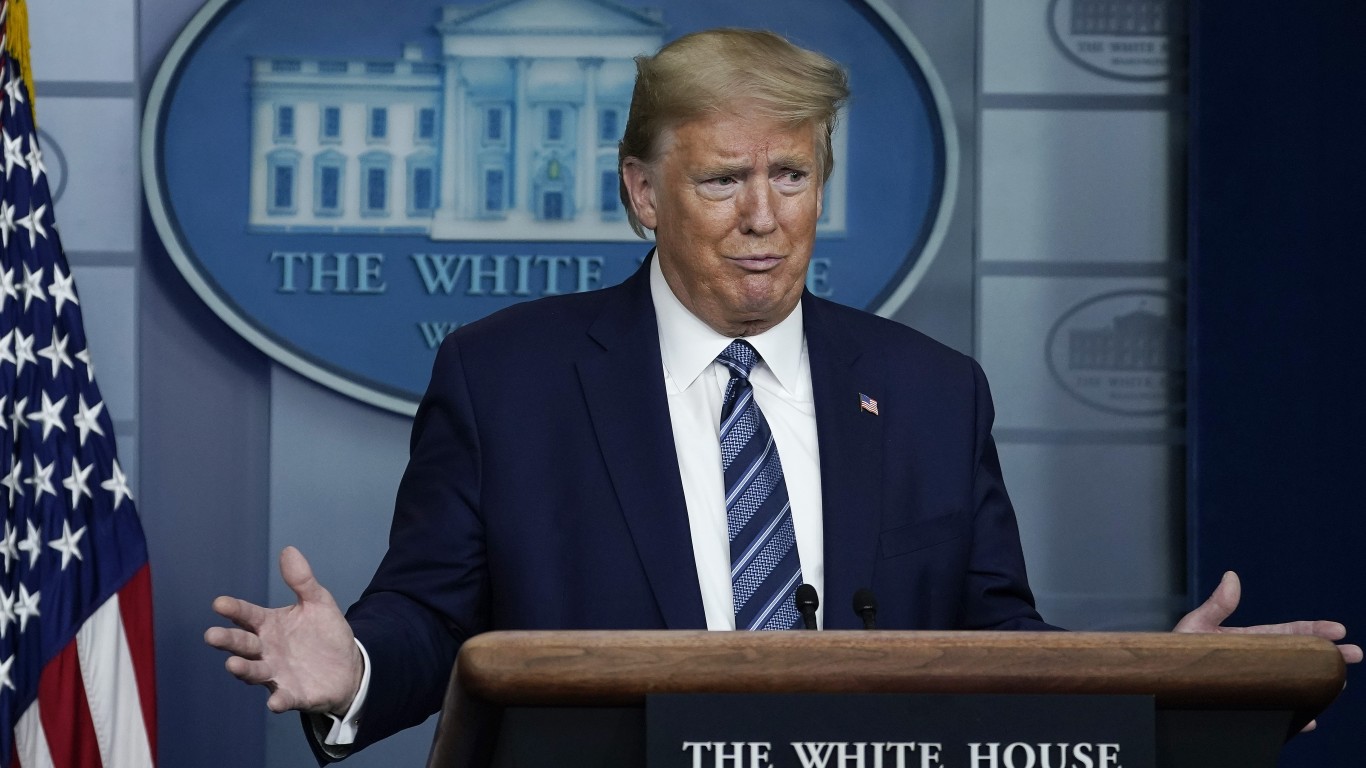
In an interview with the New York Post yesterday, Trump acknowledged he had considered having the federal government acquire Nvidia stock, saying, “Maybe I should do it.” Although he hasn’t raised the issue with the company, he added, “It’s probably not too late.”
The comments follow Trump’s intervention in Jensen Huang’s return as Nvidia CEO, underscoring how closely Washington now ties America’s artificial intelligence (AI) leadership to the fortunes of one corporation.
There is already a blueprint for such an investment. In August 2025, the Trump administration secured a 9.9% ownership stake in Intel (NASDAQ:INTC) in exchange for $8.9 billion. The investment comprised $5.7 billion in previously awarded CHIPS Act grants and $3.2 billion earmarked for the government’s Secure Enclave program.
Washington received 433.3 million shares priced at $20.47 each, though the agreement didn’t give the government board representation.
With Nvidia valued at approximately $3.8 trillion based on Tuesday’s closing share price, a comparable 10% equity stake would be worth $380 billion — nearly 43 times the original Intel investment.
Even a 1% ownership position would represent $38 billion.
Nvidia Doesn’t Need Uncle Sam’s Money
Unlike Intel, which required capital to expand its domestic semiconductor manufacturing capabilities, Nvidia is practically printing money.
According to Nvidia’s third-quarter earnings release last week, revenue more than doubled from the prior year to $115.8 billion, while free cash flow reached $43.8 billion. The chipmaker generated $113.7 billion in free cash flow through the first nine months of fiscal 2027. It also has $227.3 billion remaining under its stock repurchase authorization.
Ironically, Nvidia has been spending billions reducing its share count, while an Intel-style transaction involving newly issued stock would increase it.
If Washington received newly issued shares representing 10% of Nvidia’s expanded share count, existing shareholders would see their ownership percentage diluted by 10%. Whether that reduced the value of their holdings would depend on how much Nvidia received in exchange.
Alternatively, the government could purchase existing shares without diluting shareholders, though the money would go to selling investors rather than Nvidia.
The Intel investment demonstrated how taxpayers could participate in a company’s recovery. Nvidia, however, would be an entirely different proposition. Washington would be acquiring a piece of an already enormously profitable business.
The Government’s Competing Interests
Government ownership could benefit Nvidia by strengthening its relationship with Washington and supporting the development of America’s AI infrastructure.
Yet the federal government also determines which advanced AI chips Nvidia can sell overseas. Nvidia’s fiscal fourth-quarter revenue forecast of $130 billion assumes no sales of data center computing products to China.
A government equity stake would give Washington a financial interest in the very business whose commercial activities it regulates.
That could create competing priorities. Restricting exports to protect national security could reduce Nvidia’s profits and the value of taxpayers’ investment. Conversely, relaxing those restrictions could benefit shareholders while raising security concerns.
Trump’s own disclosed investments in Nvidia are a separate issue, but illustrate how financial and political interests can become intertwined.
Key Takeaway
Trump hasn’t proposed formal terms for a Nvidia investment, and $380 billion represents the potential value of a hypothetical stake, not an announced expenditure.
Investors shouldn’t buy Nvidia stock expecting Washington to provide a financial safety net. Instead, watch whether any eventual agreement involves discounted shares, new stock issuance, or special government voting rights.
Nvidia’s ability to generate tens of billions of dollars in quarterly profits remains its biggest attraction. Having Uncle Sam as a fellow shareholder wouldn’t necessarily make it a better investment.
Contact [email protected] for any questions or corrections.
After two decades of patrolling the dark corners of suburbia as a police officer, Rich Duprey hung up his badge and gun to begin writing full time about stocks and investing. For the past 20 years, he’s been cruising the markets looking for companies to lock up as long-term holdings in a portfolio while writing extensively on the broad sectors of consumer goods, technology, and industrials. Because his experience isn’t from the typical financial analyst track, Rich is able to break down complex topics into understandable and useful action points for the average investor. His writings have appeared on The Motley Fool, InvestorPlace, Yahoo! Finance, Money Morning, and, of course, 24/7 Wall St. He has been featured in both U.S. and international publications, including MarketWatch, Financial Times, Forbes, Fast Company, and USA Today.