This Is Why I Wouldn’t Ignore This Stock Heading Into 2027

This post may contain links from our sponsors and affiliates, and Flywheel Publishing may receive compensation for actions taken through them.
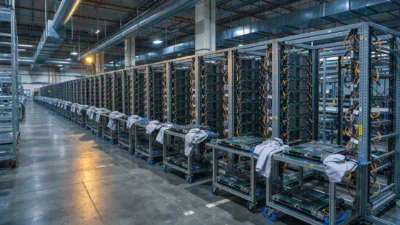
Broadcom (NASDAQ:AVGO | AVGO Price Prediction) has become the chip partner that frontier AI labs turn to when they want silicon built around their own models.
Last quarter it shipped Jalapeno, OpenAI’s first-generation custom accelerator[1], and began production shipments of TPU version 8i to Google. CEO Hock Tan summed up the thesis: “When you co-develop a chip that is optimized for your particular large language model workloads, you will outperform any GPU.”[1]
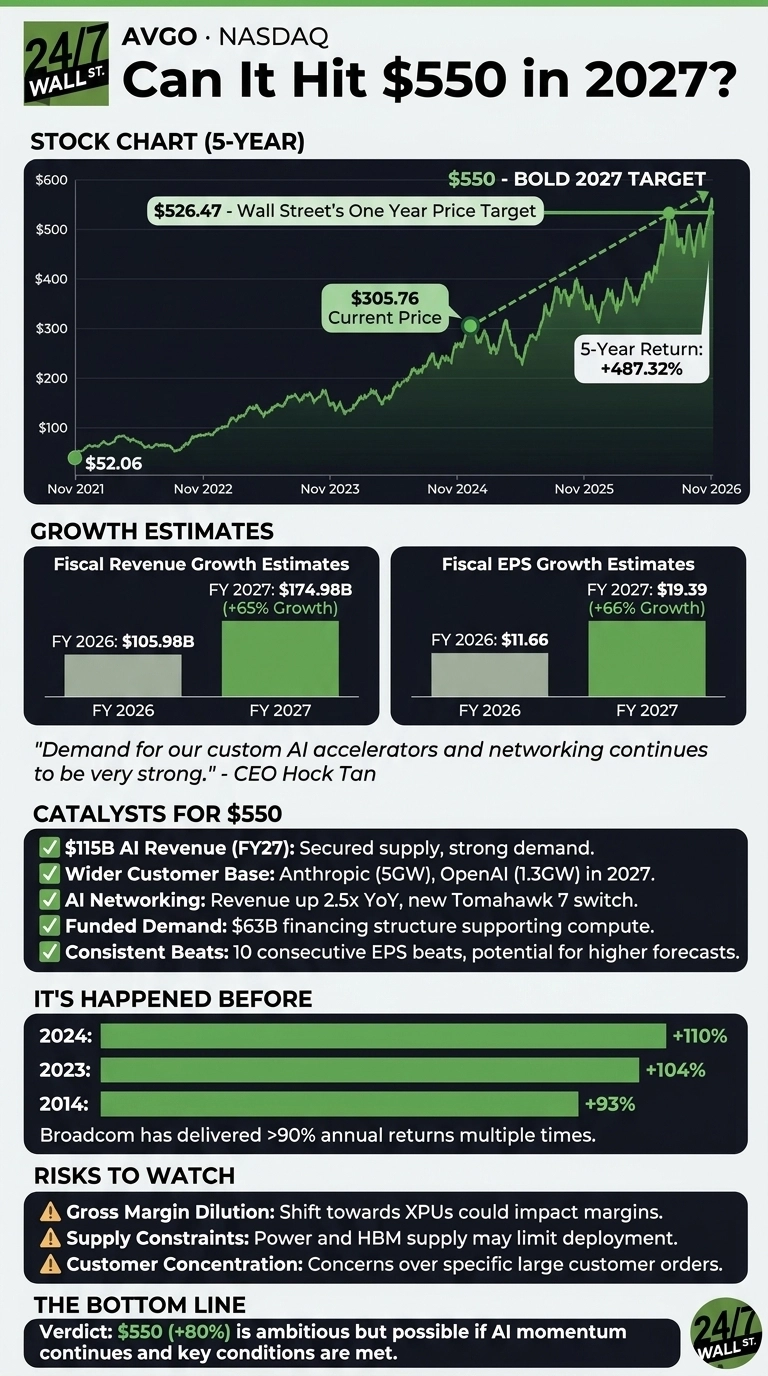
The stock has fallen behind the business. Shares are down 11.17% year-to-date at $305.76, including an 11.89% slide in the past week after a Barron’s report that Google is cutting AI chip shipments. Over five years, shares are still up 487.32%. To hit $550 in 2027, Broadcom needs to do the following.

Wall Street Sees 72% Upside Even After the Sell-Off
The average analyst price target is $526.47, which implies 72% upside. Analysts have issued 8 Strong Buy and 41 Buy ratings, against 2 Holds and zero Sells.

That optimism comes from the growth outlook. Analysts expect fiscal 2027 EPS of $19.386, up from $11.6644 in fiscal 2026. That works out to 66% growth, with revenue forecast to rise 65%.
Over the past 30 days, analysts made 2 upward revisions and zero downward revisions to fiscal 2027 estimates.
Here’s What It Takes for Broadcom to Reach $550
Right now, Broadcom trades at roughly 16x fiscal 2027 earnings. At $550, that multiple would rise to about 28x. That multiple is well below the 66% earnings growth expected in a year.
Recent results support the forecast: fiscal Q3 revenue rose 85.5%[2] to $29.591B, and AI semiconductor revenue climbed 221% to $16.7B.
What Could Push Broadcom to $550?
- A $115 billion AI year: Management expects fiscal 2027 AI semiconductor revenue of about $115 billion[1] and says the supply to deliver it is already secured. Tan added, “Our customers want us to ship more.”[1]
- A wider customer base: Anthropic is expected to use 5 gigawatts of TPU version 8i in 2027[1]. OpenAI’s Jalapeno is on track for 1.3 gigawatts in 2027[1]. Tan puts Broadcom’s content at $20 billion to $30 billion per gigawatt[1]. Customers beyond Google reduce the impact of any single order cut.
- Networking: AI networking revenue rose over 2.5x year-over-year[1], and Broadcom has taped out Tomahawk 7, the industry’s first 200-terabit-per-second Ethernet switch.
- Funded demand: Bank of America, Blackstone, Citi and Morgan Stanley announced a $63 billion financing structure[3] to support compute capacity built with Broadcom.
- A beat run: Broadcom has beaten EPS estimates for 10 straight quarters, so actual results could top today’s forecasts. The next test is the December 9[3] earnings report, which follows Q4 guidance of $34.8B[2] in revenue.
Past Returns Show an 80% Gain Is Within Reach
Hitting $550 requires a gain of about 80%. Broadcom has cleared that bar three times since 2010.
Shares returned 93% in 2014, 104% in 2023 and 110% in 2024. With a market cap near $1.46 trillion, gains like that are harder to repeat, but the stock has done it before at a large size.

My Take on Broadcom at $550
Hitting $550 would take an 80% rally in 2027. That’s ambitious. Still, the Street already sees 72% upside, earnings are forecast to grow 66%, and management has laid out a path to $115 billion in AI revenue.
The risks are real: gross margin dilution from the shift toward XPUs, constraints on power and HBM supply, and questions about Google’s orders.
Broadcom is one way to play the expansion, though the suppliers of power, cooling, and networking around these chips matter just as much (we covered seven of them in a free AI infrastructure report here). Oversized returns are rare at this level, but this is how Broadcom could deliver them in 2027.
Contact [email protected] for any questions or corrections.
Vandita Jadeja is a financial publisher with over a decade of experience writing about financial topics, including investment, savings, retirement, insurance and banking. Vandita is a Chartered Accountant who loves to debunk financial concepts for readers.
Her work has appeared on sites that include The Motley Fool, InvestorPlace, and Benzinga. She covers investing and focuses on stock picks and price prediction for 24/7 Wall St.
When not looking for the next stock investment opportunity, she can be found traveling, reading, chasing sunsets and enjoying her iced latte.