A Magnificent Seven Stock Has a Surprising Path to New Highs

This post may contain links from our sponsors and affiliates, and Flywheel Publishing may receive compensation for actions taken through them.

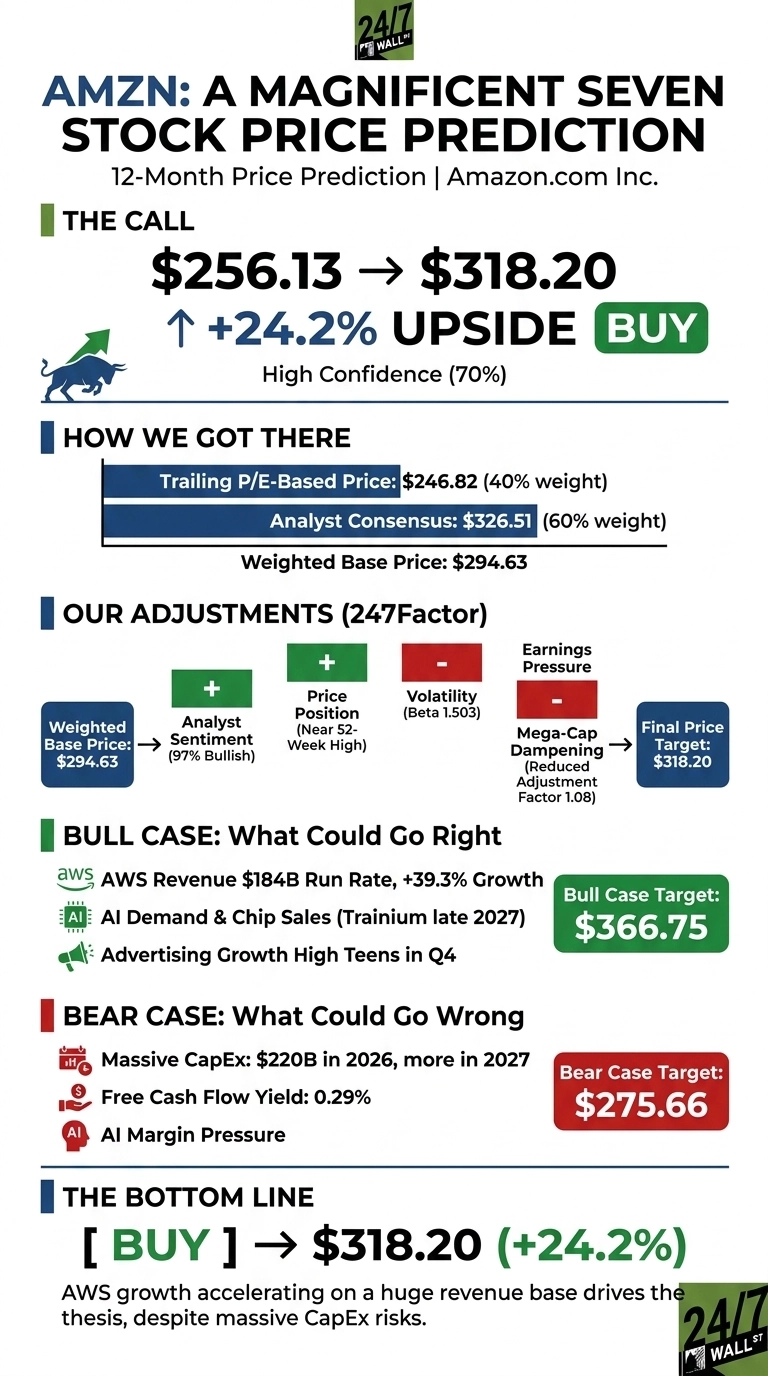
Amazon (NASDAQ:AMZN | AMZN Price Prediction) has spent much of 2026 weighed down by its own spending plans. Its path to new highs runs through Amazon Web Services (AWS). Amazon trades at $256.13 in midday trading. Our 24/7 Wall St. price target of $318.20 for the next 12 months means 24.2% upside.
24/7 Wall St. Price Target Summary
| Metric | Value |
|---|---|
| Current Price | $256.13 |
| 24/7 Wall St. Price Target | $318.20 |
| Upside/Downside | 24.2% |
| Recommendation | BUY |
| Confidence Level | 70% |
Our target sits above the $287.20 52-week high, so reaching it would mean new highs for the stock. The model rates the stock a buy with fairly high confidence.
AWS growth has now accelerated for the sixth straight quarter[1], and management expects that segment to grow north of 40% in each of 2027 and 2028. Our confidence is lower than it would otherwise be because of how much Amazon is spending to build that capacity.

Record Margins Get Lost in a Choppy November
Shares rose 3.77% today, which only partly offsets a 3.95% drop over the past week and a 2.38% decline over the past month. The stock is up 10.97% year to date and sits 10.8% below its high. That pullback came as the Nasdaq slid sharply. Separately, Jeff Bezos donated Amazon stock over two days.
Third-quarter results fell just short of expectations. EPS of $1.89[2] missed the $1.9579 estimate, and revenue of $201.94 billion missed the $202.20 billion estimate.
Moving Prime Day into the second quarter cut third-quarter growth by roughly 400 bps[2]. Even so, operating income rose 61.15%[2] to $28.08 billion, and the 13.9% operating margin was the highest in Amazon’s history.
Why Bulls See $366.75 and Beyond
AWS now runs at a $184 billion[1] annual revenue rate and has a $578 billion backlog. Token volume on Bedrock, AWS’s AI model platform, grew nearly 17x[1] from a year earlier. Amazon plans to start selling its Trainium AI chips to outside buyers in late 2027[1].
Management also expects advertising growth to return to the high teens[2] in the fourth quarter. CEO Andy Jassy said “In AWS, our plan is working.”[1]
Of the analysts covering the stock, 16 rate it Strong Buy, 43 rate it Buy, and only 2 rate it Hold. Under the most optimistic scenario, the stock reaches $366.75.

Capex Is the Risk Worth Watching
Capital spending is expected to reach about $220 billion[2] in 2026, and management plans to spend meaningfully more in 2027[1]. Free cash flow fell 65.95%[3] in 2025, and the stock’s free cash flow yield is just 0.29%.
AI also makes lower margins than AWS’s core business, though all that spending flows straight through to the power, cooling, and networking suppliers behind the data centers (we covered seven of them in a free report on the AI infrastructure buildout).
Meanwhile, operating cash flow grew 19.41%[2] to $42.42 billion. Jassy said “We can fund this plan.”[1] Even under the most conservative scenario, the stock reaches $275.66.
How Amazon Compares to Its Cloud Peers
| Company | P/E | Cloud Growth |
|---|---|---|
| Amazon | 20 | 39%[2] |
| Microsoft (NASDAQ:MSFT) | 27 | 48% |
| Alphabet (NASDAQ:GOOGL) | 12 | 103% |
Microsoft goes here because Azure competes directly with AWS. Microsoft’s cloud arm posted 48% growth, and its commercial backlog reached $677 billion, yet its P/E is higher than Amazon’s.
Alphabet shows how the same AI spending can strain cash: Google Cloud grew 103%, but free cash flow was -$9.065 billion last quarter. Amazon trades at a forward P/E of 23. Against that group, our target looks reasonable.
Amazon Earns Its BUY Rating
The 24/7 Wall St. price target is $318.20, with a buy rating and 70% confidence. The key factor is that AWS growth keeps accelerating on an already huge revenue base.
I would view the stock favorably if AWS keeps growing near 40% and its margins hold. A larger rise in 2027 spending without a matching increase in operating income would make me more conservative. For now, the numbers support the bulls.
Further out, here is where our model projects Amazon could trade if current growth and market conditions hold.
| Year | 24/7 Wall St. Price Target |
|---|---|
| 2026 | $249.70 |
| 2027 | $311.51 |
| 2028 | $370.25 |
| 2029 | $426.01 |
| 2030 | $474.65 |
These projections depend on Amazon continuing to execute its current strategy. Outside chip sales could lift results well above them, while a slowdown in AI spending could drag them well below.
Contact [email protected] for any questions or corrections.
Vandita Jadeja is a financial publisher with over a decade of experience writing about financial topics, including investment, savings, retirement, insurance and banking. Vandita is a Chartered Accountant who loves to debunk financial concepts for readers.
Her work has appeared on sites that include The Motley Fool, InvestorPlace, and Benzinga. She covers investing and focuses on stock picks and price prediction for 24/7 Wall St.
When not looking for the next stock investment opportunity, she can be found traveling, reading, chasing sunsets and enjoying her iced latte.