Western Digital Plummted 20% in The Last 3 Months: Two Wall Street Ratings Firms Expect Nearly 130% Returns Within 12 Months
A Toshiba supply rumor torched Western Digital shares even as the company posted record results and raised guidance, and now two Wall Street firms are betting the selloff created one of the biggest buying opportunities in the storage sector.


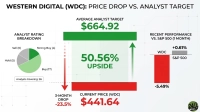
Western Digital (NASDAQ:WDC | WDC Price Prediction) currently trades at $396.42, while the average analyst price target sits at $613.38. That gap implies 54.73% upside.
After separating its Flash business into Sandisk (NASDAQ:SNDK) in February 2025, the company is a pure-play hard disk drive maker. Its high-capacity nearline drives hold the training data, inference logs and video that AI systems generate, and hyperscalers have been taking in every exabyte it ships.
The implied upside tops 40%, and some analysts see far more. Cantor Fitzgerald and Robert W. Baird both hold $900 targets, implying 127.03% upside.
A Toshiba Supply Scare Overpowered Record Results
Fear of new supply drove the drop. A report that Toshiba plans to expand hard drive capacity sent Western Digital and Seagate Technology (NASDAQ:STX) sharply lower in a single session as investors read it as a sign of new supply, feeding worries that the hard-drive shortage will ease. Shares are down 14.45% over three months and 12.53% over the past month.
Earnings did little to stop the slide. Fiscal Q1 adjusted EPS of $4.64 beat the $4.0771 consensus, and revenue rose 55.46% to $4.381 billion. Barron’s summed it up: the earnings failed to get the stock back on track. The selloff hit the whole hard drive group, which points to an industrywide repricing of the pricing cycle.
Analysts Argue the Pricing Cycle Has Years Left
Pricing power within a tight HDD duopoly supports the optimistic view. Cost per terabyte rose 28% year over year, and the CFO said “there is definitely further room for ASP per terabyte increases going forward over the next, call it, three, four quarters.” Fiscal Q2 guidance calls for revenue of $5.1 billion, plus or minus $100 million, gross margin of 60%–61%, and EPS of $5.80, plus or minus $0.20.
Visibility is the second factor. Management says it has “good visibility up to 2030, 2031” across its top seven customers. Near-term drivers include HAMR qualifications with two hyperscalers in the first quarter of calendar 2027, volume shipments in the first half of calendar 2027, and the 40TB ePMR platform reaching 50% of nearline shipments by fiscal Q3.
Coverage stays bullish. Of 26 analysts, 4 rate it Strong Buy, 17 Buy, 5 Hold and zero Sell. Cantor raised its target in mid-2026 and has since repeated it, and Melius Research sits even higher at $1,050 based on 2028 financials. Skeptics note that each of those targets assumes Toshiba’s added capacity fails to dent pricing.
Seagate Fell Harder While NetApp Missed the Selloff
Hard drive makers dropped together. The broader storage group did not.
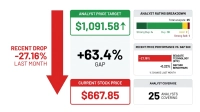
Seagate dropped 24.26% over the past month to $697.97. Its $1,091.58 average target implies 56.39% upside, with 4 top ratings, 18 positive, 2 neutral and 1 bearish rating. That upside roughly matches Western Digital’s.
NetApp (NASDAQ:NTAP) gained 9.66% over the month to $223.66, above its $211.69 average target, implying 5.35% downside. Holds dominate, at 12 versus 8 Buy or Strong Buy ratings.
Seagate carries the most implied upside, slightly ahead of Western Digital. Both drive makers are being priced for the same supply risk.
Triple-Digit Gains This Year Despite the Pullback
At $396.42, Western Digital carries 54.73% implied upside to the $613.38 consensus from 26 analysts. It is well off its 52-week high of $799.61 and trades at about 17 times forward earnings.
The stock is still up 130.37% year to date after the drop, while the S&P 500 has gained 13.26%. Over the past month, the index rose 0.88% as Western Digital fell 12.53%. Price targets are one input, and they lag sentiment shifts whichever way they go.
Pricing Power Decides Whether $900 Is Realistic
The thesis strengthens if price per terabyte keeps climbing through calendar 2027 and HAMR ships on schedule. Hitting the Q2 guide while margins move past 60% would support that case.
The bear case gains weight if Toshiba’s expansion turns into price cuts. Cloud makes up 88% of revenue, so a hyperscaler slowdown would reach the income statement quickly.
Recent execution supports the upbeat thesis. The company beat estimates for a sixth consecutive quarter and guided higher, while the market is responding to supply that has yet to arrive. Keep an eye on pricing commentary in the next earnings report. If price per terabyte holds up, the average target looks more reachable than the $900 calls.
Contact [email protected] for any questions or corrections.
Alex Sirois is a financial writer with experience spanning both retail and institutional investing. He has written for InvestorPlace and held roles at BNY Mellon and Bernstein, giving him a perspective that bridges Main Street portfolios and Wall Street analysis.
Alex holds an MBA from George Washington University and has built his career across multiple industries, including e-commerce, education, and translation — a breadth of experience that informs how he breaks down complex financial topics for everyday investors. His writing is conversational, actionable, and grounded in long-term, buy-and-hold investing principles.
At 247 Wall St., Alex focuses on delivering analysis that is both accessible and useful, with a clear emphasis on helping readers make more informed decisions with their money.