This AI Investing Prodigy Lost 65% in a Single Quarter and Is Still Up 88.5% in 2026. Here’s the Lesson for Investors.

This post may contain links from our sponsors and affiliates, and Flywheel Publishing may receive compensation for actions taken through them.

Leopold Aschenbrenner worked at OpenAI before he founded Situational Awareness. His 2024 essay of the same name forecasted heavy spending on AI chips, memory and electricity. He has now told investors that his hedge fund lost 65% after fees in Q3 2026 and was still up 88.5% year to date through September. Margin calls nearly sank the fund earlier in the year. His record shows that a correct call on AI does not protect a portfolio that is too large or too leveraged to survive the swings.
How a 439% Gain Shrank to 88.5% in One Quarter
In early July, Situational Awareness was up 439% for the year. Before the sell-off, its assets reportedly reached $45 billion. The fund had borrowed from brokers to make its positions bigger. When AI stocks fell, it sold its public stock portfolio to Citadel at a discount on July 29, according to reporting based on the Financial Times. In a letter to investors, Aschenbrenner wrote: “These setbacks have cost us dearly, but I intend to do everything I can to ensure that they become invaluable lessons for our organization and for me personally as we move forward.” He promised the fund would stop borrowing from banks to increase its positions.
Recovering from a large loss requires a much larger gain. After a 65% drop, an investor needs a 185.7% gain just to get back to even. An investor who avoids the drop keeps compounding from a much higher starting point.
Correct AI Calls Still Left the Fund Exposed
The businesses behind the AI idea kept getting stronger. Micron Technology (NASDAQ:MU | MU Price Prediction) reported fiscal Q4 revenue of $54.23 billion, up 379.3% YoY[1]. Its non-GAAP EPS of $33.42[1] beat the $31.35 consensus. On the earnings call, President Manish Bhatia said, “We made the statement that we really don’t have line of sight to when supply and demand balance.”[2] SanDisk (NASDAQ:SNDK) grew fiscal Q1 revenue 377.9%[3] to $11.03 billion, and its datacenter sales rose 61% sequentially. Bloom Energy (NYSE:BE) raised its full-year guidance for a third time after Q3 revenue climbed 138.1%.
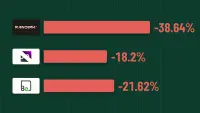
The stocks fell anyway. Over the past month, Micron went down 33.47%, SanDisk dropped 53.1% and Bloom fell 25.02%. Borrowed money turns swings like these into forced selling.
What Aschenbrenner’s Latest 13F Reveals
Funds file a 13F every quarter to list their U.S. stock holdings. Situational Awareness filed its 13F for the quarter ended September 30 on November 16. It reported holdings of $1,577,454,028. The fund sold its common stock in Micron, Taiwan Semiconductor Manufacturing (NYSE:TSM) and Core Scientific (NASDAQ:CORZ). It held call options on Bloom covering 1,405,000 shares, on Nebius Group (NASDAQ:NBIS) covering 1,410,000 shares and on SanDisk covering 105,000 shares. A 13F does not show option strike prices or what the fund paid for the options, so their real weight in the portfolio is unknown.
TSMC’s October revenue rose 59.7% YoY, and its shares are up 13.52% in 2026. Nebius grew Q3 revenue 571.3%[4]. It also plans about $27 billion[4] of capital spending in 2026 and does not expect to break even before taxes until Q4 2027. Its stock has fallen 44.55% in a month. Core Scientific, which rents data center capacity to major AI cloud and chip customers, has more than $24B[5] of signed revenue still to collect. It also carries $4.3 billion[5] of long-term debt and a $1.09 billion stockholders’ deficit. Its shares are down 25.69% year to date. The power, cooling, and data center suppliers behind this expansion are the same names we profiled in a free report on seven AI infrastructure stocks that aren’t chipmakers.
Borrow the Ideas, Skip the Margin
Warren Buffett has long stressed protecting capital, being patient, and avoiding heavy borrowing. Aschenbrenner, by contrast, reportedly believes today’s opportunities offer the highest potential returns in his fund’s history. Investors can act on both ideas at once. Someone who owned Micron without borrowing is still up 110.83% in 2026, and a SanDisk holder is up 148.07%.
Spreading money across several holdings, keeping each position small enough to ride out a deep drop, and paying attention to valuation let investors stay in the AI trade without risking ruin. Upcoming reports to keep an eye on:
- Micron’s fiscal Q1 revenue guidance of $61.5 billion ± $1.5 billion[1]
- SanDisk’s fiscal Q2 revenue outlook of $12.2 billion to $12.6 billion[3]
- Nebius’ 2027 revenue outlook of $12 billion to $13 billion[4]
The aim is to build wealth over decades. Investors can use Aschenbrenner’s ideas without copying his use of borrowed money.
Contact [email protected] for any questions or corrections.
After two decades of patrolling the dark corners of suburbia as a police officer, Rich Duprey hung up his badge and gun to begin writing full time about stocks and investing. For the past 20 years, he’s been cruising the markets looking for companies to lock up as long-term holdings in a portfolio while writing extensively on the broad sectors of consumer goods, technology, and industrials. Because his experience isn’t from the typical financial analyst track, Rich is able to break down complex topics into understandable and useful action points for the average investor. His writings have appeared on The Motley Fool, InvestorPlace, Yahoo! Finance, Money Morning, and, of course, 24/7 Wall St. He has been featured in both U.S. and international publications, including MarketWatch, Financial Times, Forbes, Fast Company, and USA Today.