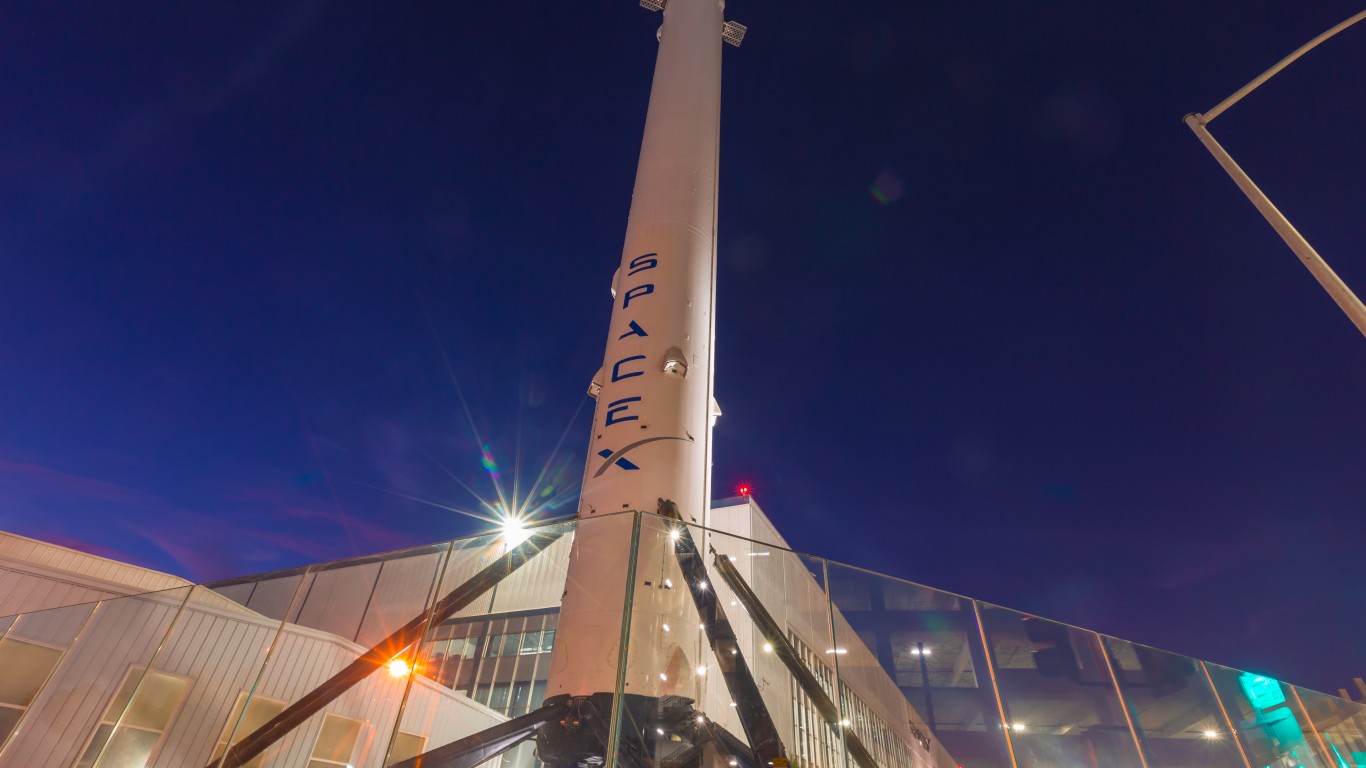
Anterix and NextNav Stocks Soar as SpaceX Goes Spectrum Shopping

This post may contain links from our sponsors and affiliates, and Flywheel Publishing may receive compensation for actions taken through them.
Two small spectrum companies that rarely trade on the same news both rose on November 27, 2026. Anterix (NASDAQ:ATEX) closed at $83.67, up 10.57%, and NextNav (NASDAQ:NN) closed at $9.47, up 14.51%.
Bloomberg reported that SpaceX (NASDAQ:SPCX | SPCX Price Prediction) is eyeing Anterix’s 900 MHz licenses to expand its direct-to-device service, which lets ordinary phones connect to satellites. The report said SpaceX could instead buy NextNav’s 900 MHz spectrum.
No offer, deal or price exists. If you hold either stock, the question is how much of a buyer’s apparent interest is already in the price.
The public record shows SpaceX and Anterix moving toward each other. On August 11, Anterix publicly backed a SpaceX FCC filing seeking satellite direct-to-device expansion options in its 900 MHz band.
On October 29, 2026[1], the FCC advanced a proposal to modify its Supplemental Coverage from Space rules, the framework that lets satellites use spectrum assigned to ground networks, including consideration of the 900 MHz band.
Why Low-Band Airwaves Suit Phone-to-Satellite Service
Anterix, a small New Jersey company, is the largest U.S. holder of 900 MHz licenses, mostly leased to utilities for grid networks, with only about 15% of its holdings in use.
Low frequencies travel further and pass through buildings better, which matters when the transmitter is a satellite in orbit. CEO Scott Lang said on the last earnings call, “Licensed low-band spectrum is hardest to come by, and we have it.”
The FCC voted February 18, 2026, to expand Anterix’s broadband band from 6 MHz to 10 MHz. In April, the CFO valued that asset at roughly $2.5 billion to over $7 billion, against a $1.65 billion market value.
Anterix executive Chris Guttman-McCabe said the company is talking to “all the right parties” and that unused spectrum could triple in value with the right buyer.
SpaceX Has Bought Spectrum Twice Before
On September 8, 2025, SpaceX agreed to buy EchoStar (NASDAQ:SATS) AWS-4 and H-block licenses for about $17 billion, half in cash and half in stock. On October 8, 2026, it agreed to buy Grain Management’s nationwide 800 MHz licenses on undisclosed terms, with press reports putting the price near $8 billion.
Grain had paid T-Mobile (NASDAQ:TMUS) $2.9 billion in cash plus 600 MHz spectrum for that portfolio in August 2026. SpaceX expects that deal to close in the first half of 2027.
SpaceX closed at $133.59, up 4.8% from Wednesday but below its $135 June IPO price.
FCC decisions on giving Anterix’s spectrum a satellite designation could limit its use for direct-to-device service. Opposition to the SpaceX and Grain deal is due December 8.
A media report carries no price, and another buyer or no buyer remains possible. Both companies last reported on November 10[2].
What Anterix’s Price Already Assumes About a SpaceX Deal
Anterix has risen about 283% this year from $21.83 at the end of 2025, although it remains below its $108.21 record close on July 1. Its market value sits under the low end of the CFO’s range, but that range is the company’s own estimate.
Anterix’s position has strengthened because the FCC expansion is complete, the iPhone 18 Pro and iPhone Duo now support Band 106, and the company has no debt and $107.47 million[1] in cash.
NextNav is the riskier alternative. It is down about 43% this year from $16.64 and about 60% below its June 4 close of $23.59, and its value still depends on a pending FCC petition for 5G positioning.
Check Anterix against its $67.37 close on November 20. A drop back below that level before December 8 would mean the market has written off a SpaceX deal.
Contact [email protected] for any questions or corrections.
Omor Ibne Ehsan is a writer at 24/7 Wall St. He is a self-taught investor with a focus on growth, cyclical, and dividend equities that have strong fundamentals, value, and long-term potential. He also has an interest in high-risk, high-reward investments such as penny stocks.