The Real Satellite Race Isn’t About Rockets — It’s About Who Controls the Spectrum in Your Phone
The satellite race everyone is watching plays out on launchpads, but the contest that determines who profits runs through a far less visible battlefield: the radio frequencies fighting to reach the phone in your pocket.

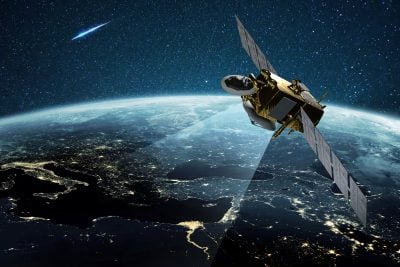
Wall Street loves a rocket, but the real satellite race is being fought in radio waves. As of September 2026, the FCC has authorized Supplemental Coverage from Space, unlocking a new category where orbital constellations beam service directly into ordinary handsets. Four public names now define the competitive map, and one downstream beneficiary sits at the center of it. Rankings below reflect exposure to the spectrum-plus-partnership advantage that will decide who owns the connection between orbit and the phone in your pocket.
1. AST SpaceMobile (ASTS): Pure-Play Leader on Handset Compatibility
AST SpaceMobile (NASDAQ:ASTS) is the only company built solely to connect unmodified smartphones to satellites. Management has assembled over 60 MNO partners covering more than 3 billion subscribers, is on a path to roughly 100 MHz of U.S. spectrum, and can tune 1,150 MHz across low and mid-band frequencies. Q2 2026 revenue was $31.52 million, up 2,626.6% year over year, with FY26 guidance reaffirmed at $150M to $200M and backlog of $1.30 billion. CEO Abel Avellan stated, “Spectrum is like fuel for our business.” Shares are up 48.85% over the past year despite a 14.21% year-to-date pullback. Beta service is targeted for later this year. No competitor matches the depth of MNO integration.
2. SpaceX (SPCX): Incumbent With a Landmark Spectrum Grab
SpaceX (NASDAQ:SPCX | SPCX Price Prediction) secured FCC approval of the EchoStar license transfer, delivering 65 MHz of U.S. spectrum plus global Mobile Satellite Service licenses. Management called it “a foundational competitive advantage for Starlink Mobile” and plans to integrate the spectrum after launching Mobile V2 satellites later next year. Q2 revenue reached $7.81 billion, up 92%, with connectivity contributing $4.29 billion and Starlink subscribers doubling to 12.0 million. New Starlink Mobile relationships with SoftBank, NTT Docomo, and Spark New Zealand extend the carrier footprint. Cash of $93.52 billion and backlog of $47.50 billion give SpaceX unmatched firepower to build the terrestrial layer needed to activate the EchoStar bands.
3. Rocket Lab (RKLB): Vertical Integration Through Iridium
Rocket Lab (NASDAQ:RKLB) is transforming from launch provider to full-stack space power. The pending Iridium acquisition adds 66 satellites, 2.5 million subscribers, and more than $870 million in annual revenue. Peter Beck emphasized the strategic value of L-band spectrum: “rain- and weather-penetrating, indoor-penetrating spectrum, because not all spectrum is the same.” Q2 revenue rose 62% to $234.07 million, backlog climbed 137% to $2.36 billion, and the company holds $2.13 billion in cash. Iridium’s L-band is not standard-phone compatible today, so RKLB targets safety-critical, IoT, aviation, maritime, and PNT use cases. Shares are up 49.48% over the past year. Neutron execution and mid-2027 deal close remain the swing factors.
4. Amazon (AMZN): Leo Constellation Enters Service Year
Amazon (NASDAQ:AMZN) is the D2D challenger with the deepest balance sheet. Amazon Leo now has close to 400 satellites in orbit, enough to begin initial satellite internet service this year, alongside more than 20 partners extending global reach. The network is already powering satellite services for Apple iPhone and Apple Watch, with a Delta Air Lines rollout beginning 2028 and a Vodafone extension across Europe and Africa. AWS revenue grew 37% to $42.23 billion, funding capex of $54.21 billion in a single quarter. Shares are up 12% year-to-date.
5. Apple (AAPL): Downstream Beneficiary and Kingmaker
Apple (NASDAQ:AAPL) is the demand side of every spectrum bet on this list. Its handsets and wearables are already the confirmed anchor for Amazon Leo’s iPhone and Apple Watch satellite services, and any AST SpaceMobile or SpaceX consumer service will run through iOS as much as Android. Apple’s decision on which D2D partners to certify at the operating-system and modem level will shape subscriber economics for every network in the race.
Cross-Company Themes and Uncertainties
The common thread is regulatory. Spectrum grants, license transfers, and MNO joint ventures now matter more than launch cadence. ASTS offers the purest near-term consumer D2D leverage, SpaceX brings capital and the largest new spectrum block, Rocket Lab plays a differentiated L-band hand, and Amazon leans on distribution scale. Key uncertainties include beta-to-commercial conversion for ASTS, EchoStar terrestrial buildout costs for SpaceX, Iridium deal close for Rocket Lab, and Amazon Leo service ramp timing. Investors watching this sector should track FCC actions and carrier certifications as closely as launch manifests.
Contact [email protected] for any questions or corrections.
After two decades of patrolling the dark corners of suburbia as a police officer, Rich Duprey hung up his badge and gun to begin writing full time about stocks and investing. For the past 20 years, he’s been cruising the markets looking for companies to lock up as long-term holdings in a portfolio while writing extensively on the broad sectors of consumer goods, technology, and industrials. Because his experience isn’t from the typical financial analyst track, Rich is able to break down complex topics into understandable and useful action points for the average investor. His writings have appeared on The Motley Fool, InvestorPlace, Yahoo! Finance, Money Morning, and, of course, 24/7 Wall St. He has been featured in both U.S. and international publications, including MarketWatch, Financial Times, Forbes, Fast Company, and USA Today.