Palantir Went From Defense Contractor to AI Powerhouse. Here’s What Early Investors Made

This post may contain links from our sponsors and affiliates, and Flywheel Publishing may receive compensation for actions taken through them.
From Spy Software to America’s AI Workhorse
Palantir (NASDAQ:PLTR | PLTR Price Prediction) began trading through a direct listing on September 30, 2020. Back then, most investors knew it for Gotham, the software it built for U.S. defense and intelligence agencies, and many questioned whether it could sell to corporations at scale.
Foundry and the Ontology framework got Palantir into the commercial market. The real growth came from AIP, its Artificial Intelligence Platform, which launched in 2023. Once generative AI hit corporate boardrooms, AIP let companies plug large language models straight into their daily operations. Chief executive Alex Karp calls this the “Sovereign AI” movement.
The turning point came in Q3 2026. U.S. commercial revenue reached $984 million (+148% YoY)[1] and passed U.S. government revenue of $953 million[1] for the first time. Total revenue rose 95.87%[1] to $2.313 billion, and management raised its full-year 2026 forecast to about $8.53 billion, or 91% growth.
Your $1,000 Became $8,187, Then Stalled
Palantir pays no dividend, so every dollar of return comes from the share price. The S&P 500 figures below are price-only, too.

1-Year Return
- Initial Investment: $1,000
- Current Value: $1,038.60
- Total Return: 3.86%
- S&P 500 (same period): $1,071.60 (7.16%)
5-Year Return
- Initial Investment: $1,000
- Current Value: $8,186.90
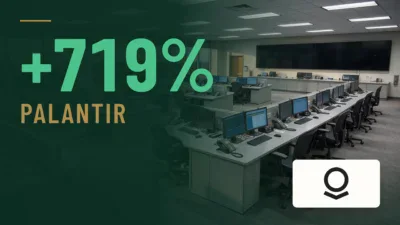
- Total Return: 718.69%
- Annualized Return: 52.27%
- S&P 500 (same period): $1,586.90 (58.69%, or 9.68% annualized)
The stock has only about six years of trading history, so a 10-year window doesn’t exist. If you had bought at the $9.50 close on listing day, your $1,000 would now be worth $18,123.20. Palantir is exactly the kind of runner most investors walked past early on, the pattern we broke down in a free report on the winners you already missed.
Holding on took a strong stomach. In the past 52 weeks alone, shares traded between $106.37 and $212.94. When Q4 2025 earnings beat estimates by 38.89%, the stock still dropped 11.62% the next day. Timing also made a big difference: revenue nearly doubled over the past year, yet buyers who paid $165.77 twelve months ago are trailing the index.

Rapid Growth Meets a Demanding Valuation
Bulls are counting on U.S. commercial growth running close to triple digits. One encouraging sign is U.S. commercial remaining deal value (contracts already signed but not yet booked as revenue), which rose 79%[1] to $6.517 billion, giving that growth some support.
The bear case centers on cooling new contract signings. Total contract value grew just 6%[1] in Q3. Stock-based compensation has also risen fast, reaching $318.9 million[1] versus $172.3 million a year earlier, which cuts into existing shareholders. At a P/E of 244 and a forward P/E of 66x, the share price already assumes years of near-flawless execution.
If you’re investing for retirement, position size matters most. Palantir’s beta of 1.61 means it has historically moved more sharply than the overall market, and it can lose double digits in a single day even after beating estimates. That kind of volatility makes position sizing a central consideration for retirement savers.

My view: the business is outstanding, and the valuation is very demanding. The next five years are likely to look very different from the last five.
Contact [email protected] for any questions or corrections.
Chris Lange is a financial and geopolitical writer with more than a decade of experience covering a myriad of topics. He has published thousands of articles for 24/7 Wall St., with past coverage focused heavily on stocks, IPOs, healthcare, defense, global affairs, and technology.
His work has been quoted, or referenced by a number of outlets including Business Insider, USA Today, Yahoo Finance, MSN, The Motley Fool, and many other publications. A graduate of Southwestern University, he studied business with a focus on investments and has previous experience in banking and startups.
When not reading or writing the news, he is following his passion for Lacrosse, playing chess, or building solar projects with his dad.