Ripple Is Now a Premier Member of the x402 Foundation, Alongside Visa and Mastercard
AI agents are about to start spending money on their own, and whoever owns the rails they pay on owns a brand-new market. Ripple just took a seat at the table where those rules are being written, alongside Visa, Mastercard,…

This post may contain links from our sponsors and affiliates, and Flywheel Publishing may receive compensation for actions taken through them.

Software is starting to spend money on its own. An AI agent doing a job will pay a few cents to grab some data or use an online service, and it does this over and over without a human clicking approve. The trouble is that the internet’s payment system was built for people, and it breaks down when the customer is a machine.
A standard called x402 is meant to fix that, by letting software pay for what it needs the moment it needs it, with no account and no card. Today the nonprofit behind Linux launched the x402 Foundation to govern it, and Ripple (CRYPTO:XRP) joined as a Premier Member, alongside Visa, Mastercard, Google, and Stripe. The lineup shows how seriously big finance is taking machine payments, and Ripple is in the room helping write the rules.
Ripple Joins the Payment Giants Behind x402

x402’s name points to an old, unused corner of the web. When the internet’s rules were first written, its creators set aside a signal called “402 Payment Required” for a day when a web page might charge for access on its own. That day never came, and the code stayed dormant for decades. x402 finally puts it to work, turning it into a way for software to pay for what it needs the instant it needs it, inside an ordinary web request.
Coinbase built x402 and got it working, then gave the standard away. In April, it announced it would hand the protocol to the Linux Foundation, the nonprofit that stewards Linux, Kubernetes, and much of the open-source software the internet runs on. Today that move became official with the launch of the x402 Foundation, the body that will govern it. Putting it under the Linux Foundation is the whole point, since it means no single company, not even Coinbase, owns the way software pays software.
That neutral ground is what drew the giants. Forty companies joined the Foundation to help shape the standard, and the top tier reads like a roll call of everyone who moves money online, from Visa and Mastercard to Stripe, American Express, Google, and Amazon. Ripple joined at that same top tier, as a Premier Member, which puts it among the few companies actually writing the rules for how AI agents will pay each other.
Ripple’s whole business is moving money, so being in the room while these rules get set actually means something to it. That said, it’s one of 40 members, so it’s helping shape how things work, not calling the shots.
Why AI Agents Need Their Own Way to Pay

Picture an AI agent you’ve asked to research a company. To finish, it needs one piece of data from a service it has never used, and that service charges four cents to look it up. It needs that data once, and probably never again.
The problem is that every way we pay online was built around a person making a normal-sized purchase. A card can’t even handle a charge that small, because most networks take a fixed fee of around thirty cents on every transaction, so a four-cent sale would lose money before it cleared.
Opening an account for the AI agent would work, but an agent doing this work touches dozens of services, each one just once, and it can’t stop to register at every single one. A subscription makes even less sense for something used a single time. So software needs its own way to pay, built for tiny amounts, sent instantly, with no human in the loop.
That’s the gap x402 fills. The agent asks the service for the data, and the service replies that it costs four cents and where to send it. The agent checks the spending limits its owner set, pays, and gets the data, all in a few seconds. There’s no account to open, no card to enter, and no one waiting to approve it, which is exactly why it works for software when nothing built for people does.
That new customer is why the biggest names in payments suddenly care about a dormant web code. If software becomes a paying customer in its own right, then whoever owns the rails it pays on owns a brand-new market. That’s what Visa, Mastercard, and Ripple are all racing for, and none of them wants to miss out.
What Ripple Has Been Building
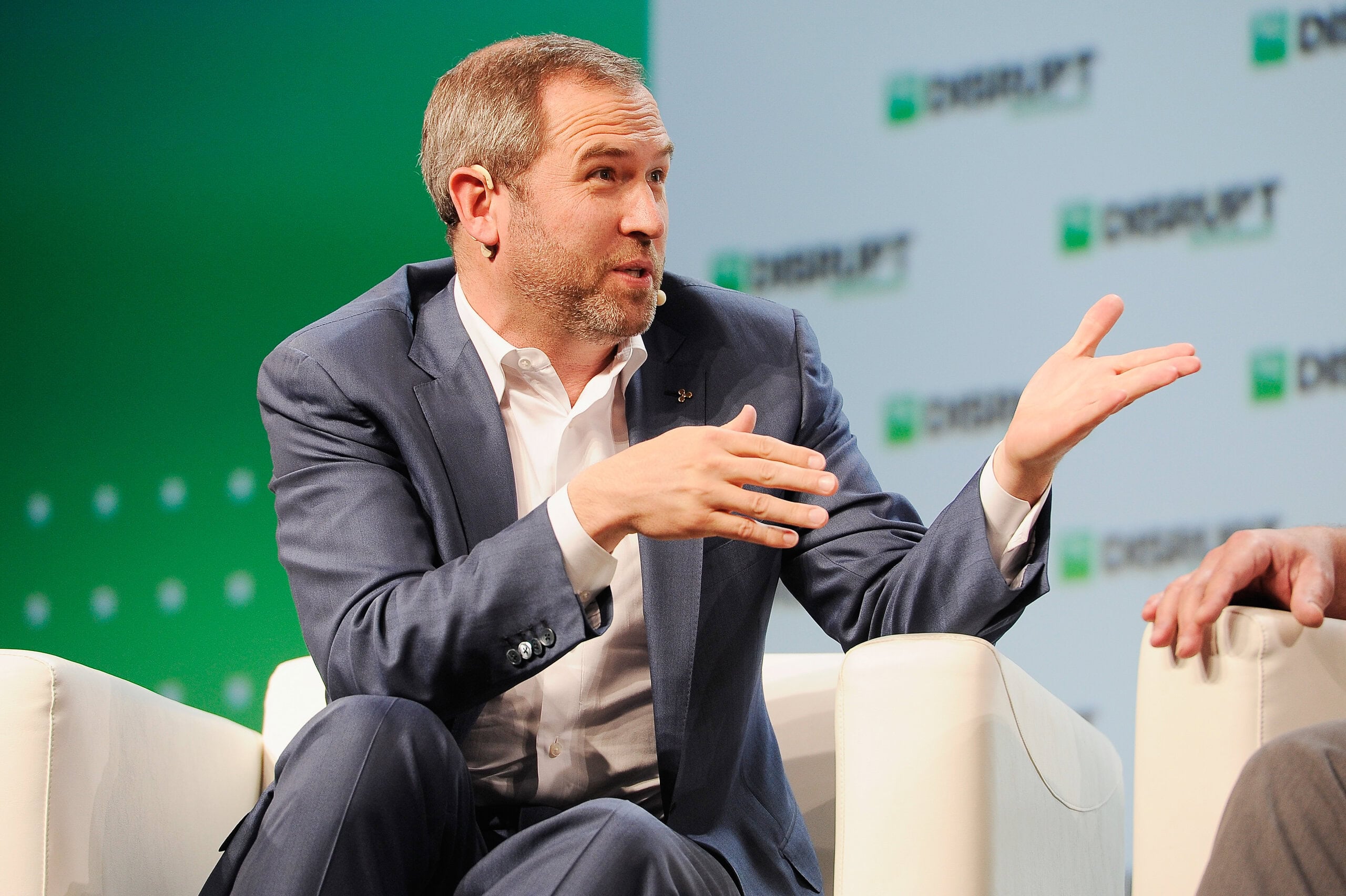
Ripple has been laying the groundwork for months, and joining the Foundation is its newest step. Back in June, it released the XRPL AI Starter Kit, the tools that hand an AI agent a wallet and let it pay in XRP or RLUSD with no human involved. Around the same time, Mastercard named Ripple as one of more than 30 launch partners for its own agent-payments network.
By July 8, that groundwork had produced more than a million agent payments in roughly four weeks, each one costing a fixed $0.0002. The agents are buying from services that already exist, like a gateway that offers access to more than 30 AI models.
Compared to industry leaders, Coinbase’s Base network has handled more than 119 million x402 payments, and Solana about 35 million, both with a year’s head start and most of it settled in the USDC stablecoin. So, next to that, Ripple’s million is small.
That said, Ripple isn’t going to win that race on volume, so it’s chasing something else—the one thing those crypto-native rails can’t offer a bank. It gives them fixed costs they can budget around, no risk from buggy smart contracts, a Mastercard-backed record showing a human authorized each payment, and a regulated dollar in RLUSD.
Why This Matters for XRP
On the XRP Ledger, agents pay using both XRP and RLUSD, Ripple’s dollar-backed stablecoin. Each plays a different part. RLUSD gives agents a steady dollar to price things in, and XRP is the native asset the whole ledger runs on.
Every payment uses a little XRP in fees, agent wallets have to hold XRP in reserve to work at all, and XRP can move liquidity between currencies when an agent needs it. The more agents transact on the ledger, the more of that activity runs through XRP.
It is still early, but what Ripple has done is put both XRP and RLUSD inside the standard the biggest names in payments are now building on, which is right where it wants them as that market takes shape.
Contact [email protected] for any questions or corrections.
Sam Daodu is a crypto analyst and the editor of 24/7 Wall St.'s Crypto Desk, where he covers Bitcoin, XRP, Ethereum, Solana and the altcoins investors search for most. His work focuses on price levels, spot ETF flows, on-chain data and the regulatory decisions that move crypto markets, written so a first-time buyer and a seasoned trader can both use it.
Sam has written about crypto professionally since 2019 and has published more than 2,000 articles. Before joining 24/7 Wall St., he wrote for crypto media outlets and Web3 companies and ghostwrote for crypto founders and token launches. His analysis is syndicated on Yahoo Finance, MSN and AOL and has been cited by other crypto news sites. He also founded MacLabs Marketing, a content and personal branding agency for crypto founders and executives.
When he isn't reading charts, Sam is usually at the gym or watching One Piece, a series he maintains has better tokenomics than most altcoins.