Dogecoin (DOGE) Is Nearing Its First Death Cross of 2026. What Happened After the Last One?
Dogecoin is closing in on a rare technical signal that preceded nearly a year of losses the last time it appeared, but a cluster of whale activity near current prices suggests this setup may not play out the same way…

This post may contain links from our sponsors and affiliates, and Flywheel Publishing may receive compensation for actions taken through them.

Dogecoin (CRYPTO: DOGE) is heading toward its first daily death cross of 2026, a signal traders watch for as a sign of a weakening trend. This death cross is happening just weeks after DOGE’s first daily golden cross of the year in October.
As of October 16, DOGE is trading around $0.0806, down 5.3% over the past week and 12.5% over the last 14 days. The cryptocurrency is currently 89% below its May 2021 peak. The downward trend has been consistent, with DOGE closing at $0.10 on September 22 before hitting an intraday low of $0.0777 on October 15.
Dogecoin’s 50-Day Average Is Sliding Toward Its 200-Day Line
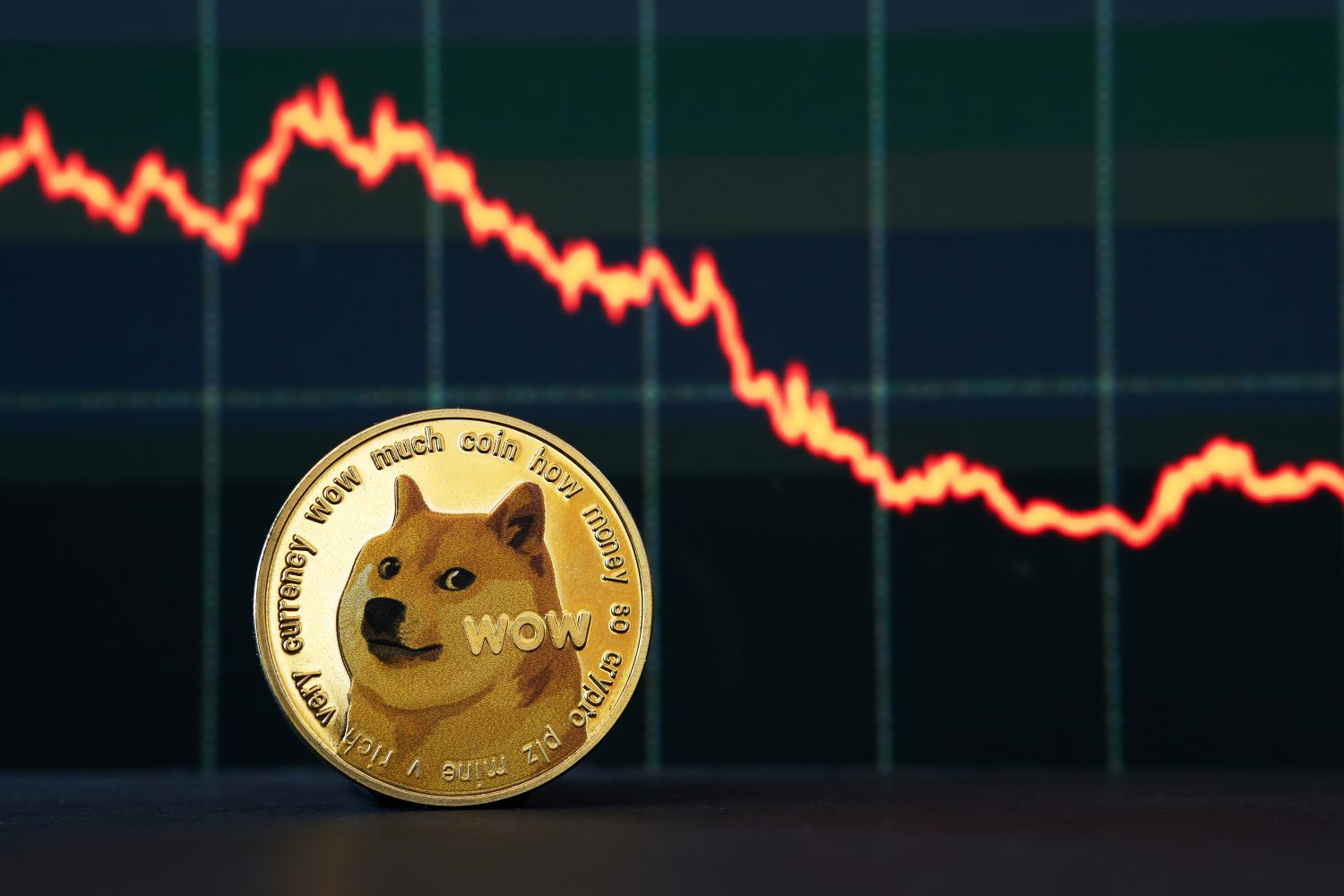
Dogecoin’s 50-day moving average is approaching its 200-day line, setting the stage for a potential death cross. A moving average represents the average closing price over a specific timeframe and is updated daily. DOGE’s simple 50-day average, calculated from daily closing prices between August 28 and October 16, stands at approximately $0.0882.
Currently, DOGE is trading about 9% below this average, and as long as it stays below this line, new closing prices are likely to pull the average down further. Charts indicate the 50-day average is trending downward, while the 200-day average has leveled off. A death cross occurs when a declining short-term average crosses below a flat long-term average, a situation DOGE is approaching.
Rising interest rates add to the pressure. U.S. wholesale prices rose 6.3% year over year in September, and the Federal Reserve implemented its first interest rate hike in over three years that month. Another hike is anticipated in December, and higher rates typically dampen demand for speculative cryptocurrencies.
Additionally, the supply dynamics work against DOGE. Approximately 156.4 billion DOGE are currently in circulation with no maximum cap, meaning new coins continue to enter the market. With a market cap of about $12.6 billion, DOGE ranks 12th in crypto. With more coins in circulation, any given price point now represents a larger valuation than it did in 2021.
What a Death Cross Tells Dogecoin Traders, and What It Misses

A death cross occurs when the 50-day moving average drops below the 200-day moving average, while a golden cross is the opposite. Traders interpret a death cross as confirmation that short-term momentum has weakened compared to the longer trend.
Both signals lag market movements because they rely solely on past closing prices. By the time the averages cross, much of the decline may have already occurred. Therefore, a death cross reflects the recent trend rather than predicting future movements.
These signals tend to be less reliable in choppy markets. A golden cross followed shortly by a death cross is called a whipsaw, indicating a flat trend. The timing of DOGE’s potential death cross remains uncertain, as an upward movement could disrupt the setup before the averages meet.
What Happened After DOGE’s Last Death Cross in November 2025?

DOGE’s previous daily death cross occurred in November 2025, leading to several months of price declines. An early indicator appeared on October 31, 2025, when the 50-day exponential moving average, which weighs recent days more heavily, dipped below the 200-day average as DOGE fell below $0.20.
This selling pressure persisted for nearly a year. DOGE finished at around $0.127 on January 1, 2026, dropped to $0.10 by May 31, and fell further to $0.0695 by August 16. Thus far, it has declined 31.3% this year and 56.4% over the past 12 months.
However, some buyers have started stepping in. Crypto analyst Ali noted a TD Sequential buy signal near $0.081, suggesting the decline may be ending. He cited data showing that about 36 billion DOGE, valued at roughly $2.9 billion, last traded near that price point, while large holders (whales) have accumulated an additional 600 million DOGE (around $48 million) since October 12.
Nonetheless, institutional buyers have avoided DOGE funds. October saw no new investments in DOGE from U.S. funds, meaning that the support around $0.081 relies solely on whales and retail traders. If the support holds, Ali suggests a target range of $0.16 to $0.17.
Does the Dogecoin Death Cross Signal More Losses Ahead?
The Dogecoin death cross likely confirms an already weak trend, and, as with the last occurrence, it could herald additional losses. For holders, the $0.081 support level, where whales have been buying, may hold more significance than the cross itself. A daily close above the $0.0882 average could stave off the death cross.
For a recovery to materialize, DOGE needs to stay above $0.081, reclaim the $0.0882 average, and surpass the $0.10 close from September before Ali’s $0.16 to $0.17 target becomes a possibility. However, if support breaks, the November 2025 pattern could repeat, with the August low of $0.0695 becoming the next reference point. A daily close below the October 15 low of $0.0777 would indicate that sellers have regained control.
Contact [email protected] for any questions or corrections.
Sam Daodu is a crypto analyst who's spent nearly a decade making blockchain understandable—no easy task when most whitepapers read like fever dreams. He writes for 24/7 Wall St., covering Bitcoin, altcoins, and crypto market analysis for investors. Before crypto, he was a tech writer (back when explaining "the cloud" was peak innovation). Since 2018, he's written for CoinTelegraph, Yahoo Finance, The Block, Cryptonews, Zypto, Rain, and more—basically anywhere people want crypto news without the headache. Sam runs MacLabs Marketing, a content agency for crypto brands tired of sounding like AI wrote their website. He also publishes free crypto education on his site for Web3 enthusiasts who think "gas fees" is a typo. When he's not writing or staring at charts, Sam's either: - Watching anime (currently convinced One Piece has better tokenomics than most altcoins) - At the gym sculpting himself into a Greek god - Listening to the music your mum warned you only bad boys listen to Connect: LinkedIn | Email | MacLabs Marketing