Can Uniswap (UNI) Get Back to $10 After a 21% Monthly Drop?
Uniswap surged 220% over the summer, landed a historic Wall Street futures listing, and then started bleeding out in October. Whether UNI can claw back to $10 depends on a fragile set of conditions falling into place at once.

This post may contain links from our sponsors and affiliates, and Flywheel Publishing may receive compensation for actions taken through them.
Uniswap (CRYPTO:UNI) needs to climb 40.6% to reach $10, a level it last closed above on September 22, 2026. Uniswap is trading at $7.11, down 4.8% in the last 24 hours and 19.9% over the past month, making UNI one of the weakest large tokens in October.
Traders often refer back to the $10 mark because UNI closed at $10.22 when CME Group (NASDAQ:CME | CME Price Prediction) announced it would list UNI futures. Although trading in these contracts began on October 19, UNI kept declining. Since the sell-off in early October, the price has fluctuated between $7.89 on October 11 and $6.74 on October 13.
So, can UNI bounce back to $10, and what would it take?
UNI Has Failed to Hold Above $10 Twice in a Year
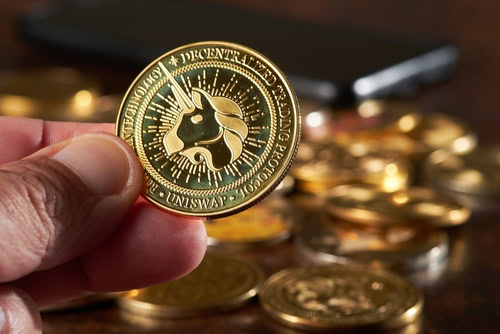
UNI is the governance token for Uniswap, a decentralized exchange that lets users swap cryptocurrencies directly from their wallets without a central authority. Token holders vote on how the protocol operates.
Over the past year, $10 has been a significant barrier. UNI briefly touched $10.29 on November 11, 2025, but closed at $8.25 that day. It reached $10.93 on September 23, 2026, before closing at $9.24. It last traded above $10 on September 27 at $10.19, but sellers quickly pushed it back below that level each time.
On a longer view, a return to $10 seems modest, especially since UNI trades 84.2% below its all-time high and has declined about 73.5% from $26.78 on October 23, 2021. A move to $10 would only take UNI back to its September highs.
CME Futures Brought In New Buyers and Gave Funds a Way to Short UNI
UNI is the first DeFi token to be listed on CME futures. DeFi, or decentralized finance, lets users trade and lend without banks, while futures contracts are agreements to buy or sell an asset at a predetermined future price.
A standard futures contract covers 10,000 UNI, worth around $71,100 at $7.11, while a micro contract covers 1,000 UNI. Both contracts settle in cash, meaning no tokens are exchanged at expiration. On October 20, CME announced that FalconX and GSR had executed the first block trade—a significant privately negotiated transaction.
So far, the futures listing has only led to a one-time boost. On September 22, UNI opened at $8.99 and closed at $10.22, up 13.7%. However, it peaked the next day and has continued to decline since, a classic case of “buy the rumor, sell the news.”
Futures contracts also give sellers a powerful tool. A short position profits when the price falls, and CME contracts let large funds short UNI without needing to borrow tokens. Therefore, while the futures listing has attracted new buyers, it could also increase selling pressure.
After a 220% Surge, UNI Holders Are Cashing Out
Martin Gaspar, a senior crypto market strategist at FalconX, noted that UNI surged 220% in the third quarter, far outpacing Bitcoin’s 43% increase (CRYPTO:BTC). Despite the October decline, UNI still boasts an 88% gain over 90 days, from $3.78 on July 24.
Rapid price increases let early investors realize significant gains, prompting many to sell when positive news emerges. For example, UNI surged 71.7% from a September 10 close of $5.95 to $10.22 just 12 days later. Buyers from that period still have profits to lock in at $7.11.
With a modest 1.1% gain in the past week, the selling pressure appears to be easing. However, this small movement still falls short of indicating a strong recovery.
UNI Needs Bitcoin and Ethereum to Turn Higher
Bitcoin is trading at $81,836 after a 2.3% drop over the past 30 days, while Ethereum (CRYPTO:ETH) is priced at $2,402, down 10.2% over the same period. Both cryptocurrencies also fell in the last 24 hours, with Bitcoin down 1.9% and Ether down 2.6%.
Lesser-known tokens like UNI often perform best when major cryptocurrencies rise. Bitcoin and Ether have gained 31.4% and 29.2%, respectively, over the past 90 days, fueling UNI’s summer rally. Further gains in these leading coins could support UNI’s price, but another dip could push $10 further out of reach.
Can the Uniswap Price Reach $10 by the End of 2026?
In our opinion, UNI is unlikely to hit $10 by the end of 2026. The futures listing already produced its price spike in September, and profit-taking may still be ongoing. Before reaching $10, UNI needs to clear its October 11 high of $7.89, which is 11% above its October 22 price. It also needs to close above $9.08, its October 5 closing price before the breakdown—about 27.7% higher.
Only if these milestones are met can the $10 target become plausible. Furthermore, UNI must sustain its position above this level after failing to do so in November 2025 and September 2026. Continued demand for CME futures and a recovery in Bitcoin prices would help with both steps. Conversely, a daily close below the October 13 low of $6.74—5.2% lower—would suggest that sellers still dominate UNI, making the $10 target even more elusive.
Contact [email protected] for any questions or corrections.
Sam Daodu is a crypto analyst who's spent nearly a decade making blockchain understandable—no easy task when most whitepapers read like fever dreams. He writes for 24/7 Wall St., covering Bitcoin, altcoins, and crypto market analysis for investors. Before crypto, he was a tech writer (back when explaining "the cloud" was peak innovation). Since 2018, he's written for CoinTelegraph, Yahoo Finance, The Block, Cryptonews, Zypto, Rain, and more—basically anywhere people want crypto news without the headache. Sam runs MacLabs Marketing, a content agency for crypto brands tired of sounding like AI wrote their website. He also publishes free crypto education on his site for Web3 enthusiasts who think "gas fees" is a typo. When he's not writing or staring at charts, Sam's either: - Watching anime (currently convinced One Piece has better tokenomics than most altcoins) - At the gym sculpting himself into a Greek god - Listening to the music your mum warned you only bad boys listen to Connect: LinkedIn | Email | MacLabs Marketing