Hyperliquid Has $612 Million of Leveraged Longs Below Its Price. How Far Could HYPE Fall?
Whale sell-offs, a regulatory question mark hanging over the ICE partnership, and hundreds of millions in leveraged longs clustered just below the current price have put HYPE in a precarious spot. One small move could trigger a cascade that reshapes…

This post may contain links from our sponsors and affiliates, and Flywheel Publishing may receive compensation for actions taken through them.

Traders currently hold $612 million in leveraged long positions for Hyperliquid (CRYPTO: HYPE), according to CoinMarketCap data. If the price drops, these positions might be forcibly closed. A long position profits when the price rises, and leverage means traders borrow money to increase their stake.
Meanwhile, another $411 million in short positions sits above the current price and benefits from a decline. So, how far could HYPE fall if those long positions start to unwind?
HYPE is trading at $86, down 2.9% over the past 24 hours. This decline is steeper than Bitcoin (CRYPTO: BTC), Ethereum (CRYPTO: ETH), or Solana (CRYPTO: SOL).
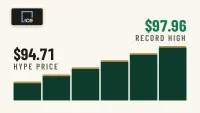
Currently, HYPE trades 12.7% below its all-time high of $98 reached on September 23, and it holds the 11th spot by market value. However, HYPE has shown resilience, gaining 9.6% over the past week, bouncing back from a low of $76 on October 25.
Whales Sold $109 Million of HYPE After ICE’s Hyperliquid Plan

Market pressure began on October 31, when two major investors, known as whales, sold $109 million of HYPE. These whales are large holders whose trades can influence market prices. On-chain data from Lookonchain traced these sales, showing the whales sold after buying before the announcement and locking in profits from an earlier price rally.
This rally was sparked by Intercontinental Exchange (NYSE: ICE | ICE Price Prediction) announcing plans to introduce Hyperliquid-based perpetual futures in the U.S. through Trade[XYZ]. Perpetual futures enable traders to speculate on prices indefinitely, often using borrowed money. However, ICE’s revised statement says the plan is “subject to regulatory approvals,” and the U.S. Commodity Futures Trading Commission has yet to approve it.
Despite the uncertainty, HYPE’s price surged following the announcement. It closed at $81 on October 28, jumped to $89 on October 29, the day the ICE plan was unveiled, peaked at $90 on October 30, and has since trended downward, closing at $88 on November 1.
Leveraged Longs Could Turn a Small HYPE Drop Into a Bigger One

When a long position incurs losses, the margin—the cash collateral a trader posts—can shrink, prompting forced sell-offs by exchanges. Each required sale can drive the price lower, potentially triggering a cascade effect of further liquidations.
The 2.9% drop on November 2 happened without any new news, suggesting it continued the earlier whale selling. This is concerning because a minor decline could trigger a chain reaction, causing more liquidations and pushing prices down until all leveraged longs are depleted.
While HYPE had maintained its rise amid a general crypto market decline following the Binance hack, it carries unique risks. As the token for an exchange focused on leveraged trading, the $612 million in long positions directly affects HYPE’s price. Moreover, the recent rally was largely driven by the ICE announcement, leaving HYPE vulnerable to corrections.
Hyperliquid does buy back HYPE daily using revenue from fees through its Assistance Fund, providing consistent buying support. However, additional fees from U.S. trading rely heavily on ICE’s products, which are still awaiting approval and a launch date.
HYPE Is Clinging to Its 50-Day Average as the Majors Slip

Traders often use moving averages, which calculate average closing prices over specific periods, to gauge market trends. Currently, HYPE is trading just above its 50-day average of $85 (only 0.1% below) and well above its 20-day average of $81 (5.1% below). It is significantly above its 200-day average of $67 (21.9% below), which indicates a slight medium-term upward trend.
Over the past week, HYPE has also outperformed major cryptocurrencies. Bitcoin fell 3.4%, Ethereum fell 2.1%, and Solana fell 8.1%, while HYPE gained 9.6%. On the upside, the price closed at $94 on October 5, a key level buyers have yet to reclaim. On the downside, HYPE posted four consecutive lower closes from October 22, leading to its $76 low.
How Far Could HYPE Fall If Long Positions Unwind?
If long positions start to unwind, HYPE could decline back toward $81 (5.7% below) because it closed at that level on October 28, when the ICE rally began, and its 20-day average is there too. The last significant buying pressure appeared at the $76 low from October (10.8% below), which may need to hold to prevent a further drop. A daily close below $76 could undo the gains made in late October.
Until ICE’s products gain approval, the gains HYPE saw in late October largely depend on a proposal rather than a concrete product. This means that leveraged traders are likely to exit their positions faster than they would for approved products. On the upside, a close above $90 (5.1% above) could indicate new buyers absorbing the selling pressure from whales, which might also put the $411 million in short positions at risk.
Contact [email protected] for any questions or corrections.
Sam Daodu is a crypto analyst and the editor of 24/7 Wall St.'s Crypto Desk, where he covers Bitcoin, XRP, Ethereum, Solana and the altcoins investors search for most. His work focuses on price levels, spot ETF flows, on-chain data and the regulatory decisions that move crypto markets, written so a first-time buyer and a seasoned trader can both use it.
Sam has written about crypto professionally since 2019 and has published more than 2,000 articles. Before joining 24/7 Wall St., he wrote for crypto media outlets and Web3 companies and ghostwrote for crypto founders and token launches. His analysis is syndicated on Yahoo Finance, MSN and AOL and has been cited by other crypto news sites. He also founded MacLabs Marketing, a content and personal branding agency for crypto founders and executives.
When he isn't reading charts, Sam is usually at the gym or watching One Piece, a series he maintains has better tokenomics than most altcoins.