Deutsche Bank Launched Crypto Custody With Bitcoin and Ethereum but Not XRP or Solana. Why Were They Left Out?

This post may contain links from our sponsors and affiliates, and Flywheel Publishing may receive compensation for actions taken through them.
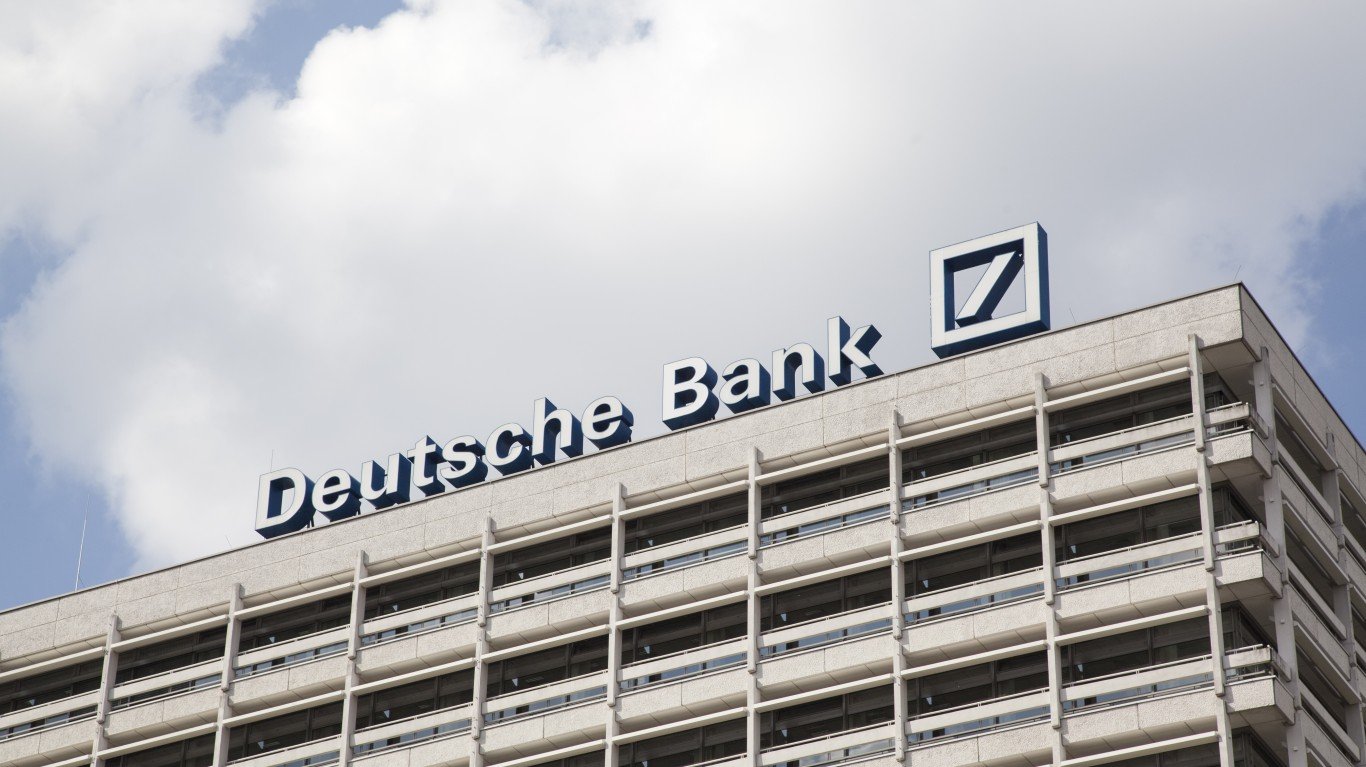
Deutsche Bank (NYSE:DB | DB Price Prediction) officially launched its crypto custody service for institutional and corporate clients on November 11, 2026. The bank is holding Bitcoin (CRYPTO:BTC), Ethereum (CRYPTO:ETH), and three stablecoins: USDC, EURC, and EURAU. In crypto custody, the bank manages the private keys—the secret codes that control the coins—so clients don’t have to handle them themselves. However, XRP (CRYPTO:XRP) and Solana (CRYPTO:SOL) are absent from the list.
The announcement didn’t lift any of the four coins. Even with a shout-out from Michael Saylor, a prominent Bitcoin advocate, who posted “Deutsche ₿ank” on X, Bitcoin trades at $71,297, down 3% in 24 hours, while Ethereum trades at $1,998, down 2.7%. XRP and Solana trade at $1.02 and $81, respectively, both down 3.4%.
So why did Germany’s largest bank limit its crypto custody service to Bitcoin and Ethereum, and what does that mean for XRP and Solana holders?
Deutsche Bank Holds Five Assets, and One Comes From Its Corporate Family

The bank’s September 16 announcement said it would begin with a “selected range of digital assets,” naming Bitcoin, Ethereum and the stablecoins USDC, EURC and EURAU. EURAU is an e-money token, a stablecoin that EU law treats like electronic cash and backs it one-for-one with a currency. The bank’s custody page confirms these five assets, while XRP and Solana are conspicuously absent.
The launch timing was linked to the regulatory process. Deutsche Bank’s entry in the EU’s MiCA register is dated October 12 and names Germany’s BaFin as its regulator. The service is available in Germany, with cross-border servicing across Europe.
Eligible clients include institutional investors, multinational companies, governments and wealth managers, who can access the service via Autobahn, the bank’s corporate platform. The service covers custody and transfers, but not trading, and Deutsche Bank has yet to disclose its first clients or pricing.
EURAU also has a direct tie to the bank. Its issuer, AllUnity, is a joint venture between DWS, Flow Traders and Galaxy, and DWS is the bank’s majority-owned asset manager. Deutsche Bank has also signed a memorandum of understanding with DWS to explore tokenized money market funds, crypto-asset exchange-traded commodities and stablecoins. So one of the five slots went to a coin from the bank’s own family of companies.
Deutsche Bank’s Only Stated Reason Is Client Demand

In its announcement, Deutsche Bank said the range of supported assets “may be expanded over time, subject to client demand and the bank’s product-approval, risk management and regulatory processes.” The bank gave no other reason for excluding XRP or Solana, nor did it say it reviewed and rejected these coins.
The announcement also didn’t name a settlement asset—a coin the bank might use to move funds between parties. Paul Maley, the bank’s global head of trust and securities services, said the medium-term goal is a fully integrated, regulated ecosystem supporting the custody, tokenization and settlement of digital assets. That vision doesn’t commit the bank to using Bitcoin, Ethereum, or any other cryptocurrency for payments.
It mirrors Cross River Bank’s RLUSD deal, where the bank used Ripple’s stablecoin for settlement without holding XRP.
Rival Banks Show XRP and Solana Can Clear a Compliance Review
EU regulations don’t explain the exclusion either. MiCA sorts cryptocurrencies into asset-referenced tokens, e-money tokens and other crypto-assets. By our reading, Bitcoin, Ethereum, XRP and Solana all fall into the last category, so EU law treats the four alike, while only the stablecoins belong to a different category.
In fact, several large institutions already handle XRP and Solana or plan to. Itaú Unibanco (NYSE:ITUB) registered with Brazil’s central bank on October 27 to trade and custody 15 digital assets, including XRP and Solana. Charles Schwab (NYSE:SCHW) announced plans in October to add Solana, Avalanche and Chainlink alongside Bitcoin and Ethereum by the end of 2026.
Schwab’s rollout mirrors Deutsche Bank’s: it starts with the two largest cryptocurrencies and adds more later, though Schwab is a brokerage whose fee schedule serves retail traders. Custody banks have followed the same pattern, as BNY (NYSE:BK) started with Bitcoin and Ethereum in October 2022.
Size probably plays a part in that order. Bitcoin holds the top spot by market value, followed by Ethereum, while XRP and Solana rank sixth and seventh. We think Deutsche Bank prioritized the assets that pension funds and corporate treasurers ask for first.
Will Deutsche Bank Add XRP or Solana, and Would Either Coin Gain?
XRP and Solana were likely excluded from Deutsche Bank’s initial lineup because institutional investors demand them less than Bitcoin and Ethereum, and the bank’s stated test is client demand plus its own approvals. If either coin appears on the custody page, or the bank names one as a settlement asset, the exclusion ends, and the bank’s planned expansion into Asian financial centers in 2027 could be the next point where the list changes.
Even then, a custody listing earns the bank a fee but gives a coin no guaranteed buyer, because custodians hold what clients have already bought. Until Deutsche Bank names XRP or Solana as a settlement asset, the bank probably isn’t a reason for either coin’s price to rise.
Contact [email protected] for any questions or corrections.
Sam Daodu is a crypto analyst and the editor of 24/7 Wall St.'s Crypto Desk, where he covers Bitcoin, XRP, Ethereum, Solana and the altcoins investors search for most. His work focuses on price levels, spot ETF flows, on-chain data and the regulatory decisions that move crypto markets, written so a first-time buyer and a seasoned trader can both use it.
Sam has written about crypto professionally since 2019 and has published more than 2,000 articles. Before joining 24/7 Wall St., he wrote for crypto media outlets and Web3 companies and ghostwrote for crypto founders and token launches. His analysis is syndicated on Yahoo Finance, MSN and AOL and has been cited by other crypto news sites. He also founded MacLabs Marketing, a content and personal branding agency for crypto founders and executives.
When he isn't reading charts, Sam is usually at the gym or watching One Piece, a series he maintains has better tokenomics than most altcoins.