VEA Is Crushing SPY This Year, but the Decade-Long Scorecard Tells a Different Story
VEA has quietly outpaced the S&P 500 over the past year, and the gap is widening in 2026, but a longer look at the scoreboard raises a question every U.S.-heavy investor needs to sit with before adding international exposure.

This post may contain links from our sponsors and affiliates, and Flywheel Publishing may receive compensation for actions taken through them.

Most American portfolios carry an unspoken bet: that U.S. mega-caps will keep leading the world. The Vanguard FTSE Developed Markets ETF (NYSEARCA:VEA) exists to hedge that bet. VEA is the low-cost workhorse for owning the rest of the developed world, Europe, Japan, the U.K., Canada, Australia, without touching emerging markets. For an investor whose portfolio is dominated by the S&P 500, VEA is one of the cleanest ways to correct concentration risk without dropping into more volatile geographies.
The Fund and the Job It Does
VEA tracks the FTSE Developed All Cap ex US Index, giving broad exposure to roughly 3,900 to 4,000 stocks across developed markets outside the U.S. The return engine is straightforward: capital appreciation from large multinationals like Nestlé, ASML, Toyota, and Novo Nordisk, plus dividend income passed through from those holdings. There is no options overlay, no active tilt, no currency hedge. What foreign markets deliver in local terms plus the effect of the U.S. dollar, that is what VEA delivers, minus a 0.03% expense ratio.
The currency piece matters. When the dollar weakens, returns from euro- and yen-denominated stocks translate into more dollars, boosting VEA’s headline result. When the dollar strengthens, that tailwind reverses. Any investor holding VEA is implicitly making, or at least accepting, a bet against U.S. dollar dominance.
Does It Deliver on the Diversification Promise?
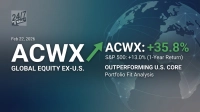
Over the past year, VEA returned roughly 26%, ahead of the SPDR S&P 500 ETF Trust (NYSEARCA:SPY) at roughly 18%, with year-to-date 2026 gains of nearly 12% compared with SPY’s about 9%. That recent stretch reflects valuation mean-reversion in European and Japanese equities plus a weaker dollar.
Zoom out and the story flips. Over five years, VEA gained about 58% against SPY’s roughly 71%, and over ten years VEA returned roughly 158% versus SPY’s nearly 242%. Owning VEA over the past decade meant giving up meaningful gains relative to a pure U.S. allocation. That is the tradeoff of diversification: it smooths outcomes, and smoothing works both ways.
Looking forward, J.P. Morgan projects developed international equities to return around 7.5% annually over the next 10 to 15 years, versus 6.7% for the S&P 500, citing narrowing earnings gaps, fiscal stimulus abroad, and stretched U.S. valuations.
The Tradeoffs
- Lumpy income. The distribution pattern is not what U.S. dividend investors expect. Recent quarterlies swung from $0.109 in Q1 2026 to $0.3772 in Q2 2026, with December payouts often the largest, $1.04 in December 2025. Trailing 12-month distributions totaled $1.8127. Useful for total return, unreliable for budgeting.
- Currency exposure is unhedged. A rising dollar can erase local-market gains. Investors who want purely fundamental foreign exposure may prefer a currency-hedged competitor.
- Foreign tax withholding. Dividends get taxed at the source; the U.S. foreign tax credit recovers most of it, but only in taxable accounts. Holding VEA in an IRA gives up that credit.
Cheaper Peers and Who Should Own It
The closest competitor, iShares MSCI EAFE ETF (NYSEARCA:EFA), returned about 53% over five years and roughly 142% over ten, trailing VEA while charging a higher expense ratio. VEA also holds Canada and small-caps, which EFA does not. For pure developed ex-US exposure at the lowest cost, VEA is the default.
VEA fits investors whose equity sleeve is 80% or more U.S. and who want to bring international weight up to 20% to 30% without emerging-market volatility. It suits accumulators with a decade-plus horizon and retirees using it as a diversifier rather than an income anchor. Investors who want emerging markets included should look at a total international fund; those seeking capital appreciation from U.S. innovation leaders should keep their core in the S&P 500 and treat VEA as the counterweight to that core.
Contact [email protected] for any questions or corrections.
I am a long time investor and student of business, and believe finding good companies that can become great investments is the best game on earth. After 20 years of writing and researching the public markets it is clear that individuals have never had more tools and information to take control of their financial lives. From ETFs and $0 commissions to cryptos and prediction markets there has never been a greater democratization of access to investing.
I write to help people understand the investments available to them so they can make the best choice for their portfolio, whether they're starting out or looking for income in retirement.