ETF Showdown: Concentrated Growth Funds CNEQ vs GARY
CNEQ and GARY both run concentrated growth books packed with mega-cap tech, but beneath that surface similarity they are placing entirely different bets on where the market goes next.

This post may contain links from our sponsors and affiliates, and Flywheel Publishing may receive compensation for actions taken through them.

Investors hunting for concentrated U.S. growth exposure keep running into the same two names: the Alger Concentrated Equity ETF (NYSEARCA:CNEQ) and the Mango Growth ETF (NYSEARCA:GARY), the Gary Black-managed fund from The Future Fund. Both run short, high-conviction books packed with mega-cap technology. Both are actively managed. And both have gotten hammered in the past month. Look one layer deeper, however, and they are running very different bets: CNEQ is Alger’s institutional large-cap growth process, while GARY is a thesis-driven AI-infrastructure wager wrapped in an ETF.
What Each Fund Is Actually Betting On
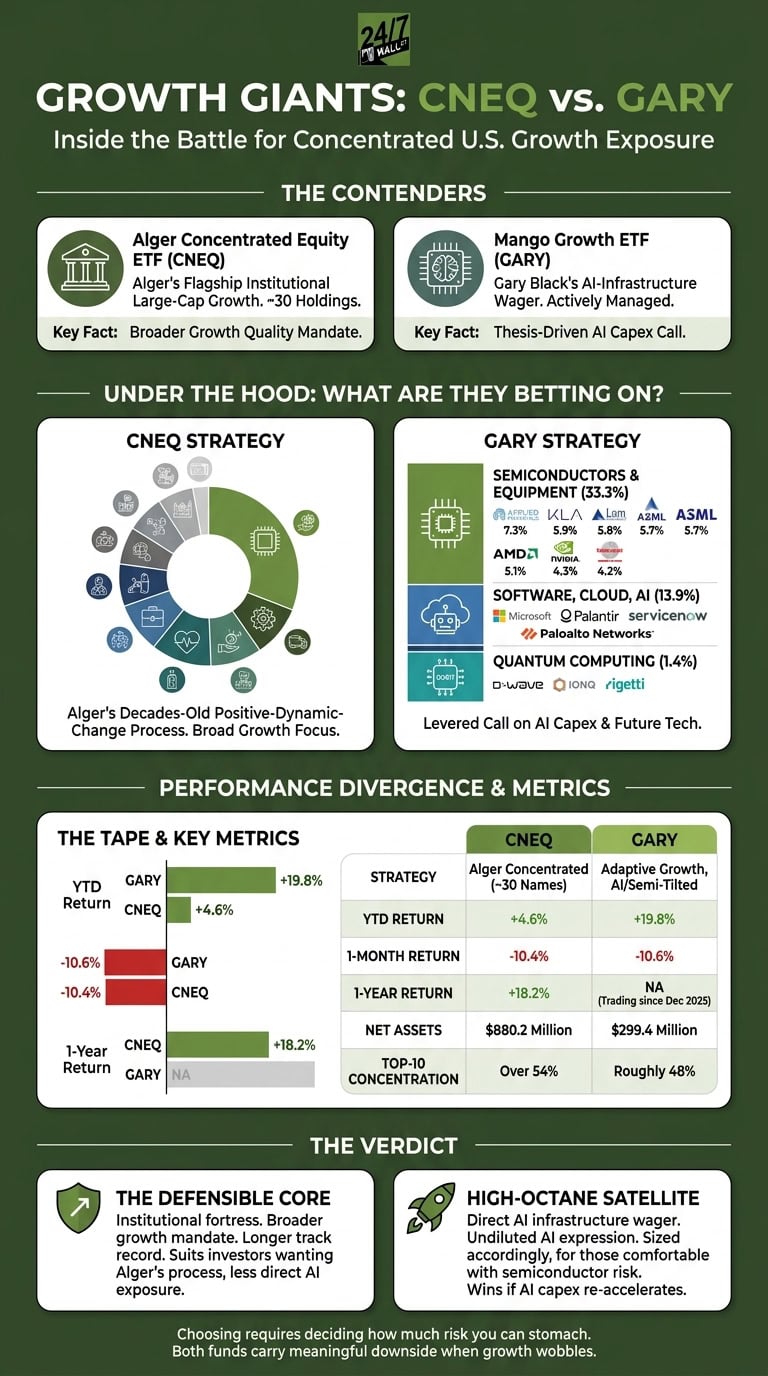
GARY’s portfolio is the more revealing of the two. Semiconductor and semiconductor-equipment names dominate the book: Applied Materials at 7.3%, KLA at 5.9%, Lam Research at 5.8%, ASML at 5.7%, AMD at 5.1%, Nvidia at 4.3%, and Taiwan Semiconductor at 4.2%. Roughly 33.3% of the fund is allocated to chips and chip equipment, with another 13.9% in software, cloud, and AI names like Microsoft, Palantir, ServiceNow, and Palo Alto Networks. There is even a small speculative sleeve, about 1.4% spread across D-Wave, IonQ, Rigetti, and other quantum-computing plays. This is a levered call on the AI capex cycle continuing to expand, with a small option ticket on quantum going commercial.
CNEQ, by contrast, is Alger’s flagship concentrated growth strategy, typically holding around 30 large-cap growth names selected through the firm’s decades-old positive-dynamic-change research process. It is tech-heavy, but the mandate targets broader growth quality rather than the semiconductor equipment build-out specifically.
Where the Divergence Shows Up
The bets already look different on the tape. Year to date, GARY is up 19.8%, while CNEQ is up 4.6%. The chip-heavy book has captured the AI-infrastructure rally more directly. The trade cuts both ways in a drawdown: over the past month, GARY fell 10.6% and CNEQ fell 10.4%, suggesting both funds carry meaningful downside when growth wobbles.
One important caveat: GARY only began trading in late December 2025, so there is no multi-year record to lean on. CNEQ has the modestly longer history, with a one-year return of 18.2%.
The Practical Comparison
| Metric | CNEQ | GARY |
|---|---|---|
| Strategy | Alger concentrated large-cap growth, ~30 names | Adaptive growth, AI/semiconductor-tilted |
| YTD return | +4.6% | +19.8% |
| 1-month return | −10.4% | −10.6% |
| 1-year return | +18.2% | NA |
| Net assets | $880.2 million | $299.4 million |
| Top-10 concentration | Over 54% of assets | Roughly 48% of assets |
The Verdict
These funds solve for different problems. GARY makes sense for an investor who wants a direct, undiluted expression of the AI infrastructure thesis and is comfortable owning a portfolio where one-third of the book rides on chip capex. When the AI trade works, this fund captures it in the least filtered way available in an ETF wrapper. The flip side: any sudden drop in semiconductor demand, a Taiwan disruption, or a shift in hyperscaler spending will show up quickly.
CNEQ suits the investor who wants Alger’s institutional growth process running a concentrated book rather than a specific sector wager. It gives up some upside in vertical AI moves for a broader growth mandate and a manager team with a much longer track record than GARY has had time to build. For most investors deciding between the two, CNEQ is the more defensible core holding, and GARY is a satellite position, sized accordingly. What would flip that calculus is a multi-year re-acceleration of AI capex, at which point the least diversified fund wins by design.
Contact [email protected] for any questions or corrections.
Trey has been an editor and author at 24/7 Wall St. for more than a decade, where he has published thousands of articles analyzing corporate earnings, dividend stocks, short interest, insider buying, private equity, and market trends. His comprehensive coverage spans the full spectrum of financial markets, from blue-chip stalwarts to emerging growth companies.
Beyond 24/7 Wall St., Trey has created and edited financial content for Benzinga and AOL's BloggingStocks, contributing additional hundreds of articles to the investment community.
Trey's editorial expertise extends across multiple publishing environments. He served as production editor at Dearborn Financial Publishing and development editor at Kaplan, where he helped shape financial education materials. Earlier in his career, he worked as a writer-producer at SVE. His freelance editing portfolio includes work for prestigious clients such as Sage Publications, Rand McNally, the Institute for Supply Management, the American Library Association, Eggplant Literary Productions, and Spiegel.
Outside of financial journalism, Trey writes fiction and has been an active member of the writing community for years, moderating workshop sessions at regional conventions.