3 ETFs Surging as Amazon Clears $3 Trillion Market Cap
Amazon just handed investors a historic earnings blowout, and three ETFs built on top of the stock are racing higher in completely different directions. Which one you held this week made all the difference.


The aftershocks are still hitting today after Amazon.com (NASDAQ:AMZN | AMZN Price Prediction) reported blowout Q2 2026 results on July 30th, with the market bidding shares up another 5% (+23% over the past week!) as it digests Amazon’s across-the-board good news.
What’s more, derivative trades on ETFs including Direxion Daily AMZN Bull 2X Shares (NASDAQ:AMZU), Roundhill AMZN WeeklyPay ETF (CBOE:AMZW), and YieldMax AMZN Option Income Strategy ETF (NYSEARCA:AMZY) are all moving as well, but in different ways.
Let’s dig in.
Earnings Galore
Amazon posted EPS of $5.75 against a consensus of $1.82 (a massive beat), on revenue of $200.6 billion, up 20% year over year. The engine was AWS, which grew 37% to $42 billion at a 39% operating margin, its fastest pace in 18 quarters. Advertising revenue grew 26% to $20 billion, and Q3 guidance called for net sales of $197 billion to $202.0 billion. The AI cycle at AWS was the through-line: fastest growth in years, expanding margins, and a capital plan built around it.
Amazon is one stock. But the three ETFs I mentioned above, which are built on top of it, are producing three very different weekly returns. AMZU amplifies. AMZW and AMZY convert upside into income.

AMZU: The Leveraged Bull That Doubled Down
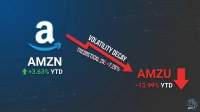
AMZU is a 2X daily leveraged single-stock ETF designed to deliver twice Amazon’s daily return, then reset each session. It won’t always get that number exactly right, but it’s directionally pretty good at that: AMZU shares are +9.4% today and up a whopping 47% in the past week. Of course, those magnified gains turn into magnified losses in the event of a downturn.
Context on the trend matters here, because leveraged funds decay in choppy tape. AMZU is only up 33% over the trailing year, despite Amazon stock itself being up 32% over the last year. That’s volatility drag in action: because the fund resets daily, sideways or choppy weeks compound against holders. It is a short-term tactical tool.
AMZW: Weekly Income, Capped Upside
AMZW is set up as an options-income product that holds Amazon exposure and layers a weekly-distribution options overlay on top so owners earn weekly income. Because the options structure trades upside for income. When Amazon rallies hard, the fund’s overlay caps how much of that spike flows through to share price, converting some of that potential gain into premium collected and paid out as distributions.
Because of that income focus, AMZW doesn’t have the kind of levered gains that AMZU can boast day to day – it’s up “only” 27% in the last week. And of course, distributions from these funds can include return of capital and may erode NAV over time, so a high headline payout rate is not free money. After all – it’s down about half a percent YTD, and 11% over the last year.
AMZY: Covered Calls, Smallest Upside Capture
If AMZY pushes even further on the income side of the spectrum, with a synthetic covered-call strategy generating monthly income. Over the trailing week, AMZY has gained 18%, which is less than Amazon’s stock itself moved over the same time period (23%).
The trade-off is the whole point of a covered-call fund. Selling calls each cycle brings in premium that funds distributions; in exchange, the fund gives up participation above the strike price during sharp rallies like we just saw. As with AMZW, distributions may include return of capital and can weigh on NAV over time, as evidenced by the fact that the fund itself is down 11% YTD.
Same Catalyst, Three Payoffs
Each product is engineered for a different job, and Amazon’s earnings surge exposed that clearly:
- AMZU amplified the move via 2X daily leverage, delivering the largest weekly gain at 47%, but daily-reset decay makes it a short-term tactical tool.
- AMZW captured a solid 27% while paying weekly income, giving up some upside to the options overlay.
- AMZY lagged at 18%, exactly what a covered-call fund does during a big rally in its underlying: capped upside, higher distributions.
These are complex, higher-fee, single-stock-linked products, and they behave in ways that plain index funds do not. When the underlying pops 23% in a week on an earnings blowout, the leveraged version doubles down and the income versions convert part of that upside into cash payouts. The key is to make sure the tool you use matches your investing goals.
Contact [email protected] for any questions or corrections.
I've spent more than 15 years inside enterprise software, working alongside the finance, sales operations, and HR leaders who run the revenue engines at some of the largest tech companies in the country.
My day job is helping enterprise executives make smarter decisions about retention, compensation, and growth. These are the same operational levers that show up in every earnings report investors actually read. That perspective shapes my writing for 24/7 Wall St.
The headline numbers are easy. The interesting stuff is underneath: how companies make money, what executives are worried about, and what any of it means for the person checking their 401(k) on a Sunday afternoon. I write about personal finance and business as someone who has spent her career inside the rooms where these decisions get made.