Solar Is Now Half of All New Power on the Grid and This ETF Still Trades Like Nobody Noticed
Solar now accounts for roughly half of every new megawatt added to the U.S. grid, yet one major solar ETF still trades like the pipeline data never happened. A single pending government decision could either shatter that disconnect or validate…

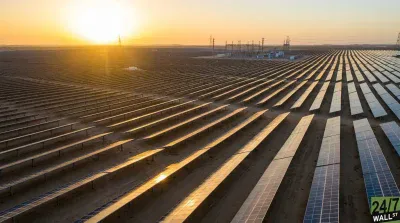
The Invesco Solar ETF (NYSEARCA:TAN) closed Wednesday at $52.47, up roughly 7% year to date while the S&P 500 has returned about 14%. That is a strange result for a fund whose underlying industry is now building out roughly half of every new megawatt added to the U.S. grid, according to EIA’s Electric Power Monthly planned additions tables. Over the past year, TAN has actually returned nearly 41%, nearly double the S&P, so the market is starting to notice. It just is not pricing solar the way it prices the pipeline data.
The Fund and Where It Sits Today
TAN tracks the MAC Global Solar Energy Index and held $2.29 billion in net assets as of its most recent NPORT filing dated May 31, 2026. Its largest single position is First Solar (NASDAQ:FSLR | FSLR Price Prediction), which has been the anchor of the fund for years. The problem, and the opportunity, is right there in the holdings: First Solar is down about 14% year to date even after posting a Q2 EPS beat of 39% and reaffirming $4.90 billion to $5.20 billion in full-year sales guidance. The stock is dragging the ETF while the business is compounding.
Over five years TAN is still down 36%, a reminder that this is a policy-sensitive, high-beta sleeve. The last 12 months have shifted the setup, but the fund still trades well below where solar deployment data alone would suggest.
Macro Factor: The Pending Section 232 Solar Decision
The single most important macro variable for TAN over the next 12 months is the Section 232 tariff decision on imported solar modules. On the Q2 call, CEO Mark Widmar said “there are meetings that are being had that would indicate they’re close to making a decision” and flagged that “there clearly are customers that are sitting on the sidelines” waiting on the outcome. A clean ruling with a minimum import price and no wide waivers would tighten module supply, lift domestic average selling prices, and re-rate the whole ETF. A ruling riddled with exemptions, as Widmar noted happened with Section 201, would gut the thesis.
Watch for Commerce Department and USTR announcements, and track the Federal Register weekly. Any headline naming a minimum import price, a quota, or a technology carve-out is the event.
Fund-Specific Factor: Hyperscaler Backlog Versus FSLR Concentration
Because First Solar sits at the top of TAN’s holdings, its 45.1 GW contracted backlog worth $13.6 billion and extending through 2030 is effectively a floor under the ETF’s earnings power. In July, First Solar announced roughly 5 GW of new project capacity across Cypress Creek’s Steel River center for Google, Terrigen, and Panamint. Widmar told analysts hyperscalers need a partner who can “make sure those photons become electrons”, and that is showing up as pricing power at roughly 36 cents per watt on U.S. gross bookings.
The signal to monitor is FSLR’s quarterly bookings volume and average selling price, both disclosed in its 10-Q and earnings deck. A step-up in ASP or a reading above 3 GW of net new bookings in a quarter would be the clearest tell that the data center buildout is flowing through to the ETF’s largest weight. A softer reading, or new customer terminations, would confirm the market’s caution.
What To Watch Next
The near-term catalyst is the Section 232 decision; the fund-level tell is First Solar’s next bookings update and any Q3 change in the $60 to $80 million net tariff impact assumption. If both break in solar’s favor before year end, TAN’s gap to the S&P is likely to keep closing.
Contact [email protected] for any questions or corrections.
Marc Guberti is a personal finance writer who has written for US News & World Report, Business Insider, Newsweek and other publications. He also hosts the Breakthrough Success Podcast which teaches listeners how to use content marketing to grow their businesses.