This 2.7% ‘Dividend’ ETF Quietly Holds 28% Big Tech. Here’s Who Should Own It Anyway
Fidelity's so-called high dividend ETF hides a portfolio that would surprise most income investors, and understanding who it actually benefits requires looking past the yield altogether.

This post may contain links from our sponsors and affiliates, and Flywheel Publishing may receive compensation for actions taken through them.

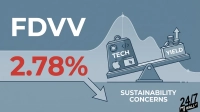
The name says high dividend. The portfolio says something different. Nearly 28% of the Fidelity High Dividend ETF (NYSEARCA:FDVV) is invested in technology stocks, and its three largest holdings are Nvidia, Apple, and Microsoft. Together, those three companies account for nearly 17% of the entire fund. That is not exactly what most investors picture when they go shopping for dividend income.
But that mismatch is also what makes FDVV interesting. Investors get a roughly 2.7% TTM dividend yield without abandoning the technology companies that have driven much of the market’s recent growth. For investors who want more income than the broader market provides, but are not ready to rotate heavily into utilities, consumer staples, and other traditional high-yield sectors, FDVV occupies a unique middle ground.
This Is Not Your Traditional Dividend ETF
FDVV tracks the Fidelity High Dividend Index, which looks beyond dividend yield alone. The strategy screens for companies with relatively high dividend yields, lower payout ratios, and dividend growth. That last part matters. A stock does not necessarily need a 5% yield to qualify as an attractive dividend investment if earnings and distributions are moving higher over time.
That approach produces a portfolio that looks surprisingly growth-oriented. As of June 30, information technology represented 27.58% of assets, making it FDVV’s largest sector. NVIDIA alone accounted for 6.76%, followed by Apple at 5.98%, Microsoft at 4.05%, Broadcom at 3.11%, and Dell Technologies at 2.93%. Add Alphabet at 2.02%, and roughly one-quarter of the portfolio sits in six major technology companies.
The rest of the fund brings the dividend exposure investors probably expected. JPMorgan Chase, Coca-Cola, Bank of America, Goldman Sachs, Philip Morris, Procter & Gamble, Home Depot, and Altria all ranked among its larger positions. The result is a 100-plus-stock portfolio combining mega-cap technology with financials, consumer staples, utilities, real estate, and other income-producing sectors.
The Tech Exposure Has Actually Helped
Loading a dividend ETF with Nvidia and Apple would be harder to defend if it came at the expense of long-term returns. So far, that has not been the case.
Through June 30, FDVV returned 19.47% over the previous year and an annualized 18.64% over three years. That trailed the Russell 1000’s 22.01% and 20.47%, respectively. Stretch the comparison to five years, however, and FDVV’s 13.59% annualized return edged the benchmark’s 12.66%.
That is the trade-off investors should focus on. FDVV is not trying to maximize current income at any cost. Its dividend yield is relatively modest compared with covered-call ETFs and some higher-yielding dividend strategies we have covered. Instead, the fund attempts to generate more income while retaining enough exposure to growth companies to participate when the market moves higher.
The price is concentration. Nvidia, Apple, and Microsoft alone represent 16.79% of the portfolio. Throw in Broadcom and Dell, and five technology companies account for nearly 23%. Investors who already own an S&P 500 or Nasdaq-100 fund should recognize that FDVV may add more exposure to stocks they already own rather than providing as much diversification as the “high dividend” label might imply.
Who Should Actually Own FDVV?
FDVV makes the most sense for an investor who wants to gradually shift toward income without completely abandoning growth.
Consider someone approaching retirement with a portfolio dominated by broad-market index funds. Moving aggressively into the highest-yielding stocks can increase current income, but it can also leave the portfolio underexposed to some of the companies driving earnings growth across the broader market. FDVV offers a compromise. You collect a higher dividend stream while tech remains a meaningful allocation.
The fund also keeps costs reasonably low. FDVV charges a 0.15% expense ratio, or about $15 annually for every $10,000 invested. Current assets under management currently sits at $9.7 billion as of June 30, giving investors a well-established ETF rather than a small niche product.
That said, the fund is a less obvious fit for investors whose primary objective is maximizing current income. A roughly 2.7% yield will not compete with an 8% or 10% option-income ETF when monthly cash flow is the priority. FDVV is also less compelling as a diversification tool for someone whose portfolio is already heavily concentrated in mega-cap technology.
See the table below for an overview of key fund metrics.
| Metric | FDVV |
| Inception Date | September 12, 2016 |
| Expense Ratio | 0.15% |
| Yield | 2.77% TTM (2.61% 30-Day SEC Yield) |
| Dividend Frequency | Quarterly |
| AUM | $9.74 billion |
| Index | Fidelity High Dividend Index |
| Strategy | Rules-based dividend strategy targeting large- and mid-cap dividend-paying stocks, emphasizing dividend yield, payout ratio, and dividend growth |
A Dividend ETF With a Growth Engine
FDVV is not built for investors chasing the highest possible yield. Its appeal is the middle ground. You get a roughly 3% yield while keeping meaningful exposure to high growth areas of the market. That makes FDVV a better fit for investors who want more income without giving up Big Tech. The 28% technology allocation may look unusual for a dividend ETF, but for the right investor, that is the point.
Contact [email protected] for any questions or corrections.
Ryne Mauck is an investment writer covering exchange-traded funds, retirement planning, and portfolio strategy. Through his work at 24/7 Wall St. and other investment platforms, including Seeking Alpha, he aims to provide clear, research-driven insights that help investors make more informed decisions while maintaining a long-term approach to investing.
Ryne holds a B.Sc. in Finance and an M.A. in Political Science. He is a formerly registered Municipal Advisor Representative and has passed the Series 50, Series 63, and Series 65 exams. His articles are not intended to be, nor should they be interpreted as, financial advice.