Forget VUG. Vanguard’s Value Fund Is Beating Its Growth Twin by 11 Points This Year, With None of the Magnificent Seven
Two Vanguard funds share the same large-cap universe, the same rock-bottom fee, and the same issuer, yet one is lapping the other by a stunning margin this year, and the reason comes down to seven stocks you probably already own…

This post may contain links from our sponsors and affiliates, and Flywheel Publishing may receive compensation for actions taken through them.
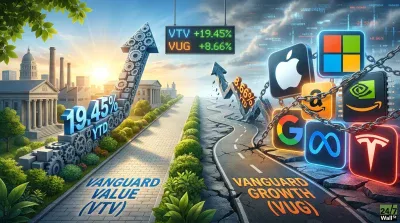
If you hold the Vanguard Growth ETF (NYSEARCA:VUG) as your large-cap growth sleeve, 2026 has been an underwhelming year, and the culprit sits inside the fund itself. Year-to-date, VUG is up 8.66% through premarket trading on September 9, 2026, trailing the S&P 500’s 12.34%. VUG’s mirror-image sibling from the same Vanguard large-cap split, the Vanguard Value ETF (NYSEARCA:VTV), is up 19.45% over the same window. Same issuer, same large-cap universe, opposite outcomes.
Same Family, Same Universe, an 11-Point Year-to-Date Gap
VTV’s 19.45% year-to-date return against VUG’s 8.66% is roughly an 11-point lead. Both funds carry an identical listed expense ratio of 0.03%, and both draw from Vanguard’s split of the U.S. large-cap universe. The story is composition, since fees are identical.
What VTV Owns, and What It Deliberately Skips
Here is the defining fact: VTV holds none of the Magnificent Seven, no Apple, Microsoft, Nvidia, Amazon, Alphabet, Meta, or Tesla. VUG holds all of them. Its four largest positions are NVIDIA at 13.3%, Apple at 12.3%, Alphabet at 9.9%, and Microsoft at 9.1%, with Amazon, Meta, and Tesla layered on top.
For a reader who also holds a broad S&P 500 fund, this is where the argument sharpens. Those same seven names anchor the S&P 500 too, so pairing VUG with a total-market or SPY position doubles your exposure to a handful of stocks you already own. VTV is the diversifier. It gives you large-cap U.S. equity exposure sourced from an entirely different roster.
A Multi-Period Value Lead
Zoom out and the year-to-date gap does not look like noise. Over the trailing year, VTV is up 26.42% against VUG’s 14.09%. Two consecutive periods of double-digit outperformance from the same style is meaningful.
That said, the five-year picture adds important context. VTV has returned 82.15% over that span versus 76.92% for VUG. Growth’s long-run lead narrows the further we expand out. Value has regained competitiveness after lagging through the late 2010s, while growth remains a viable style.
Who VTV Actually Fits
VTV is aimed squarely at the investor at or approaching retirement who has quietly become overweight seven stocks without meaning to. If your equity allocation is a target-date fund, plus an S&P 500 fund, plus VUG, your true exposure to NVIDIA, Apple, Microsoft, and Alphabet is far higher than any of those labels suggests. Rotating some or all of a VUG position into VTV lowers that concentration without leaving large-cap U.S. equities.
Income-oriented readers get a secondary benefit. VTV paid a trailing 12-month distribution of $4.09 per share, well above VUG’s $1.58. Value indexes lean into financials, healthcare, and industrials, which pay cash. Growth indexes lean into companies that reinvest it.
Risks You Should Own Going In
Value can lag for long stretches, and VTV’s exclusion of the megacaps is precisely what hurt it during the 2020 to 2023 growth run. If AI capex keeps compounding and Nvidia and its peers keep taking incremental S&P earnings share, VUG will likely pull ahead again. There is no free lunch in trading concentration for diversification: you accept the risk that the concentrated bet keeps winning.
Tax mechanics matter too. In a taxable account, selling appreciated VUG shares triggers capital gains. A partial rotation, or directing new contributions to VTV rather than liquidating VUG, sidesteps that. Inside an IRA or 401(k), the switch is frictionless.
Where That Leaves You
VUG remains a concentrated bet on seven names you likely already own elsewhere. VTV is the same Vanguard machinery pointed at everything else, and this year that everything else is winning by a wide margin. If your portfolio quietly triple-counts the Magnificent Seven, moving part of your VUG allocation into VTV corrects that in a single trade. Evaluate the swap against your own tax situation and time horizon.
Contact [email protected] for any questions or corrections.
Ryne Mauck is an investment writer covering exchange-traded funds, retirement planning, and portfolio strategy. Through his work at 24/7 Wall St. and other investment platforms, including Seeking Alpha, he aims to provide clear, research-driven insights that help investors make more informed decisions while maintaining a long-term approach to investing.
Ryne holds a B.Sc. in Finance and an M.A. in Political Science. He is a formerly registered Municipal Advisor Representative and has passed the Series 50, Series 63, and Series 65 exams. His articles are not intended to be, nor should they be interpreted as, financial advice.