Chevron Has More Going for It Than Higher Oil Prices
Wall Street sees modest upside for Chevron, but a seven-quarter streak of earnings beats, a 20-year AI power deal, and a valuation well below the broader market suggest analysts are still underestimating what this stock can do.

In Chevron’s second quarter, every part of the business ran strong at once. Chevron (NYSE:CVX | CVX Price Prediction) set a U.S. upstream production record of 2,077 MBOED, ran its U.S. refineries at 97% capacity, and captured $1.5 billion in Hess savings within a year of closing. That savings figure beat the original target by 50%.
CEO Mike Wirth credited “disciplined investment and strong execution that drove record U.S. upstream production, record crude throughput in our U.S. refineries, and exceptional reliability across key assets.”
Shares are up 40.02% year-to-date and 152.16% over five years. Brent averaged $104 in Q2, but cost cuts, Guyana, and a new AI power business give this rally more runway. Here’s how Chevron could hit $250 per share in 2027.
Analysts See Modest Upside While Chevron Keeps Beating Them
Wall Street’s average price target of $223.92 implies 7.8% upside from $207.63. Sentiment leans bullish, with 6 Strong Buy and 14 Buy ratings against one Sell.

Chevron has exceeded consensus EPS for seven consecutive quarters. Q1 EPS was $1.41 versus a $0.9687 estimate. Q2 adjusted EPS jumped to $6.06 as revenue rose 51.4% to $67.20 billion. Such a run suggests current forecasts are conservative.

Here’s What It Takes for Chevron to Reach $250
Chevron trades at 15x forward earnings, cheaper than the S&P 500’s roughly 21x to 23x. A move to $250 would be a 20.4% gain, raising the multiple to about 18x forward earnings, still below the market.
Management’s 2030 plan calls for adjusted free cash flow growth averaging greater than 10% annually, assuming flat oil prices below today’s levels. For that growth, 18x is reasonable.
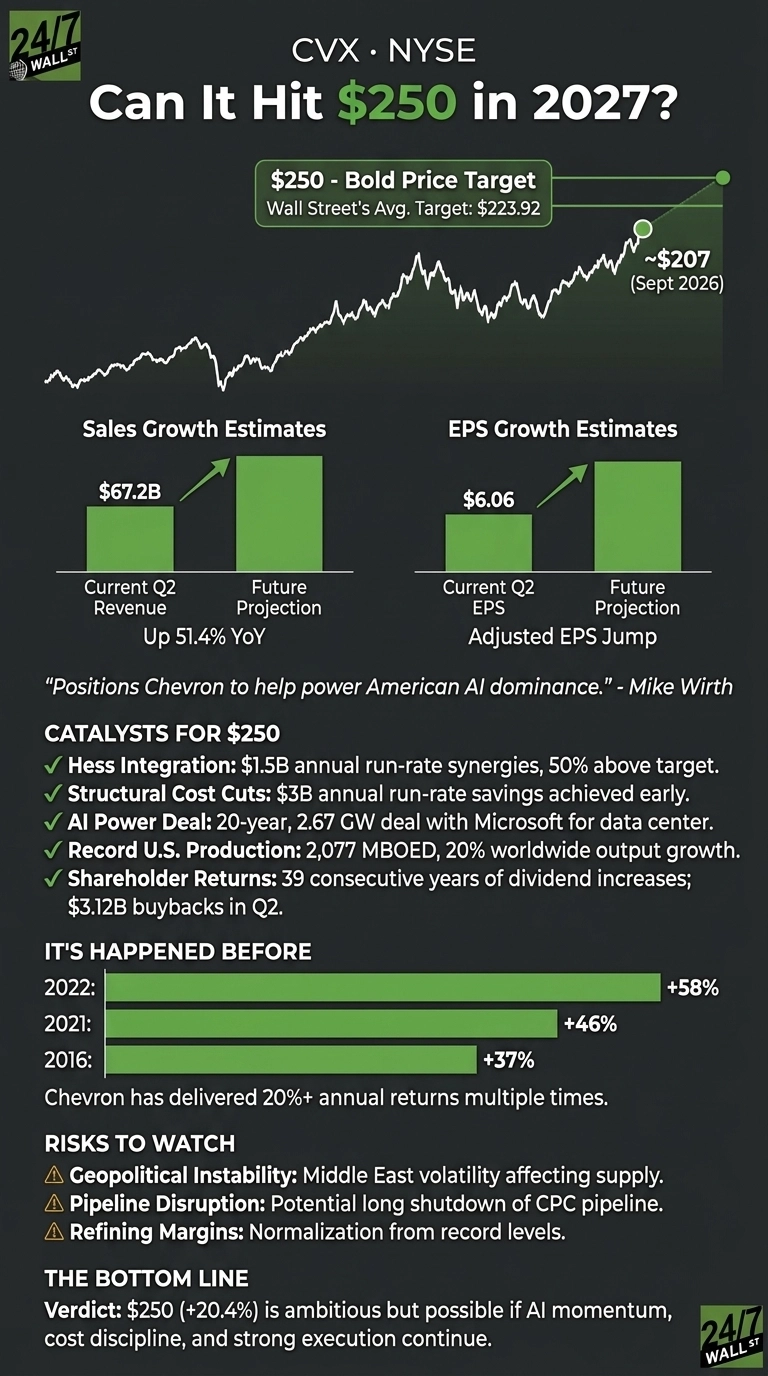

What Could Push Chevron to $250?
- Built-in savings: Chevron reached $3 billion in annual run-rate cost cuts six months early. CFO Eimear Bonner said the savings are “built into the business.”
- AI power: Project Kilby is a 20-year take-or-pay deal to supply Microsoft (NASDAQ:MSFT) with 2.67 gigawatts of power. It targets mid-teens returns from cash flows that don’t depend on commodity prices. Management calls it a repeatable model and says talks for more deals are advanced.
- Guyana: Free cash flow from the Hess assets has been “roughly double the incremental dividends,” and Guyana should keep high-margin oil growing into the 2030s.
- Refining: Downstream earnings reached $4.87 billion, up from $737 million a year ago. Management said “products are tighter than crude around the world.”
- Capital efficiency: Chevron expects to spend 25% less capex per barrel in 2026.
- Shareholder returns: Chevron bought back $3.12B of stock in Q2 and pays a $1.78 quarterly dividend. It has raised that dividend for 39 consecutive years.
- Growth options: These include Iraq’s West Qurna 2, Venezuela and Argentina, where management wants to grow the business 3x by 2035.
Chevron is one piece of a broader shift: the AI expansion runs on power, cooling, and networking, not just chips. We highlighted seven of those non-chipmaker suppliers in a free report you can grab here.

There are real risks. A long shutdown of the CPC pipeline, which carries Chevron’s Kazakhstan oil to market, conflict in the Middle East, and a return to normal refining margins could all slow progress.
Chevron’s History Says a 20% Year Is Well Within Reach
On a dividend-adjusted basis, Chevron has exceeded a 20.4% gain in eight calendar years since 2000. Total return reached 58% in 2022, 46% in 2021, 37% in 2016 and 35% in 2003.
Back-to-back big years have happened too, with 34% in 2006 followed by 31% in 2007.
$250 Is a Stretch, and Chevron Has the Tools to Get There
Reaching $250 requires a 20.4% gain, above the Street’s target. A seven-quarter beat run, $18.10B of Q2 free cash flow, commodity-proof power contracts, and a valuation below the market support it. Chevron has the tools to deliver outsized returns in 2027.
Contact [email protected] for any questions or corrections.
Vandita Jadeja is a financial publisher with over a decade of experience writing about financial topics, including investment, savings, retirement, insurance and banking. Vandita is a Chartered Accountant who loves to debunk financial concepts for readers.
Her work has appeared on sites that include The Motley Fool, InvestorPlace, and Benzinga. She covers investing and focuses on stock picks and price prediction for 24/7 Wall St.
When not looking for the next stock investment opportunity, she can be found traveling, reading, chasing sunsets and enjoying her iced latte.