CGDV vs. SCHD: Can an Active Dividend ETF Dethrone the Index Favorite?
CGDV and SCHD both carry the dividend label, but their portfolios share almost nothing in common and their recent returns have split dramatically. The fund that dominated for five years is now lagging badly, and the reason comes down to…

This post may contain links from our sponsors and affiliates, and Flywheel Publishing may receive compensation for actions taken through them.
Investors sizing up Capital Group Dividend Value ETF (NYSEARCA:CGDV) against Schwab U.S. Dividend Equity ETF (NYSEARCA:SCHD) are really choosing between two philosophies of dividend investing. CGDV lets Capital Group’s active managers own quality growers with capital appreciation potential, even if their yields are thin. SCHD hands the portfolio to a rules-based screen that demands at least 10 consecutive years of dividend payments, then ranks candidates on cash flow, ROE, yield, and dividend growth. Same category, very different bets, and 2026 has exposed the gap.
Two Very Different Bets on What a Dividend Fund Should Own
CGDV’s active mandate shows up immediately in the holdings. As of May 31, 2026, Microsoft leads at 5.81%, with NVIDIA and Broadcom close behind. Alphabet, Meta, and Eli Lilly round out the top holdings. None of those would pass SCHD’s yield-and-history screen. The implicit bet: earnings quality and reinvestment runway matter more than current payout size.
SCHD tells the opposite story. QUALCOMM leads at 6.74%, trailed by Texas Instruments and UnitedHealth, then Coca-Cola, Merck, Chevron, Verizon, and Procter & Gamble. Energy, staples, and mature healthcare dominate. The bet is that financially sturdy, cash-generative payers deliver steady total returns without needing a growth tailwind.
Where the Divergence Shows Up in 2026
This year flipped the script many investors expected. Year to date, SCHD is up 26.51% versus CGDV’s 12.75%. Over the trailing year, the spread is similar: SCHD 29.43% against CGDV’s 18.07%. The rotation into value, energy, and healthcare cyclicals played directly to SCHD’s screen. CGDV’s mega-cap tech tilt, which powered it through 2023 and 2024, has cooled off, with the fund down 4.21% over the past month.
Stretch the window and the picture rebalances. Over five years, CGDV has delivered 112.54% versus SCHD’s 61.07%, a spread that reflects CGDV’s willingness to hold names like NVIDIA, Broadcom, and Meta through the AI-driven run.
Yield, Cost, and Overlap
| Metric | CGDV | SCHD |
|---|---|---|
| Expense ratio | 0.33% | Historically low (Schwab) |
| Net assets | $35.17 billion | $94.95 billion |
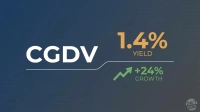
| Trailing 12-month dividend | $0.5861 | $1.048 |
| Recent share price | $48.93 | $34.14 |
SCHD delivers roughly twice the yield on its share price and costs less to hold. But overlap with an S&P 500 core position is where the funds truly diverge. CGDV replicates a large slice of the index’s mega-cap growth exposure through Microsoft, NVIDIA, Alphabet, Meta, and Apple. SCHD, by design, screens most of that out, giving investors genuine diversification against a broad-market core.
Verdict: Match the Fund to the Job
SCHD fits the investor who wants a real yield stream, low fees, and a portfolio that behaves differently from a total-market index. CGDV fits the investor who treats “dividend value” as a wrapper for quality-growth compounders and is willing to accept a thinner payout and higher tech beta to get there. If dividend income is the goal, SCHD wins outright. If total return with a dividend flavor is the goal, CGDV’s five-year record earns the argument, provided the mega-cap tech thesis keeps working.
Contact [email protected] for any questions or corrections.
Jake has been been working in financial media for almost 15 years. He focuses on all things personal finance for 24/7 Wall St. with high hopes to educate and entertain. Most recently, Jake spent 12 years working various roles at The Motley Fool. He started copy editing fool.com content, worked on premium and marketing campaigns, and helped launch The Ascent, a personal finance brand.
His work has been featured on platforms like MSN, Yahoo Finance, USA Today, and more. He's written about credit cards, social security, ETFs, savings accounts, and just about anything else you can imagine when thinking about money. Jake love to cook, play golf, and tell people he's never had a cavity. (It's true!)