USMV Cut the Worst Drawdown to 8.91%. On $300,000 That Protection Cost $131,460
Choosing a smoother ride over a volatile one sounds sensible until you add up what the comfort actually costs across five years and a single brutal week in April.

This post may contain links from our sponsors and affiliates, and Flywheel Publishing may receive compensation for actions taken through them.
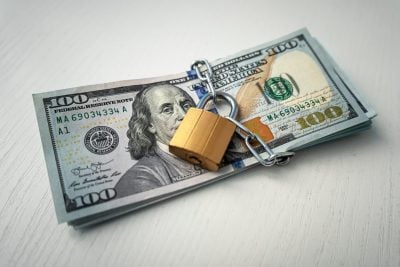
Low volatility funds offer a smoother ride, and the iShares MSCI USA Min Vol Factor ETF (CBOE:USMV) delivered one. From October 12, 2021, to October 9, 2026, its worst peak-to-trough decline was -8.91%. The worst decline for the Vanguard S&P 500 ETF (NYSEARCA:VOO) was -11.98%. Both funds hit those lows over the same few days, April 2 to April 8, 2025.
A $300,000 position in USMV held from October 8, 2021 to October 12, 2026 grew to $440,310. The same money in VOO grew to $571,770. That leaves a $131,460 gap on one account, and what it bought was a shallower drop during a single week in April.
What the Smoother Ride Actually Delivered
Over the risk window, USMV’s daily standard deviation (how much returns swing each day) was 0.778%. VOO’s was 1.065%. USMV’s lower figure supports its low volatility label.
The two funds’ daily returns had a correlation of 0.82. On a scale where 1.0 means the two move in perfect lockstep, that figure means they move together much of the time but not all of it. USMV held steady often enough to make it feel different to own.
The portfolio explains why. As of July 31, 2026, USMV’s largest positions included electric utilities, telecom carriers, waste haulers, insurance companies, and drugmakers, each at about 1% to 1.6% of net assets. VOO held 38.0% in information technology and only 2.2% in utilities as of June 30, 2026.
A Premium That Never Shows Up on Your Statement
Over the return window, USMV returned 46.77%, and VOO returned 90.59%. On $300,000, that works out to $440,310 against $571,770.
That $131,460 is the cost of lower volatility. The fund delivered on that tradeoff, because the fund fell less when markets broke in April 2025. The cost came as growth the holder never received, which is why most owners have never put a number on it.
How These Figures Were Measured
The figures come from two windows. The returns run from October 8, 2021 to October 12, 2026 and are dividend-adjusted for both funds, so every distribution is already included. The risk figures run from October 12, 2021 to October 9, 2026. The standard deviations are daily and unannualized.
The drawdown is the single worst peak-to-trough decline inside that window. It shows how USMV handled one sharp shock. It does not prove the fund buffered every downturn it has ever faced.
Where the Defensive Case Still Holds
A five-year stretch dominated by a strong market is the setting where a defensive fund should lag most. A different five years could narrow or reverse this gap. The April 2025 decline lasted about a week. In a severe, extended bear market, a smaller drawdown could matter far more than it did here.
Which Investor Paid for Something Real
Suppose you could not have held through VOO’s 11.98% drop and would have sold near the bottom. Then USMV bought you something real. Selling at the low locks in the loss and often means missing the rebound. For that investor, a calmer fund that keeps the money invested can be worth a larger premium.
To find out which investor you are, look at your record. Pull your account history from past declines, including April 2025. Did you sell? Did you break contributions or move to cash? Did you lose sleep but change nothing? What you traded during those stretches can serve as reliable evidence.
Over this window, USMV’s tradeoff favored investors at or near retirement whose own history shows they sell during declines, and who would rather give up growth than sit through a deeper drop. That early-retirement risk, where a bad stretch in the first few years does permanent damage, is the exact problem we mapped in a free guide to defending the first five years. For investors who stayed put through past selloffs, this window shows the comfort came at a steep price. Before paying a premium like this, ask yourself one question: the last time markets fell hard, what did I actually do?
Contact [email protected] for any questions or corrections.
Ryne Mauck is an investment writer covering exchange-traded funds, retirement planning, and portfolio strategy. Through his work at 24/7 Wall St. and other investment platforms, including Seeking Alpha, he aims to provide clear, research-driven insights that help investors make more informed decisions while maintaining a long-term approach to investing.
Ryne holds a B.Sc. in Finance and an M.A. in Political Science. He is a formerly registered Municipal Advisor Representative and has passed the Series 50, Series 63, and Series 65 exams. His articles are not intended to be, nor should they be interpreted as, financial advice.