Still Trading at 63? Don’t Let Losses Spill Into the Money That Funds Your Retirement
Plenty of investors in their early 60s still enjoy picking stocks, and that habit alone is not the problem. The real danger lives at the boundary between the trading account and the money retirement depends on, and it tends to…

This post may contain links from our sponsors and affiliates, and Flywheel Publishing may receive compensation for actions taken through them.

You’re 63, retirement is close, and you still enjoy trading individual stocks. You read earnings reports, you follow management teams, and some of your calls have paid off. None of that has to stop. What needs protecting is the line between the trading account and the money that has to fund your retirement.
Three broad funds can hold that line: Vanguard Morningstar Value ETF (NYSEARCA:VTV) for large U.S. value stocks, iShares MSCI ACWI ex U.S. ETF (NASDAQ:ACWX) for stocks outside the U.S., and Schwab 5-10 Year Corporate Bond ETF (NYSEARCA:SCHI) for the stable portion of your core.
Where a Fun Account Starts Costing You Real Money
The hobby itself is fine. The risk is at the boundary, and it usually fails quietly. You top up the trading account from the nest egg after a loss to get back to even. A run of winning trades convinces you to move more money over. Or you slowly start running the core money with the same short-term mindset you bring to trading.
Suze Orman framed the key question on her podcast: “Is there an amount of money that you want to keep safe and sound that you know you’re going to need by the time that you turn 65 and retire?” Once you know that number, it belongs behind a wall.
That first stretch of retirement is also where a market drop does the most damage, because withdrawals from a shrinking balance are hard to recover from (we walked through how to protect those early years in a free guide here: The First Five Years).
Build the Wall Before You Need It
- Keep separate accounts so the play money and the core never blur together on one screen.
- Fund the trading account once, in advance, and treat that amount as the most it can ever lose.
- Let losses stay put. Never refill the trading account from the core.
- Sweep gains over periodically so a good run builds up the nest egg instead of growing the trading stake.
- Run the core on autopilot with broad funds that give you nothing to tinker with.
Keeping them apart also matters for taxes, since frequent trading outside a tax-advantaged account can create taxable gains every year. A broad fund held for years forces far fewer of those decisions.
VTV Anchors Your Core in Established U.S. Companies
VTV seeks to track an index of large-capitalization value stocks, meaning mature, profitable U.S. businesses that trade at lower valuations than high-growth companies. You get the whole basket in one fund, so there’s nothing to pick and nothing to trade.
The expense ratio is 0.03%, a cost so small it barely impacts your returns. VTV pays dividends quarterly, totaling $4.1646 per share over the trailing 12 months. Payouts vary. The latest was $1.0174, down from $1.0818 the quarter before. The fund is up 25.37% over the past year and 79.84% over five years, though past gains say nothing about the next stretch.
ACWX Keeps Your Retirement From Riding on One Country
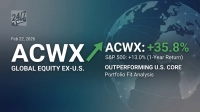
If your trading account is full of U.S. stocks, your core can add exposure beyond that same market. ACWX tracks the MSCI ACWI ex USA Index, made up of large- and mid-capitalization non-U.S. equities. Its latest holdings filing shows exposure across Canada, Japan, the United Kingdom, France, Switzerland, the Netherlands, China, India, Taiwan, Australia, Brazil, and Saudi Arabia, among other markets.
It came to market in March 2008 and held about $11.5 billion in net assets as of July 31, 2026. It returned 13.41% over the past year and 48.32% over five years, but it slipped 2.92% in the past month. Expect that kind of movement.
SCHI Holds the Stable Portion, With Real Risks Attached
SCHI tracks the Bloomberg US 5-10 Year Corporate Bond Index, which covers intermediate-term corporate debt. It charges 0.03%, holds about $11.6 billion in net assets, and pays monthly. Distributions came to $1.1416 per share over the trailing 12 months. Its bonds come from issuers in utilities, telecommunications, health care, financials, technology, energy, and real estate.
SCHI has more exposure to corporate defaults and interest-rate risk than a short-term Treasury fund. The 10-year Treasury yield hit 5.31% on October 5 before falling to 4.98%, and moves like that push bond prices around. SCHI is down 1.35% this year. Also keep in mind that a bond fund invests in bonds but never matures itself. There’s no date when your principal comes back the way it does with a single bond.
Trade-Offs to Weigh Before You Build Your Wall
None of these funds will give you the thrill of a good trade. VTV and ACWX will fall in stock selloffs, value stocks can trail growth for long stretches, and ACWX adds currency swings plus a higher 0.32% expense ratio. SCHI can lose value when rates rise, or credit worries flare up.
The trading account is where you make individual stock trades. These three funds sit on the other side of the wall. They are diversified, cheap to hold, and dull enough that you won’t be tempted to trade them. Keep the hobby, and keep the retirement money out of it.
Contact [email protected] for any questions or corrections.
Ryne Mauck is an investment writer covering exchange-traded funds, retirement planning, and portfolio strategy. Through his work at 24/7 Wall St. and other investment platforms, including Seeking Alpha, he aims to provide clear, research-driven insights that help investors make more informed decisions while maintaining a long-term approach to investing.
Ryne holds a B.Sc. in Finance and an M.A. in Political Science. He is a formerly registered Municipal Advisor Representative and has passed the Series 50, Series 63, and Series 65 exams. His articles are not intended to be, nor should they be interpreted as, financial advice.