BIZD’s 9.69% Expense Ratio Includes Fees Its BDCs Charge Before the Fund Takes Its Cut
BIZD's 9.69% expense ratio scares off investors before they understand what it actually measures, and that confusion costs them. Knowing where that number comes from changes how you read every yield figure the fund publishes.

This post may contain links from our sponsors and affiliates, and Flywheel Publishing may receive compensation for actions taken through them.

Investors who bought the VanEck BDC Income ETF (NYSEARCA:BIZD) for income have probably seen the number that stops them cold. VanEck’s fund page lists a total expense ratio of 9.69%, and VanEck notes that figure includes acquired fund fees and expenses. Many investors misunderstand what that very real cost actually represents.
What Sits Inside BIZD’s 9.69% Figure
Inside BIZD are business development companies (BDCs), which lend to small and midsize private businesses. Every BDC covers its own bills: fees to its manager, interest on the money it borrows, and day-to-day operating expenses. SEC fund disclosure rules require a fund that owns other investment funds to add those underlying costs to its own fee table. That line is called acquired fund fees and expenses (AFFE, or the underlying funds’ own costs).
Think of a store selling a jarred sauce. The shelf price already covers what the sauce maker spent on ingredients, labor, and its own loans, but now imagine the store had to print the maker’s costs on its own price tag, next to its own markup. You still pay once at the register.
BIZD’s own fee is separate from the BDC layer. According to VanEck’s fund page, the fund’s adviser bears its expenses except the management fee, acquired fund fees and expenses, interest expense, offering costs, trading expenses, taxes, and extraordinary expenses.
Your Yield Already Reflects These Costs
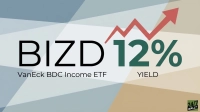
As of November 2, 2026, VanEck lists a twelve-month yield of 12.42%, a 30-day SEC yield (a standardized, after-cost income measure) of 9.34%, and a distribution yield of 13.93%.
BDCs pay their managers and lenders before their income reaches BIZD. The costs are already reflected in those yields. The 9.69% is spent inside the BDCs and the fund itself, before anything reaches your account. Holders never get a separate annual bill for it.
Returns Already Include Every Layer
The same logic applies to performance. On an adjusted-price basis that accounts for distributions, BIZD returned -2.66% from November 3, 2025 to November 3, 2026, and 23.31% from November 4, 2021 to November 3, 2026. Those results come after BDC management fees, BDC interest costs, and VanEck’s own fee.
Where the Cost Still Bites Income Investors
Costs taken out upstream still matter. Money a BDC spends on incentive fees (performance bonuses for its manager) or on interest is money its loans cannot pass through to shareholders. Fee structures and borrowing levels differ widely across the sector, so two BDCs with similar loan books can deliver very different income.
Payouts move around too. Distributions of $0.4818 per share went out with an ex-date of April 1, 2026, then $0.2391 on July 1, 2026, then $0.4371 on October 1, 2026. A retiree who budgets around a regular check should account for that swing. A very high yield can also signal stress in the underlying loans, so the headline number deserves a closer look (we listed the seven warning signs that a big yield is about to break in a free guide, here).
What BIZD Owns Right Now
VanEck’s daily holdings show several names. As of November 2, 2026, they include Ares Capital (NASDAQ:ARCC | ARCC Price Prediction) at 14.12%, Main Street Capital (NYSE:MAIN) at 5.39%, Blue Owl Capital Corp (NYSE:OBDC) at 5.33%, and Blackstone Secured Lending (NYSE:BXSL) at 5.03%.
The fund also holds two U.S. Treasury bill positions weighted at 18.27% and 18.07%. It holds two total return swaps (contracts that pay an index’s return) on the MVBDC index, with notional values of $547,143,268 and $16,052,930. In plain terms, part of BIZD’s BDC exposure comes through swap contracts instead of direct share ownership.
BIZD tracks the MVIS US Business Development Companies Index. VanEck publishes its own guide on BIZD’s acquired fund fees, and it is worth reading alongside the prospectus.
Two Fee Lines to Find Before You Buy
Before buying any BDC or closed-end fund vehicle, open the prospectus fee table and find two lines. The first is the fund’s own management fee, which the sponsor keeps. The second is acquired fund fees and expenses, which the underlying managers and lenders spend before income ever reaches you. Then compare the SEC yield—which is net of costs—with what similar credit risk pays elsewhere. Ask yourself one question: after every layer of cost, am I being paid enough for the credit risk I hold?
Contact [email protected] for any questions or corrections.
Ryne Mauck is an investment writer covering exchange-traded funds, retirement planning, and portfolio strategy. Through his work at 24/7 Wall St. and other investment platforms, including Seeking Alpha, he aims to provide clear, research-driven insights that help investors make more informed decisions while maintaining a long-term approach to investing.
Ryne holds a B.Sc. in Finance and an M.A. in Political Science. He is a formerly registered Municipal Advisor Representative and has passed the Series 50, Series 63, and Series 65 exams. His articles are not intended to be, nor should they be interpreted as, financial advice.