Forget SCHD: 4 Dividend Stocks Retirees Should Own Instead

This post may contain links from our sponsors and affiliates, and Flywheel Publishing may receive compensation for actions taken through them.
The Schwab U.S. Dividend Equity ETF (NYSEARCA:SCHD) grounds many retirement income portfolios for good reason. SCHD tracks the Dow Jones U.S. Dividend 100 Index, screens for yield and quality, and holds about $112.3 billion[1] in net assets. Its trailing yield works out to about 2.96%. Over the past year, though, SCHD raised its payout only 1.95%. A four-stock basket of AT&T (NYSE:T | T Price Prediction), Chevron (NYSE:CVX), Merck (NYSE:MRK) and Walmart (NASDAQ:WMT) pays a similar yield, and its dividends are growing faster.
Why Retirees Trust SCHD
SCHD spreads its money across healthcare, energy, staples, financials and industrials, so no single dividend cut can damage a retiree’s income much. It has also delivered gains. The price rose 35.52% over the past year. The weak spot is the payout itself.
SCHD paid $1.0541 per share over the trailing 12 months, versus $1.0339 in the prior 12 months. The June 2026 distribution of $0.2525 came in below the $0.2602 paid a year earlier. That pace leaves little room when costs climb every year in retirement.
SCHD’s holdings also overlap with the basket. As of August 31, 2026[1], SCHD already held Merck at 4.76%[2] and Chevron at 4.01% of assets. AT&T and Walmart did not appear in its holdings, so the basket adds two businesses the fund doesn’t own.
Four Payers, Four Different Jobs
AT&T: Highest Income
AT&T yields about 4.99% on its $1.11 annual dividend. The dividend costs roughly $7.5 billion a year, while management targets $18B+[3] in 2026 free cash flow, rising to $21B+ by 2028. That leaves plenty of cash to cover the payout. The risk is growth. The payout has held at $0.2775 per quarter since 2022, down from $0.52 in 2020 and 2021. AT&T’s leverage also stands at 3.13x[3] net debt to EBITDA.
Chevron: Yield Plus Raises
Chevron yields about 3.27%, above SCHD. Third-quarter free cash flow of $12.0B[4] covered the roughly $3.47 billion quarterly dividend bill more than three times over, and Chevron cut net debt by $7.8B. The quarterly dividend has risen from $1.07 in 2016 to $1.78 today. The risk: Brent averaged $97/bbl vs $69[4] a year ago, and today’s cash flow depends on those prices.
Merck: Steady Growth
Merck yields about 2.37%, below SCHD. Its case rests on reliability. The dividend rose 4.94% to $0.85 per quarter, and the record shows no cuts back to 1999. The CFO said, "We remain committed to the dividend, with the goal of increasing it over time."[5] Its 2026 EPS guidance of $2.77-$2.82 looks thin next to the dividend because it includes one-time acquisition charges of $3.62 and $2.31 per share. The risk: Keytruda loses exclusivity in the coming years, and Merck expects more than $2 billion[5] of 2027 headwinds from generics.
Walmart: Long-Term Growth
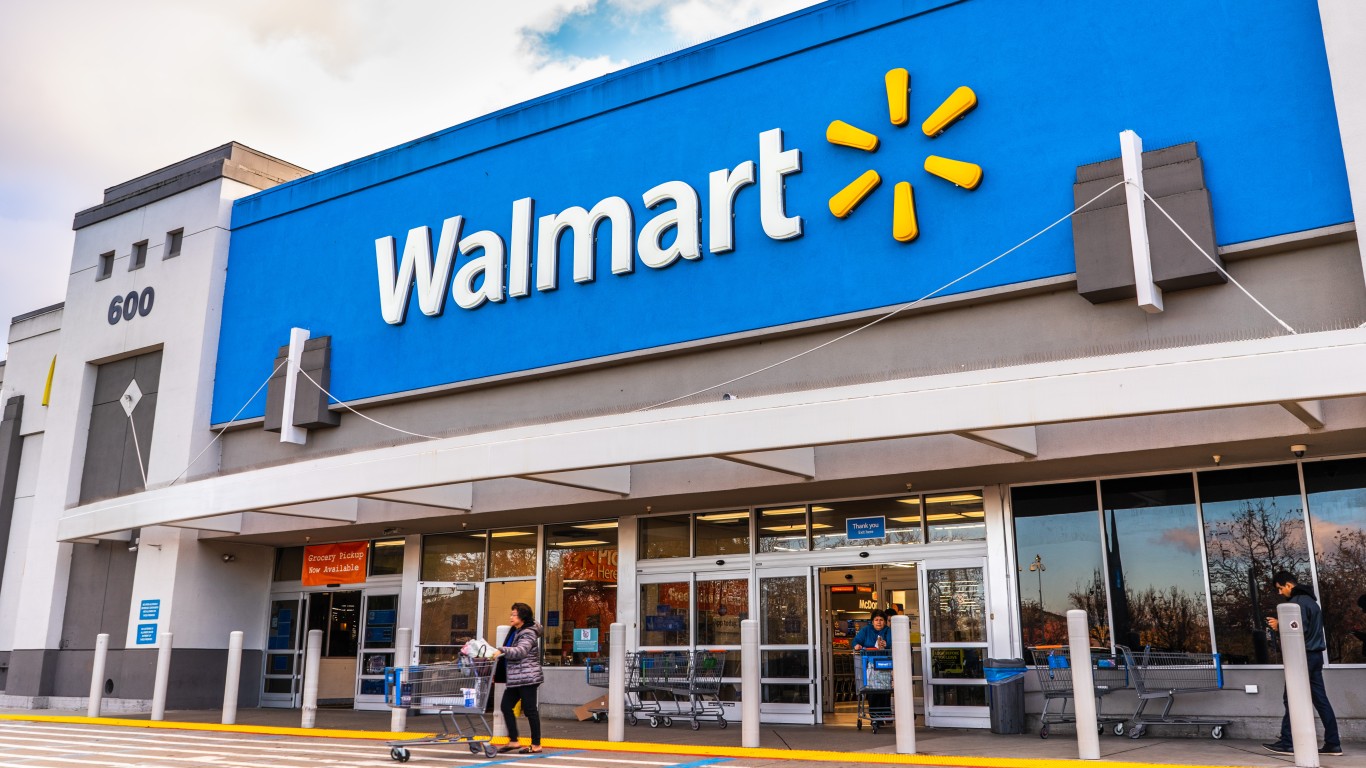
Walmart yields just 0.78%, far below SCHD. It wins a spot through growth. This year’s raise came to 5.32%, and the payout uses about 35% of fiscal 2027 EPS guidance of $2.80-$2.87[6]. Global eCommerce grew 23%[6] last quarter. The risk is valuation: the stock trades at 39 times forward earnings.
Comparing the Basket Dollar for Dollar
Put $100,000 into SCHD and you collect about $2,955 a year. Split it equally across the four stocks and you collect about $2,853, a blended yield of 2.85%. That costs you a little income today. In exchange, the basket’s dividends grew an average 3.59% this year, versus 1.95% for SCHD. You also pay no fund expense ratio. The edge is modest, and it builds over time.
The trade-off is concentration. One dividend cut would take about a quarter of the basket’s companies with it, and SCHD includes that kind of blow across its full portfolio. AT&T’s flat payout also drags down the basket’s growth rate.
Tax Costs Could Shrink Any Shift Out of SCHD
SCHD is up 33.24% this year, so selling it in a taxable account likely realizes capital gains. Swaps inside an IRA avoid that realization, as does routing fresh money and SCHD’s quarterly payouts into the four stocks. Dividend dates also affect near-term income. Chevron’s next dividend has a record date of Nov 18, 2026[4], and Walmart’s ex-dividend date is December 11, 2026.
Where This Leaves an SCHD Holder
A partial move maintains more diversification than a full exit. Combining SCHD as a diversified core with the four stocks would add faster dividend growth and AT&T and Walmart exposure (the broader goal of building income you can live on without selling shares is the whole subject of our free dividend ladder guide, here). The case gets stronger if AT&T resumes raises once its free cash flow reaches its targets. It gets weaker if oil prices fall or Merck struggles as Keytruda loses exclusivity. How much to move depends on your own tax situation and time horizon.
Contact [email protected] for any questions or corrections.
Lee Jackson has covered Wall Street analysts' equity and debt research and equity strategy daily for 24/7 Wall St. since 2012. His broad, diverse career, including a stint as creative services director at an NBC affiliate in Austin, Texas, gives him unique insight into the financial industry.
Lee Jackson's journey in the financial industry spans more than 30 years, including nearly two decades as an institutional equity salesperson at Bear Stearns, Lehman Brothers, and Morgan Stanley. His career spanned pivotal sell-side Wall Street events, from the dot-com rise and bubble to the Long-Term Capital Management debacle, 9/11, and the Great Recession of 2008. This reflects his resilience and adaptability amid market volatility.
Lee Jackson’s practical financial industry experience, gained through a career at some of the biggest banks and brokerage firms, is complemented by a lifetime of writing across various platforms. This unique combination allows him to shed light on the intricacies of Wall Street in a way only someone with deep insider experience and knowledge can. Moreover, his extensive network across Wall Street continues to provide direct access for him and 24/7 Wall St., a privilege few firms enjoy.
Since 2012, Jackson’s work for 24/7 Wall St. has been featured in Barron’s, Yahoo Finance, MarketWatch, Business Insider, TradingView, Real Money, The Street, Seeking Alpha, Benzinga, and other media outlets. He attended the prestigious Cranbrook Schools in Bloomfield Hills, Michigan, and has a degree in broadcasting from the Specs Howard School of Media Arts.