A 66-Year-Old With $600,000 in VOO Owns Nvidia Without Ever Buying a Share. SCHD Owns None.

This post may contain links from our sponsors and affiliates, and Flywheel Publishing may receive compensation for actions taken through them.

Picture a 66-year-old retiree with $600,000 in the Vanguard S&P 500 ETF (NYSEARCA:VOO). To most holders, VOO is one simple, cheap core fund. It also makes this retiree a part owner of Nvidia (NASDAQ:NVDA | NVDA Price Prediction), though they never bought a single share. Vanguard’s April 28, 2026 prospectus says VOO tracks the S&P 500 Index and holds each stock “in approximately the same proportion as its weighting in the Target Index,” and Nvidia ranks among the fund’s top holdings. Many income-focused retirees compare VOO with the Schwab U.S. Dividend Equity ETF (NYSEARCA:SCHD). SCHD holds no Nvidia at all.
People own VOO because one purchase buys the whole large-cap U.S. market, and that market has a lot of technology in it. Vanguard’s semi-annual report showed 519 holdings, with information technology at 38.0% of net assets as of June 30, 2026. A VOO holder owns that tilt whether they meant to or not.
What Schwab’s Dividend Fund Owns Instead
SCHD’s holdings disclosure as of August 31, 2026, listed 102 positions, and Nvidia was not one of them. The fund seeks to track the Dow Jones U.S. Dividend 100 Index, a benchmark built to measure high-dividend-yielding stocks issued by U.S. companies that have a record of consistently paying dividends.
Put simply, SCHD runs dividend-paying companies through its own set of rules. A company that fails those screens stays out, no matter how big it is. That explains how one of the largest U.S. companies can be missing from a fund with more than $112 billion[1] in net assets. The index is rebuilt periodically, so holdings change. This data shows only that filing date.
Which Fund Won Depends Entirely on When You Started Counting
Both funds’ return windows begin on the same dates, and all figures assume distributions were reinvested. The performance figures use delayed quotes from the Wednesday, November 18 afternoon session, when VOO traded at $672.89 and SCHD at $34.89.
| Window | SCHD | VOO | Gap |
|---|---|---|---|
| One month | 1.57% | -4.09% | SCHD by 5.66 points |
| Year to date | 30.32% | 8.24% | SCHD by 22.08 points |
| One year | 33.73% | 11.22% | SCHD by 22.51 points |
| Five years | 59.14% | 67.11% | VOO by 7.97 points |
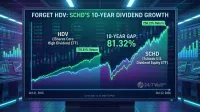
| Ten years | 244.86% | 294.61% | VOO by 49.75 points |
Since November 17, 2025, SCHD has led by a wide margin. The most recent month extended its edge further, as VOO declined and SCHD rose.
Look further back, and the order flips. Since November 18, 2021, VOO leads by a single-digit margin. Since November 18, 2016, its lead grows to nearly 50 points. Retirees who judge these funds on the past year alone see one winner, and those who look back a decade see the other. Neither window predicts the next one.
What This Means for a 66-Year-Old Retiree
An index fund owns whatever the index owns. For VOO, that means the largest technology companies, Nvidia included, along with the concentration that comes with them. A dividend-screened fund owns a different mix, and its rules can exclude some of the market’s biggest names. For a 66-year-old, the choice comes down to whether you want to own the whole market or a smaller group chosen for its dividends.
Changing course has practical costs. In a taxable account, selling VOO to buy SCHD realizes any built-up capital gains, and that tax bill can be large on a position held for years. Inside an IRA, the same swap creates no immediate tax. Some retirees skip the full swap and direct new contributions, or a portion of the position, into the second fund, so they keep both exposures without selling everything at once. Before making a move, check your cost basis, account type, and how the combined holdings would change your sector mix.
Matching Each Fund to the Right Retiree
VOO suits the retiree with a long horizon who wants to own the full large-cap market and accepts heavy technology exposure as part of that. That approach has led over five and ten years. SCHD suits the retiree who prefers a dividend-focused portfolio built by rules and accepts that some of the largest companies, Nvidia among them, will be left out. That approach has led over the past year.
Contact [email protected] for any questions or corrections.
Ryne Mauck is an investment writer covering exchange-traded funds, retirement planning, and portfolio strategy. Through his work at 24/7 Wall St. and other investment platforms, including Seeking Alpha, he aims to provide clear, research-driven insights that help investors make more informed decisions while maintaining a long-term approach to investing.
Ryne holds a B.Sc. in Finance and an M.A. in Political Science. He is a formerly registered Municipal Advisor Representative and has passed the Series 50, Series 63, and Series 65 exams. His articles are not intended to be, nor should they be interpreted as, financial advice.