Forget HDV: SCHD Returned 258.13% Over Ten Years Against HDV’s 176.81%
SCHD and HDV both promise dividend income from U.S. blue chips, but the fund that dominated the last decade actually lost to its rival over the most recent five years. Choosing between them may come down to which window of…

This post may contain links from our sponsors and affiliates, and Flywheel Publishing may receive compensation for actions taken through them.
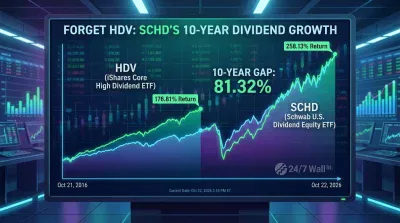
The iShares Core High Dividend ETF (NYSEARCA:HDV) gives investors one ticker for large dividends from big U.S. companies, and that simple pitch is aimed at income investors. Over the ten years ending through the Thursday, October 22 afternoon session, the fund returned 176.81% with distributions reinvested. The Schwab U.S. Dividend Equity ETF (NYSEARCA:SCHD) returned 258.13% over the same stretch, a lead of 81.32 percentage points. Both ten-year windows begin on October 21, 2016. A $100,000 position in SCHD grew to $358,130, while the same investment in HDV grew to $276,810.
HDV holders bought it for sound reasons. It concentrates on established dividend payers, spreads money across 79 positions as of July 31, 2026, and removes the work of picking individual stocks. The ten-year record says SCHD did that same job with much more growth. Shorter windows complicate the picture, though, and shorter windows deserve equal consideration.
Schwab’s Fund Leads Over One Year and Year to Date
Over one year through the October 22 session, SCHD returned 34.84% against 28.68% for HDV, a gap of 6.16 points. Year to date, SCHD gained 31.74% versus 28.16%, a lead of 3.58 points.
For an HDV holder, this shows that the Schwab fund’s long-term edge extends into the past year and into 2026. The margins are far narrower than the ten-year spread, however, so the recent lead is real but small.
Five Years of Returns Run the Other Way
Starting from October 22, 2021, the ranking flips. HDV returned 86.28% over five years, while SCHD returned 62.23%, leaving the BlackRock fund 24.05 points ahead. A $100,000 investment in HDV became $186,280, while SCHD’s matching investment became $162,230.
An investor who bought HDV five years ago did significantly better than one who bought SCHD.
HDV also led over the past month, returning 7.08% to SCHD’s 5.43%.
Two Index Funds Built on Different Dividend Rules
Both funds hold dividend-paying U.S. stocks and follow indexes, but each index selects its companies by its own rules. According to iShares, HDV “seeks to track the investment results of an index composed of relatively high dividend-paying U.S. equities.” According to Schwab, SCHD aims to track, before fees and expenses, the total return of the Dow Jones U.S. Dividend 100 Index, which is designed to measure high-yielding stocks of U.S. companies with a record of consistently paying dividends.
Both funds start with income-producing U.S. companies and then apply different screens. Those different screens produce different portfolios, so the two funds can swap leadership over long stretches. Investors who prefer picking the underlying companies directly can draw from the same pool: we ranked ten of the longest-running dividend growers by valuation in a free report on Dividend Kings.
Selecting a Time Window Means Choosing a Winner
Which fund looks better depends heavily on the period you measure. Ten years and the past year favor SCHD, while five years favors HDV. Someone measuring from 2016 sees a clear Schwab win, and someone measuring from 2021 sees the reverse. Both readings are accurate. The data points to two reasonable dividend approaches with no clear right answer, and no single window makes a strong case for switching.
Taxes add a real cost to switching. In a taxable brokerage account, selling HDV to buy SCHD can trigger a capital gain and a tax bill. IRS Publication 550 states that any exchange of shares in one fund for shares in another fund is a taxable exchange. Publication 544 adds that gains must be classified as short-term or long-term, which affects how they are taxed. Trades inside an IRA or 401(k) generally avoid current taxation.
In a taxable account, cost basis varies lot by lot, and lots with losses or small gains carry a smaller tax impact than long-held lots with large gains.
How Each Fund’s Record Lines Up With Different Investor Goals
Going forward, the key factors to watch are each fund’s upcoming distributions and the periodic reconstitutions of their underlying indexes, which can reshape holdings and shift leadership again. Investors should also track any fee changes from BlackRock or Schwab, since costs compound over the long periods during which SCHD’s ten-year lead and HDV’s five-year lead were built. For HDV holders in taxable accounts, those developments will shape whether the tax cost of switching is worth paying.
Contact [email protected] for any questions or corrections.
Ryne Mauck is an investment writer covering exchange-traded funds, retirement planning, and portfolio strategy. Through his work at 24/7 Wall St. and other investment platforms, including Seeking Alpha, he aims to provide clear, research-driven insights that help investors make more informed decisions while maintaining a long-term approach to investing.
Ryne holds a B.Sc. in Finance and an M.A. in Political Science. He is a formerly registered Municipal Advisor Representative and has passed the Series 50, Series 63, and Series 65 exams. His articles are not intended to be, nor should they be interpreted as, financial advice.